

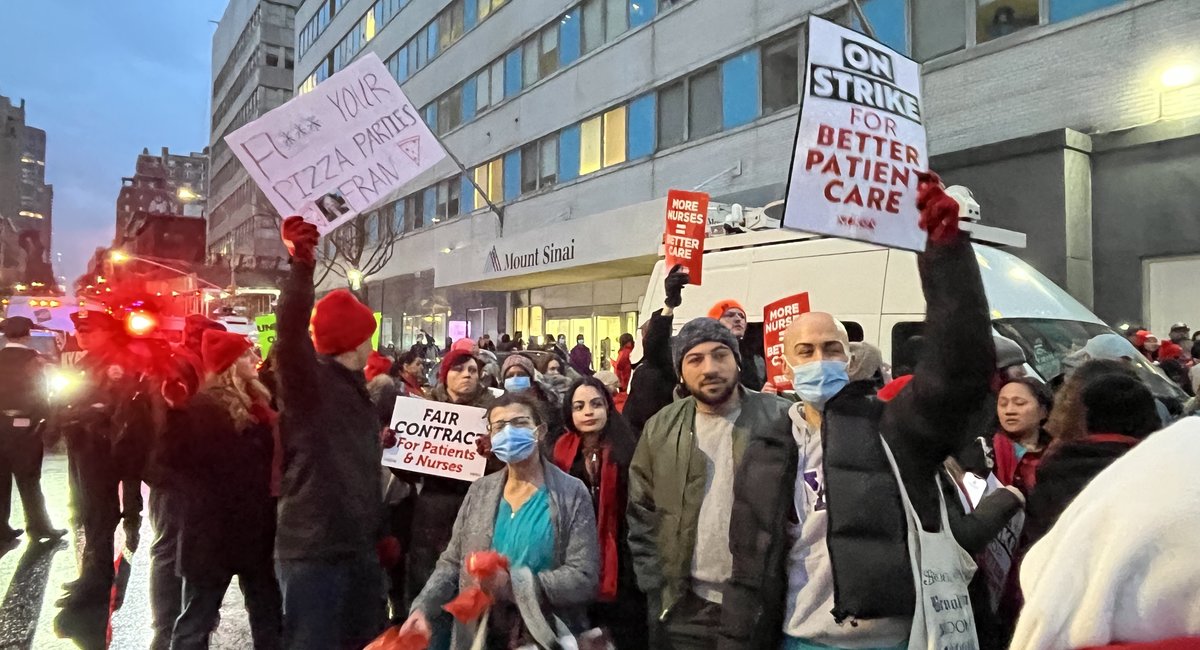
Jaime Sena had everything in place for the gastrointestinal surgery she was scheduled to have at Mount Sinai Morningside. The 49-year-old Cobble Hill resident had taken a four-week medical leave from her tech job and a friend from the West Coast had flown out to stay with her during her recovery.
But the afternoon before the surgery, Sena got an email with bad news from her doctor, which she shared with Gothamist. It said the procedure had to be postponed because of staffing issues related to the ongoing nurses strike — and the surgery, originally scheduled for Friday, has yet to be rescheduled.
Sena’s off-the-calendar surgery is just one of the casualties of the job action. Nearly 15,000 nurses have been on strike for 11 days at hospitals operated by Mount Sinai Health System, NewYork-Presbyterian and Montefiore Medical Center, with no clear end in sight.
Contract negotiations between the parties have been slow. Hospital representatives have called the New York State Nurses Association’s salary asks costly and unreasonable, while nurses have said their employers are refusing to budge on demands for better staffing and hospital security.
Nurses are back at the bargaining table with NewYork-Presbyterian today, according to a spokesperson for the hospital system. Mount Sinai and Montefiore have not said when their next bargaining dates are. The nurses’ prior contracts expired Dec. 31.
Hospital representatives have maintained throughout the strike that they have the necessary replacement staff and contingency plans in place to offer safe, high-quality patient care for as long as the work stoppage goes on.
“We have continued to deliver outstanding care to our patients, and to be present for our communities,” Dr. Brendan Carr, the CEO of Mount Sinai Health System, said in a letter to employees earlier this week, adding that the hospital system was settling into a “long-term cadence” with temporary staff.
But for some patients, the strike can’t end soon enough.
“ It’s an insult to say that they’re able to keep everything going when they clearly aren’t,” said Sena, who said she was hopeful the surgery would alleviate her chronic abdominal pain. “I’m just one person and this has taken over my life.”
Sena, who’s insured through Anthem, is also worried that if she waits too long to have her procedure, it will no longer be covered. Because of a contract dispute, Mount Sinai doctors went out of network for Anthem starting on Jan. 1 and Mount Sinai hospitals will be booted from the network starting in March, though patients who are in the middle of treatment for certain conditions may be entitled under state and federal law to extend their coverage.
Mount Sinai did not respond to a request for comment on Sena’s situation.
The comfort of familiar faces
Alyssa Hernandez said the change in nursing staff at Montefiore during the strike has been upsetting for her 5-year-old son, Jace, who’s in the middle of cancer treatment.
The Children’s Hospital at Montefiore is one of two pediatric hospitals affected by the strike, along with NewYork-Presbyterian’s Morgan Stanley Children’s Hospital.
Hernandez said getting an IV placed for transfusions is always a challenging moment for Jace, but the regular nurses know how to keep him calm. At his most recent appointment, Hernandez said it took a travel nurse a few tries to place the IV and it was “traumatizing” for him to see “ the blood all over his arm leaking down.”
“ A place that was supposed to be a healing place for him, he’s scared to walk into the doors,” said Hernandez.
She added that she also lacks confidence in the temporary nurses, who she said have to ask more questions of other clinicians on the care team as they work. She said Jace is supposed to start his last round of chemo next week, but she’s considering putting it off until the strike is over.
Hernandez outlined her concerns in a letter to the CEO of Montefiore, Dr. Philip Ozuah.
“Due to HIPAA and patient privacy considerations, we do not comment on specific cases,” said Joe Solmonese, a spokesperson for Montefiore. “Regardless of how long the strike may last, we are continuing to provide the world-class care that our patients deserve.”
Not all patients are feeling the effects of the strike to the same extent. Jim Melloan, a Mount Sinai patient who spoke with Gothamist, said he had a gallbladder surgery postponed, but was relieved when he found out it was rescheduled for a week later.
Many of the patients affected by the strike are unionized nurses themselves, whose health insurance has been suspended while they’re on the picket line.
Sylvia Morales, a nurse at NewYork-Presbyterian who’s recovering from breast cancer, said she has canceled oncology appointments during the strike. Her husband, who’s diabetic, and her 23-year-old son are also on her insurance, she said.
But Morales said striking is worth it to fight to maintain her health benefits and improve staffing and hospital security.
“ We’re not asking for more,” said Morales, noting that she currently doesn’t pay any premiums on her health insurance. “We just want it maintained.”
NYSNA has said that hospitals are trying to slash nurses’ health benefits — something representatives for NewYork-Presbyterian and other hospitals have denied.
