

In early October, Gowanus residents and agency officials packed into the auditorium of P.S. 372, The Children’s School, for a monthly Gowanus Canal Community Advisory Group meeting. The school sits on a site monitored for toxic contaminants by the state Department of Environmental Conservation. With poster boards mapping out testing for contamination in the surrounding blocks, officials from the Department of Environmental Conservation and state Department of Health fielded questions from worried residents about pollution as well as the pace of testing and cleanup across the neighborhood amid rapid redevelopment.
As climate change intensifies, New York City has seen an increase in heavy rainfall from intense storms known as cloudbursts. Gowanus lies in a high-risk flood area with a shallow water table, meaning groundwater sits close to the surface. Residents and experts said worsening flooding, redevelopment and legacy industrial pollution are colliding and being met with inadequate solutions. Advocates have raised concerns about potential contamination in the neighborhood’s groundwater, soil and indoor air.
“All of this points to the same root problem, that DEC still has no plan to address the contamination in Gowanus on a neighborhoodwide basis,” Jack Riccobono, a member of the local advocacy group Voice of Gowanus, told City & State. “They’re allowing these big buildings to be built piecemeal on top of partially remediated land parcels, leaving vast plumes of toxic pollution migrating under the ground.”
Patchwork cleanup
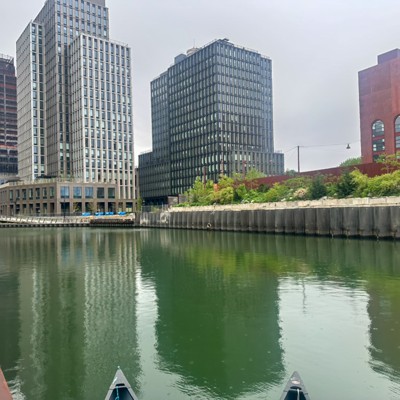
Before rezoning brought an influx of development, Gowanus was an industrial hub. Its legacy contamination stretches back more than a century. During the industrial revolution in the mid-to-late 1800s, the manmade Gowanus Canal, spilling out into New York Harbor, served as an industrial center for gasworks, manufacturers and metal shops that discharged waste directly into the 1.8-mile waterway. Over time, hazardous materials mixed with sediment to form a thick, oily sludge locals call “black mayonnaise.”
In 2010, the U.S. Environmental Protection Agency designated the canal a federal Superfund site and placed it on its National Priorities List, launching a multiyear $1.6 billion cleanup effort that includes dredging contaminated sediment from the bottom of the canal and constructing two large sewage retention tanks to reduce raw sewage overflow in the canal during storms.
The Superfund cleanup targets the canal itself. But much of the contamination comes from the “uplands,” or the land areas surrounding the canal and is addressed on a parcel-by-parcel basis by the Department of Environmental Conservation. The department works closely with the state Health Department and the EPA to administer investigations and the cleanup of the sites.
“What took the community a long time to understand, they kept talking about the Gowanus Canal. Many failed to realize that the pollution came from the uplands,” explained Voice of Gowanus member Katia Kelly, who has lived in the neighborhood for 40 years.
According to DEC officials, the coal tar plume from old manufactured gas plants has migrated into surrounding soil at depths of nearly 150 feet, particularly under the former Citizens Gas Works site, which ceased operations in 1960. The EPA is responsible for cleaning up the actual canal, while New York state is responsible for the three former manufactured gas plants along the canal. National Grid, the utility company deemed the potential responsible party of the pollution, has taken on the canal cleanup with EPA oversight.
“Our top priority is taking proven, science-based actions whenever and wherever contamination is found to potentially impact public health, and DEC and DOH will continue to work directly with the Gowanus community as these efforts advance and any time data leads to additional actions,” state Department of Health Spokesperson Erin Clary told City & State. The DEC and EPA did not respond to requests for comment for this story in time for publication.
Rising from the ashes
Despite the coal tar plume and other contamination concerns, plans for redevelopment in Gowanus have moved forward. In 2021, then-Mayor Bill de Blasio put forth a rezoning plan that would add more than 9,000 residential units by 2035, potentially adding 20,000 new residents. More than 141 residential buildings are in development including those with mandated affordable and senior housing, such as Nevins Landing and Gowanus Green – a 100% affordable development that will be built on two parcels of a former manufactured gas plant now owned by the New York City Department of Housing Preservation and Development.
Unlike federal Superfund programs, which are enforcement-driven and impose strict liability, much of the upland remediation occurs through the state’s Brownfield Cleanup Program, which encourages voluntary cleanup by private developers in exchange for tax credits and liability protections. Cleanup plans are generally limited to the boundaries of a specific property, even though contamination can extend beyond the lot lines.
Advocates and elected officials, including Assembly Member Jo Anne Simon, who represents parts of Gowanus in Assembly District 52, have criticized the use of the brownfields program for sites with extensive contamination.
“The Brownfields Program is intended to reclaim far less polluted sites, such as a former gas station, a dry cleaner, warehouses and not for the clean up of landfills, manufacturing sites, chemical plants with severe contamination and certainly not for former gas manufacturing plants,” said Simon in an August 2025 letter to the DEC.
Kelly said the cleanup methods themselves fall short when toxic chemicals can become gases and pass through cracks in building foundations, pipes and basements.
I’ve come to understand these aren’t cleanups; they are contaminants we are containing.
Katia Kelly, a Voice of Gowanus member
I’ve come to understand these aren’t cleanups; they are contaminants we are containing.
“I’ve come to understand these aren’t cleanups; they are contaminants we are containing. Highly dangerous chemicals, we are putting cement in the ground to immobilize them,” she said. “Nobody should live on them, especially vulnerable families who have no choice but to live on highly toxic land.”
Something in the air
Agency officials acknowledge that coal tar contamination can affect both groundwater and indoor air. In a September Q&A in response to community questions, the DEC said coal tar releases contaminants into the groundwater and emits vapors that can enter buildings, adding that vapor mitigation systems are being incorporated into new construction.
Vapor migration systems, such as sealed foundations and subslab depressurization, are designed to limit the movement of contaminated gases into indoor spaces. Experts note that these systems often require long-term oversight.
“In perpetuity would mean that you will keep monitoring forever; this is related to the fact that remediation is really challenging in this situation,” said Ana Navas-Acien, an environmental health scientist at Columbia University.
She pointed specifically to volatile organic compounds and degreasers like trichloroethylene, or TCE, which public health agencies point to causing cancer and reproductive health issues, and have been detected in Gowanus.
“We know the TCEs become volatile easily, and it can easily spread in the air, which in one sense is good because it can get disintegrated in the air but the other problem is that it can get trapped in the building,” she said.
Long-term monitoring, through groundwater monitoring wells around the neighborhood, is expected to continue indefinitely, a reflection of the difficulty remediation poses in a neighborhood with groundwater close to the surface and prone to flooding.
“The rule of thumb with contaminated groundwater, you have to get rid of the source of contamination,” explained Timothy Eaton, a professor of hydrology and geophysics at Queens College. “Getting rid of the source means excavating tons of material under the water table and nobody wants to pay for that. This has to be in perpetuity, this is how bad it is.”
