
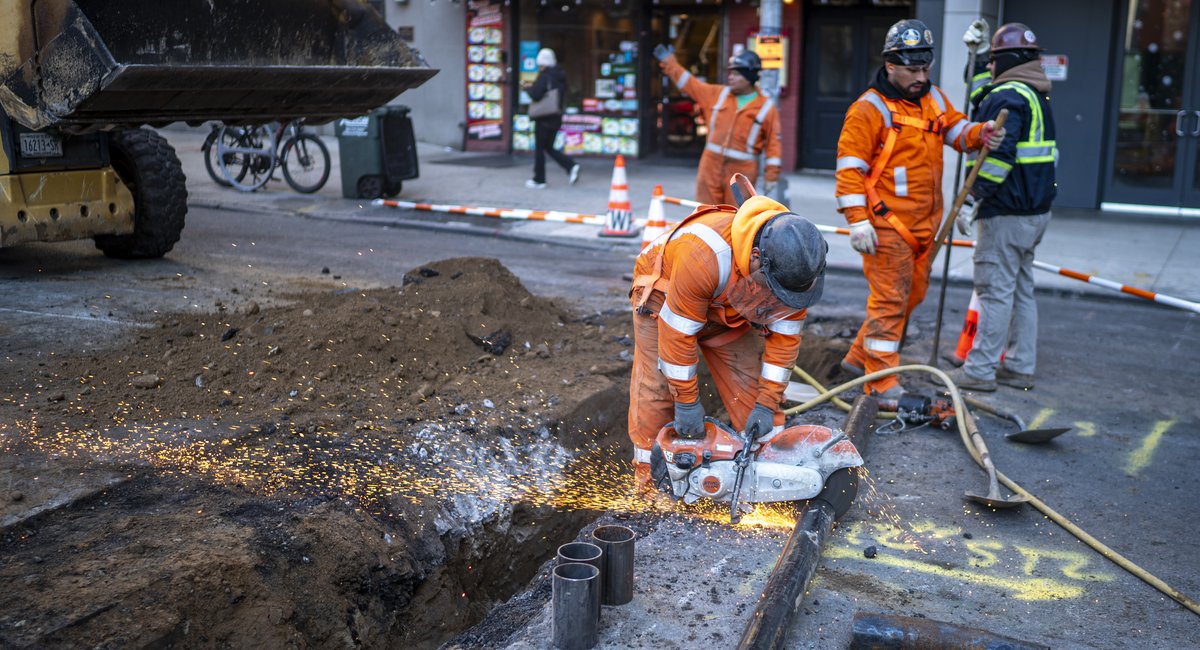
The York Avenue Sewer Replacement project was only supposed to take two or three years. That is, until crews opened the street and found a spaghetti-like jumble of pipes and utilities underground.
Without a centralized, comprehensive map to help navigate the underground labyrinth, unexpected subterranean findings have cost the city millions of dollars and years of delays, said Thomas Wynne, deputy commissioner of infrastructure for the city’s Design and Construction Department.
“We originally slated that to be a two- to three-year project, and we’re now in year nine,” Wynne said. “It was all because there were so many unknowns that we kept encountering. The biggest driver for why that job has taken so long is the fact that there were a lot of unknown utilities that we didn’t expect to find.”
The city is now endeavoring to address the challenges of navigating its subterranean world. Several private and municipal entities are working to create a complete and accurate map of the city’s subsurface layout, including its water lines, electrical conduits and natural gas pipelines. The municipal government is using $10 million from a federal grant to create the nation’s first high-tech, secret map of its underground in a project led by the Mayor’s Office of Operations.
The city’s mapmakers plan to launch its platform in early 2028.
Who knows what’s going on down there?
The project could save time and money on construction projects. But the map’s backers say it could also save lives.
“Our own emergency response professionals describe scenarios where they’re layering paper maps on the hoods of cars at the site of an emergency,” said the project’s lead, Dan Steinberg, director at the Mayor’s Office of Operations. “That to me, encapsulates the problem. More can go wrong when you’re working in this archaic way.”
A morass of utilities is below the pavement of many New York City streets.
Spencer Platt/Getty Images
Wynne said access to this data could help construction projects save six months to one year. The first part of every new project involves performing surveys and gathering subsurface information.
“You need a spoon to dig the trench. You cannot dig with heavy equipment. There’s no room and there’s no way, and it’s all intertwined,” Wynne said, emphasizing how construction workers must proceed cautiously when they start digging.
Even after the City’s Design and Construction Department has gathered information from stakeholders, it’s common for the agency to encounter incomplete subsurface data and many unknowns, especially when it comes to the location of private utility equipment.
The idea for the subsurface map was sparked by the difficulties experienced during recovery efforts following the Sept. 11, 2001 attacks on the World Trade Center. Steinberg said the underground map takes inspiration from systems in Singapore, Tokyo, Flanders, and the UK.
The UK government began its project in 2019 and began beta testing in June 2025. It anticipates that the map could lead to at least $535 million in economic growth each year because of increased efficiency, fewer accidental strikes on pipes and cables and reduced disruptions.
Digging in the dirt
The first phase of developing the map involves assessing the soil composition. Across agencies and private entities, there are tens of thousands of soil sample data points from across the five boroughs. The city’s Department of Buildings holds roughly 70% of this data, which it received from developers as part of the permitting process. This information has been digitized, and is currently being analyzed by Columbia University.
The geotechnical data includes soil type, characteristics and known contaminants, which are of great importance to a city adapting and designing for climate change and diverting stormwater. The soil type can reveal information about how much water can be absorbed and what plants can thrive. The information can be used to divert stormwater runoff from sewers and climate adaptation projects.
Keeping the underground under wraps
The map won’t be accessible to the public. In fact, only certain levels of city government will have access – and only on a need-to-know basis for limited windows of time, according to Steinberg.
The design and architecture of the city’s secret map is still in its beginning stages, but the concept is to create a “cut request system” instead of a static map that could fall into the wrong hands, making subterranean infrastructure vulnerable to attacks.
Construction timelines are routinely extended due to unexpected discoveries once workers start digging.
Spencer Platt/Getty Images
In a “cut request system,” a municipal worker with clearance would access data by making a request for a specific location. This would ping utilities and other entities to release the information and then the map would integrate the data and visualize it in 3D. The data would be purged when no longer needed or the window of time for clearance expires.
“Security concerns are not only legitimate, but inform the entire design of the project,” Steinberg said. “We have an elaborate project architecture because there’s so much paranoia around storing all this data in a static environment.”
A big challenge is simply coordinating all the different entities, both public and private, with a stake in the city’s underground. There’s the MTA, telecommunications companies, Con Edison, National Grid and many more. In the past, private companies with subsurface assets have been resistant to freely handing over data, preferring to send a human representative to share the data rather than having it all collected in one place. Steinberg said the city cannot compel utilities to share their data.
Con Edison declined to comment on the map project. National Grid said it “works closely with city agencies and our fellow utilities to ensure safe, reliable service,” and would continue to do so with this project.
The data will include ground scanning performed by the city and utility companies in partnership with NYU’s Tandon School of Engineering.
“This is an investment in future generations. The sooner we start that. The sooner this pays off,” Wynne said. “We’re going to pull together all the existing records that we have, and that in itself will be like a quantum leap from where we are.”
