

Manhattan prosecutors on Wednesday reduced the charges against two protesters who were arrested as activists confronted federal immigration agents at a parking garage near Canal Street in November.
The felony assault charges against Natalia Arai and Asif Ali were reduced to misdemeanors. Assistant District Attorney Tatsiana Zhuk said the prosecutor’s office would not be seeking more than a year in jail for either defendant, but did not say why the office determined that misdemeanor charges were more appropriate.
“It’s a step in the right direction,” Arai’s attorney, Michael Lewis, said after the hearing.
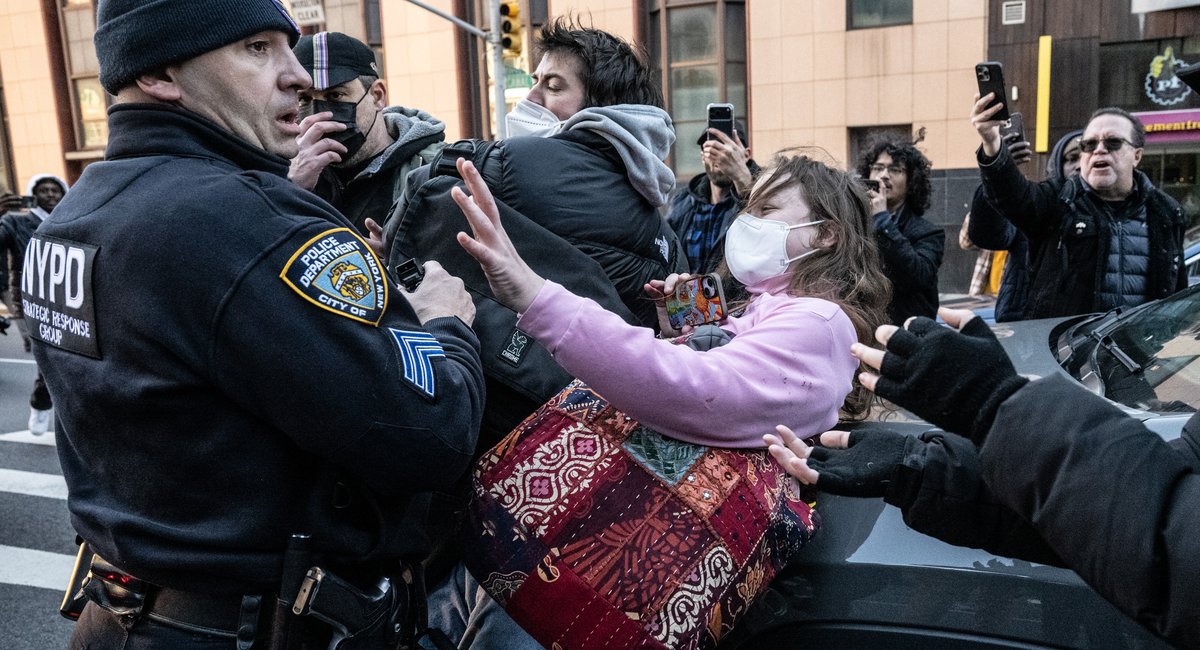
Arai and Ali were arrested by NYPD officers near Canal Street the Saturday after Thanksgiving, when anti-ICE demonstrators surrounded a parking garage they believed federal authorities were using to prepare for an immigration raid. NYPD officers responded and cleared protesters away from the garage so they could not block federal vehicles from driving away, a Department of Homeland Security spokesperson said at the time.
The clash between law enforcement and protesters happened weeks after the first major immigration raid in New York City since the start of President Donald Trump’s second term, and revealed the chaos that could ensue if ICE steps up enforcement in the city.
Arai and Ali were both charged with second-degree assault after their arrests on Nov. 29, according to criminal complaints filed against them. An NYPD officer alleged that during the protest, Arai kicked a garbage can that hit another officer and cut his leg, according to the criminal complaint.
An NYPD officer said Ali lifted a wooden pallet and pushed it onto an officer’s foot, causing pain, according to the criminal complaint filed against him.
On Wednesday, Judge Kacie Lally agreed to reduce the charges and set a next court appearance for each defendant in March.
Outside of the courtroom, Arai, a Bronx native and current graduate student, declined to speak about the specifics of her case, but said she was compelled to protest that day in part because her father, a Japanese American, was interned during World War II.
“During WWII, when all the Japanese Americans, who were citizens, were being rounded up, thrown into camps, no one stood up, no one said anything,” she said. “When history writes itself 30 years from now, the last thing you want to say is, ‘oh, I was just one of those people at home watching the news.”
Ali did not comment after his court appearance.
