

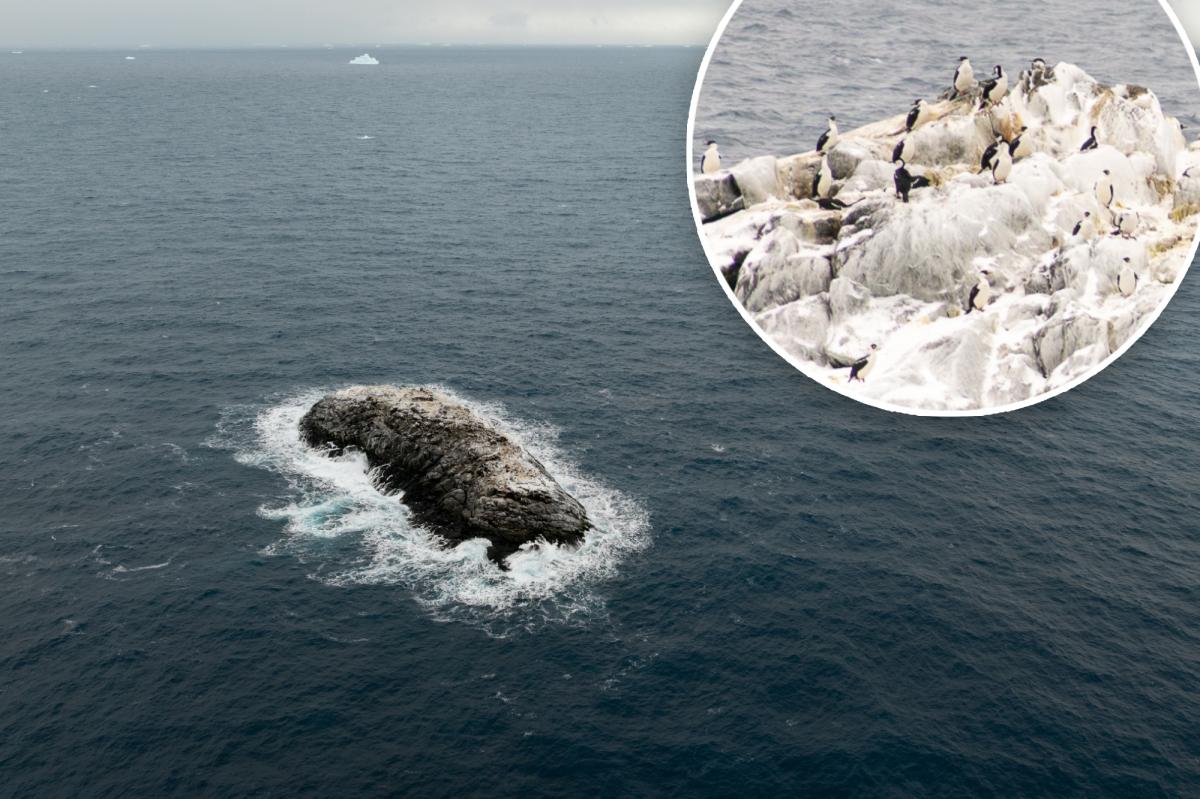
Well, isle be damned.
Explorers made the discovery of a lifetime after stumbling across an uncharted, Egyptian pyramid-sized island during an expedition in a treacherous region off Antarctica known as the “danger zone.”
“It became increasingly clear that we had an island in front of us!” declared Simon Dreutter from the Bathymetry section at the Alfred Wegener Institute, Helmholtz Centre for Polar and Marine Research (AWI), per a press release by the institute.
Dreutter was part of a 93-person team of international explorers who had been scouring the northwestern Weddell Sea aboard the organization’s icebreaker Polarstern since February 8, 2026.
However, their expedition was interrupted by a lashing storm that forced the seafarers to take refuge on the sheltered side of Joinville Island.
That’s when, like something out of an old-timey adventure novel, crewmembers and scientists alike were greeted by the sight of a mysterious landmass in an area that had previously been marked as a danger zone in the available maps.
“On our route, the nautical chart showed an area with unexplored dangers to navigation, but it wasn’t clear what it was or where the information came from,” reported Dreutter, an expert in nautical cartography. “I scoured all the coastlines we had here in the bathymetry (underwater topography) lab and went back to the bridge.”
He added, “Looking out of the window, we saw an ‘iceberg’ that looked kind of dirty. On closer inspection, we realized that it was probably a rock.”
After changing course and approaching the promontory, the crew quickly realized that it was no rock — it was an island.
The crew steered Polarstern toward the unmapped protrusion, eventually coming within 500 feet of the aquatic anomaly, which they were able to explore from above using a drone.
The land with no name reportedly jutted 50 feet above the waves and measured 165 feet wide and around 426 feet long — roughly the same length as the Great Pyramid of Giza in Egypt.
The experts are yet unclear as to why the “island is marked as a danger zone on the nautical chart, but not as a coastline in other data sets” and why its mapped position is a mile off the actual one.
The isle hides its secrets well, apparently.
“On the satellite images analyzed, the island could hardly be distinguished from the numerous icebergs drifting around in the immediate vicinity due to its ice cover,” they noted.
The next goal will be putting the island on the map, meaning it will need to be named.
Speaking of cartography-related capers, this past winter, scientists discovered the surprising reason hy Bermuda never sank after its volcanoes shut down more than 30 million years ago.
The answer lies below the oceanic crust under Bermuda, where a mysterious rock layer keeps the island aloft.
