
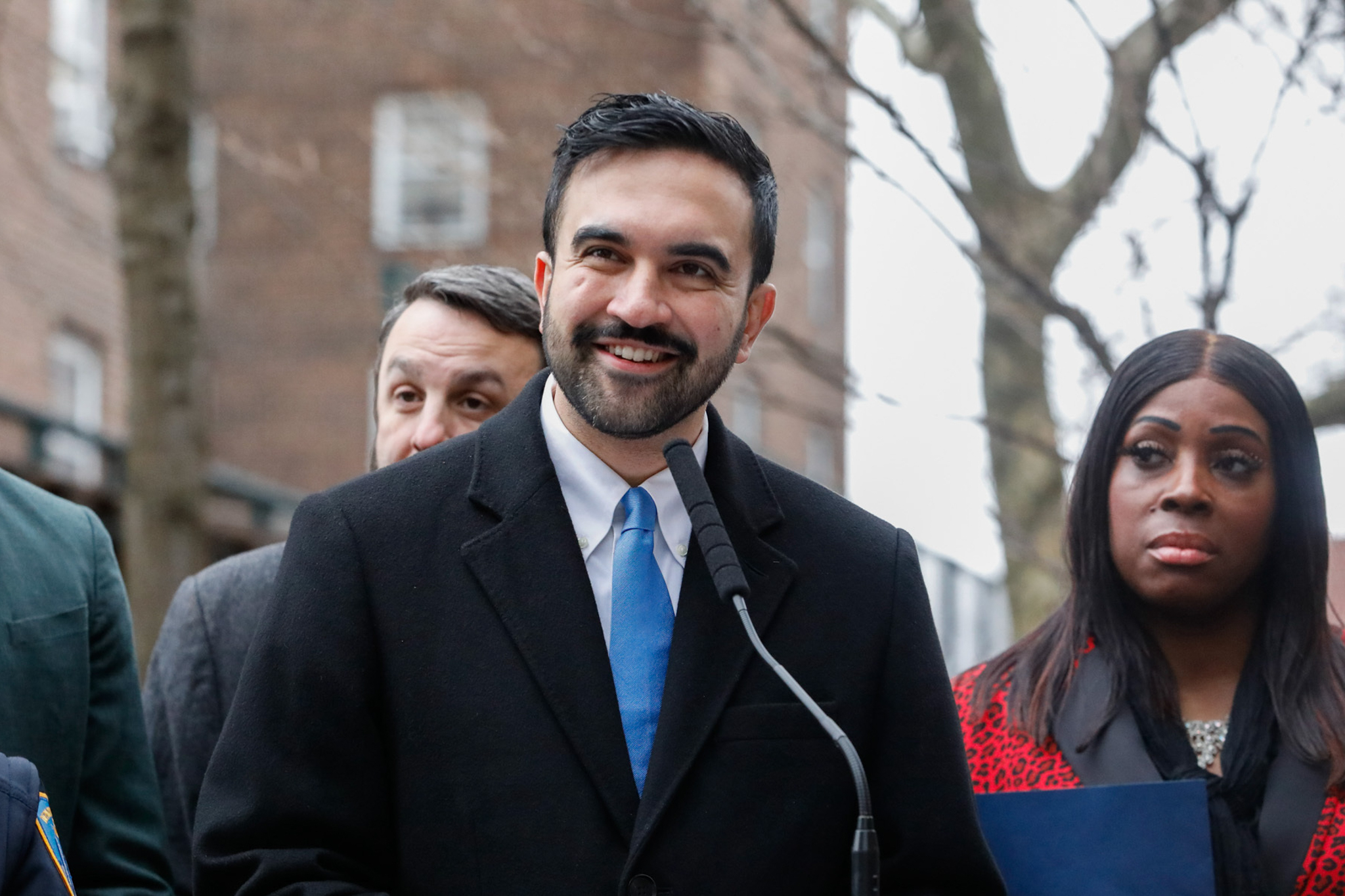
Mayor Zohran Mamdani won City Hall on a pledge to make New York City more livable and affordable.
His promises of a rent freeze for stabilized tenants, no-cost universal childcare, and fast and free buses resonated with more than a million voters — and created giant expectations in a city hungry for change.
It’ll take more than 100 days to transform New York City’s housing, transit and public safety, but the democratic socialist has found unlikely allies.
Mamdani met with President Donald Trump — who has called him “my little Communist” — for the second time in February, where Trump was receptive to the mayor’s pitch for federal money for a massive, previously abandoned housing development plan for the Sunnyside Yards in Queens. (He also persuaded the president to release students and others detained by ICE.)
In Albany, Gov. Kathy Hochul provided state money for a free childcare pilot — but has refused Mamdani’s push to raise taxes on the wealthy.
The new mayor has faced challenges in his pivot from campaign to governing, from a gaping budget hole that threatens his affordability agenda to subzero temperatures that left 19 New Yorkers dead of hypothermia.
In a city that can swiftly turn on its mayors, Mamdani’s popularity appears to have dipped since a late February poll from Siena University had his approval rating at 63%.
A Marist Poll released this week found the mayor’s approval at 48% — although 60% of polled New Yorkers felt he was fulfilling his campaign promises, and 56% said the city was moving in the right direction.

“I will always leave the grades to New Yorkers themselves,” the mayor said when asked about the most recent poll.
The first few months of the Mamdani’s mayoralty were a crucial answer to critics who said the 34-year-old was all flash and no substance, said Tess McCrae, chief operating officer for political consultants The Parkside Group.
“I think he has a lot of goodwill from most New Yorkers and I don’t think he’s abused that good will,” McCrae said. “He hasn’t gotten the free buses or the tent poles that were so much a part of his campaign, but I think most people understand that takes time.”
Here’s where some of Mamdani’s biggest initiatives stand:
Fast, Free Buses

As a longshot candidate, Mamdani pledged to speed buses that are among the slowest in the nation — and to make them free. MTA officials have questioned the “free” part of his “fast and free” slogan.
“We are working with the city to do fast — that discussion is well underway and I credit the new DOT team and the mayor and the mayor’s team for stepping up on that,” Janno Lieber, MTA chairperson and chief executive, told the City Council. “So, let’s get going in doing fast. We have a lot of questions relevant to the second half of that sentence.”
A study of a free bus pilot program on several routes that ended in 2024 found that fare-free service did not improve speeds.
“I think the key thing that everybody was looking at was: ‘Will this make buses run faster?’” MTA policy chief John McCarthy said. “And it didn’t.”
Mamdani told Politico this week that he is “absolutely committed to making buses fast and free,” while acknowledging it won’t happen this year.
Freezing the Rent

Mamdani promised to freeze the rents of tenants living in the city’s nearly one million stabilized apartments. The mayor appointed six of the nine members of the independent Rent Guidelines Board, who have officially begun a process that could result in no rent hike for the first time since 2021. A vote on a possible increase is expected in June.
Mamdani’s administration also hosted rental rip-off hearings, where tenants could vent to city officials about their lousy landlords. A report, along with Mamdani’s plan to address the housing crisis, is forthcoming, officials say.
Free Childcare

Mamdani notched an early win only a week after taking office when Gov. Hochul committed funding for two years of a free childcare program for 2-year-olds in New York City. The program will begin in the fall, with 2,000 seats for toddlers in Queens, Manhattan, Brooklyn and The Bronx, expanding to 12,000 seats in its second year. How the subsequent years of the 2-Care program will be funded, though, remains unclear.
Homelessness
Mamdani campaigned on a commitment to expand the city-funded rental voucher program, known as CityFHEPS, in line with laws the City Council passed in 2023. As mayor, Mamdani has walked away from that promise.

Those laws would make more New Yorkers eligible for the rental subsidy, which covers two-thirds of the rent paid by about 68,000 tenants. Mayor Eric Adams declined to implement the new requirements — which would have added an estimated $1 billion in costs by 2030 — and challenged the City Council measure in court.
Mamdani’s administration appealed a court order directing the city to implement the laws, while indicating openness to compromise with the Council and housing advocates.
This action did not endear Mamdani to advocates for the homeless — especially combined with the mayor’s revival of the sweeps of homeless encampments, which he’d promised he would not do.
“The Mamdani administration has yet to really articulate a plan for how it is addressing homelessness and the housing crisis for extremely low income New Yorkers,” said Alison Wilkey of the Coalition for the Homeless. “What we’ve seen is disappointing.”
City-owned Grocery Stores
Candidate Mamdani promised to open five city-owned grocery stores, one in each borough, in an effort to make food more affordable. Mayor Mamdani devoted $70 million in his proposed budget for the task. Jeanny Pak, the city Economic Development Corporation’s interim director, said officials are working on the “public grocery plan.”
Balancing the Books
Mamdani faces a $5.4 billion budget hole, which he has called a “poisoned chalice” from his predecessor.

To close the gap, Mamdani threatened to raise property taxes if Gov. Hochul doesn’t increase taxes on the wealthy. The ultimatum did not go over well, especially since the mayor hasn’t reformed the city’s wildly unequal property tax system — another campaign promise.
The mayor has ordered every city agency to find savings to show they can rein in spending. In March, he announced about $250 million of identified cuts – well short of the $1.7 billion he promised to slash. Budget director Sherif Soliman said there’s more to come.
Mamdani and the council are squared up for brutal budget negotiations. At the start of April, the council presented their preliminary budget plan which they said finds savings without taking money from reserves or raising property taxes. The mayor called it “unrealistic” and will lead to slashed services. The budget is legally required by June 30.
