

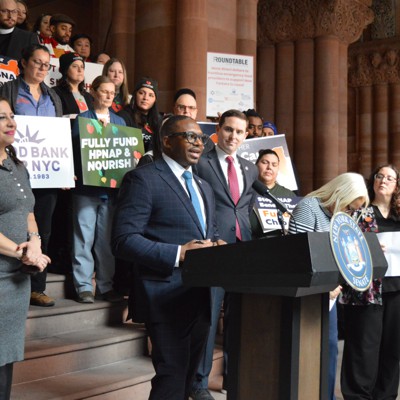
Advocates said Hochul and legislative leaders must take action as they campaign on prioritizing measures to improve affordability. WIC participation in New York has increased by 28% since 2020.
“Of the 2.9 million New Yorkers who participate in SNAP, the vast majority are children, seniors, and people with disabilities,” Hesdorfer said. “Among those who can work, most do work – their income just isn’t enough to meet basic needs.”
County leaders across the state fear the cost shift will place greater administrative and fiscal burdens on localities – with downstream impacts on taxpayers. Hesdorfer said counties will feel the brunt of the changes, estimated at $168 million in additional annual costs.
“We’re picking up administrative costs that the federal government used to reimburse,” Onondaga County Executive Ryan McMahon told City & State. “For a county my size, that’s a $4 million hit.”
McMahon, president of the New York State Association of Counties, said the costly federal changes were thrust on states, and most counties outside New York City do not have the tax base to make up the difference. And local leaders have to grapple with filling the gap while not knowing the full impact of the impending regulatory changes, including how many staff to hire as small government workers are flooded with new work.
“We’re administering a federal program, and now we have to pay for administering it – that’s a real challenge,” McMahon said. “If you’re going to change the rules, then pay for it.”
Assembly Member Jessica González-Rojas met with Hochul’s staff late last week to fight for more SNAP and WIC funding in the budget. Nearly 460,000 New Yorkers participate in WIC – one of the few programs low-income families can be eligible for regardless of immigration status – but about 200,000 eligible New Yorkers are not enrolled.
“We need to give agencies the resources to reach communities that have fallen through the cracks,” she said. “Every dollar invested in WIC yields $2.48 in savings in medical, educational, and productivity costs.”
Republicans in Washington backed Trump’s “One Big Beautiful Bill,” and said they voted for the cuts in efforts to eliminate waste, fraud or abuse in the system.
About 3 million New Yorkers rely on SNAP each month, but Hesdorfer said the program has a low rate of fraud. H.R. 1 shifts up to 15% of benefit costs onto state budgets based on the state’s error rate, but that includes underpayments and overpayments, and is not an accurate measure of fraud in the system.
Hochul included a proposal in her executive budget to modernize Electronic Benefits Transfer debit cards people use for food assistance with microchip technology to reduce skimming, and tens of thousands of cases of fraud reported in the state each quarter. González-Rojas said chip-enabled cards can make the public benefits up to 87% more secure and prevent theft, but it’s a transition the state must fund.
“The system is vulnerable – not because of fraud by recipients, but because of the cards themselves,” González-Rojas said.
The Senate and Assembly each kept the provision in their budget proposals, and it is expected to be included in the final budget deal.
McMahon, a Republican, said he thinks the federal cuts to SNAP were made with good intent to tighten program reins, but that doesn’t mean he won’t fight a federal decision that stands to have a detrimental effect on local governments.
“I understand the intent… but we’re the ones who have to do the work, and no money came with it,” McMahon said. “It doesn’t matter what political party you’re in. Nobody appreciated the cost shift to counties. If something is being pushed on counties, we’re going to push back.”
