

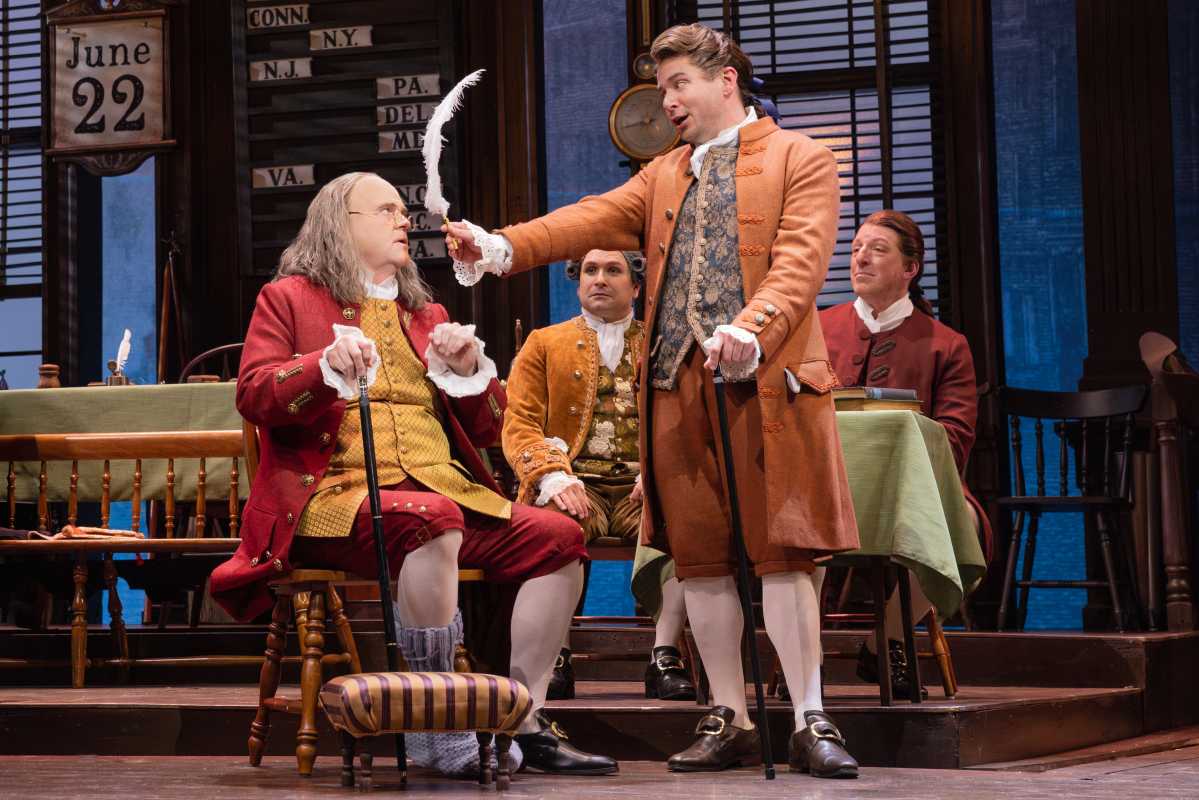
As America turns 250, a 57-year-old musical about the nation’s founding is having a moment.
This spring, productions of “1776” are running at Paper Mill Playhouse in New Jersey (through May 2), Ford’s Theatre in Washington, D.C. (through May 16), and Walnut Street Theatre in Philadelphia (April 14-May 31). All three take a relatively traditional approach, with period costumes and male actors playing the Founding Fathers.
That stands in contrast to the 2022 Broadway revival by Roundabout Theatre Company, which reimagined the show with performers identifying as female, transgender, and nonbinary and took a more revisionist, experimental approach to the material.
As it happens, Roundabout previously revived “1776” on Broadway in 1997 in a traditional production directed by Scott Ellis, who now serves as the company’s interim artistic director. That production was widely acclaimed and transferred commercially. Had Roundabout not returned to the show so recently, this anniversary might have offered an ideal opportunity for Ellis to revisit the musical. Instead, regional theaters are now taking the lead in bringing it back.
For all its historical trappings, “1776” isn’t a pageant, and it doesn’t behave like one. It’s a talky, funny, occasionally cranky chamber piece about a group of men stuck in a room, led by the stubborn, relentless John Adams, arguing their way toward independence. For long stretches, it barely behaves like a musical at all. Characters debate, bicker, filibuster, and stall — and then, almost seamlessly, the music emerges from the argument.
That’s exactly why it works. Songs like “Sit Down, John” and “He Plays the Violin” grow organically out of character and conflict, giving the debates texture without interrupting them.
In many ways, “1776” anticipates “Hamilton.” Both shows locate drama in the process: the dealmaking, the ego clashes, the grudging compromises. “Hamilton” drives that forward with speed and a contemporary sound. “1776” relies on wit, character, and the slow burn of people who don’t agree but have to get something done.

With a score by Sherman Edwards and a book by Peter Stone, “1776” is consistently sharp and unexpectedly moving, especially in the exchanges between John and Abigail Adams. It turns a history lesson into something tense and human.
My own history with “1776” goes back to the late 1990s, when I saw the 1997 Roundabout revival. It quickly became one of my favorite musicals — an unlikely obsession for a teenager. A few years later, at 17, I played John Adams in a theater camp production at French Woods Festival of the Arts, still the high point of my non-professional acting career. (If any theater is currently casting, I remain available to reprise the role — or, at this point, just about any role in “1776.”)
“1776” premiered in 1969, at the height of the Vietnam War and a period of intense political division — hardly a moment of uncomplicated patriotism. The show has never been about easy patriotism; it’s about conflict, compromise, and the difficulty of getting anything done.
The 250th anniversary has prompted calls from the Trump administration for patriotic programming — including through guidance and priorities set by federal cultural and education agencies — even as patriotism feels more complicated for many Americans in the current political climate. “1776” captures this tension better than most, not by offering a clean celebration, but by showing how the country came together — imperfectly.
The moral compromises are not hidden. The decision to allow slavery to persist in order to secure unity is confronted directly, most powerfully in “Molasses to Rum,” not as a footnote, but as the price of unanimity. Even the dialogue acknowledges the cost. As the delegates prepare to abandon the anti-slavery clause, Benjamin Franklin offers a sobering reminder: “We’re men, no more, no less, trying to get a nation started…” It reads less as triumph than as an admission of limitation.
That may be part of its durability. “1776” can speak to audiences across the political spectrum — as a story of principled debate and nation-building, or as a reminder of the compromises and contradictions embedded at the country’s founding. It doesn’t insist on a single interpretation, and that openness is part of what keeps it relevant.
It also reaches across generations. Younger audiences can encounter it as an accessible introduction to the founding era, while older viewers may be more attuned to the complexities and uneasy compromises beneath the surface.
For all its relevance, “1776” also holds up as a superb musical — witty, engaging, and dramatically compelling. Whether revisiting it or encountering it for the first time, it remains well worth seeing. And if the 250th anniversary provides the occasion to bring it back, that’s reason enough.
