

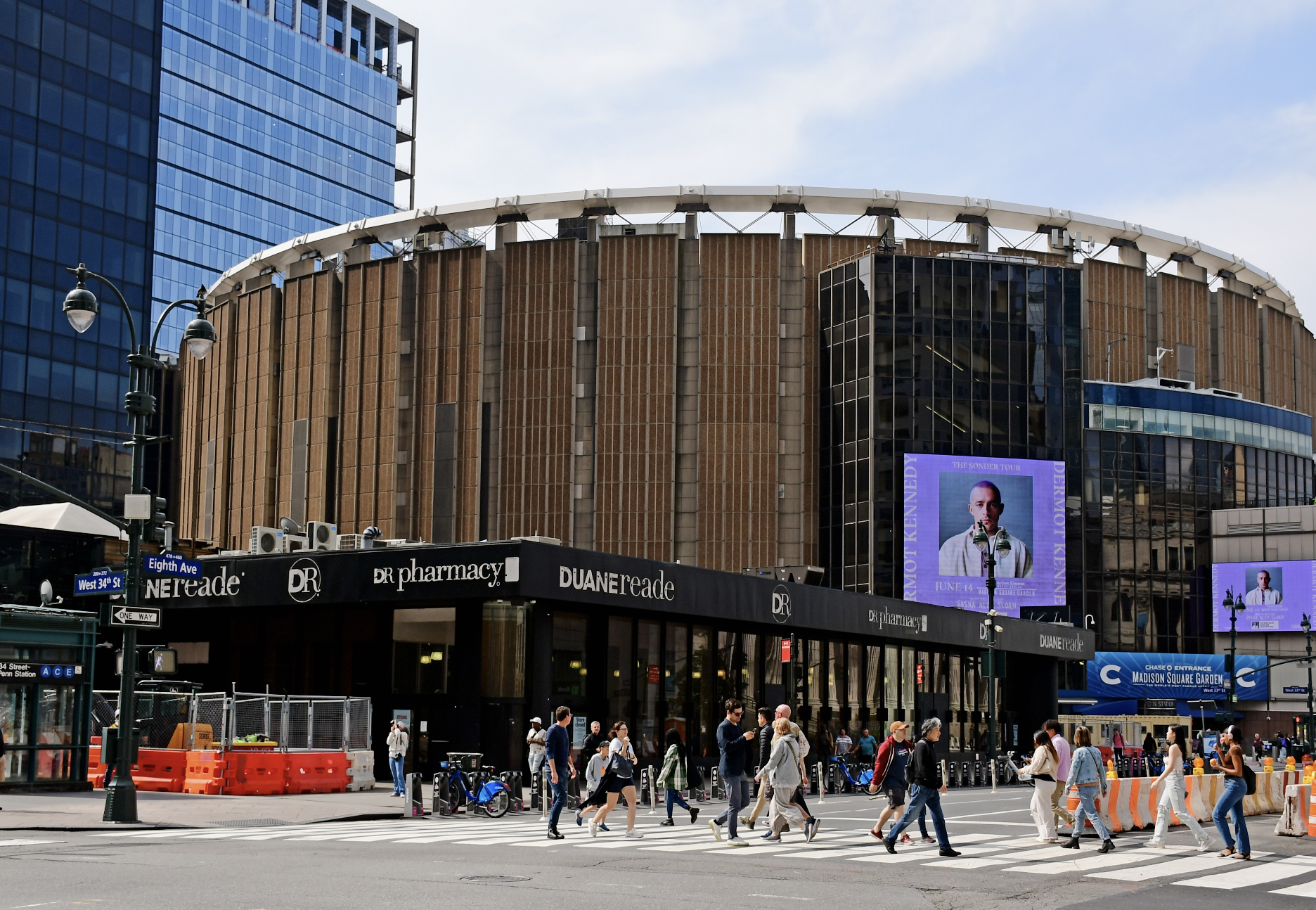
If last week’s headlines about moving Madison Square Garden had a sequel, this is it: yes, the idea of moving the Garden is back in a big way and, yes, it’s serious enough that one of Amtrak’s three shortlisted Penn Station master developer teams is advancing a proposal that would relocate the arena. But “serious” and “likely” are not the same thing, especially in New York, where every big civic dream eventually runs into permits, billionaires and countless layers of government. (Several prominent transportation and planning figures contacted by Time Out declined to comment, citing the ongoing Penn Station procurement process.)
The basic pitch is easy to understand: the Grand Penn proposal would move Madison Square Garden across Seventh Avenue, onto or near the former Hotel Pennsylvania site, and use the freed-up space above Penn Station to build a much grander, roomier train hall. Backers say that could produce a brighter, safer station, add accessibility improvements and potentially increase train throughput to 48 trains per hour. They’ve put the cost at roughly $7.5 billion and the timeline at about 11 years.
And it’s not as though the argument for getting the arena off the station is new. In a 2023 compatibility report, Amtrak, the MTA and NJ Transit laid out just how much the current arena configuration complicates Penn Station improvements, saying a comprehensive reconstruction is needed and describing how the arena interferes with safer, more efficient station operations and future upgrades. The master plan they referenced calls for more stairs, escalators and elevators, simplified circulation and expanded public concourses—all changes that are, understandably, more difficult to pull off with a 22,000-seat arena sitting on top of everything.
On the merits of pure urban planning, it’s easy to see the logic behind the move. On the real-world feasibility, not so much. For one thing, Madison Square Garden isn’t just any arena plopped onto any block. It sits directly on top of one of the region’s biggest transit nodes, which is exactly why it works so well as a venue.
“Let’s be serious. Madison Square Garden is built on top of major mass transit and commuter rail lines,” Mitchell L. Moss, the Henry Hart Rice professor of urban policy and planning at NYU, told Time Out. “There is no site that would offer a comparable set of transit connections connecting the Garden to the rest of the tri-state region and the nation.”
That gets at the first big hurdle: where do you move it that’s equally convenient? The proposed site across Seventh Avenue is close, but “close” is not the same as seamlessly integrated into Penn Station. The second hurdle is money. Moss was blunt on that, too, arguing that relocating the arena would require a massive investment and that it is hard to imagine the city, state or federal government volunteering to build a new midtown arena for James Dolan.
Then there’s Dolan himself, who has become the human asterisk on basically every Penn Station fantasy. The Grand Penn proposal cannot happen unless the Garden’s owner agrees to move and Dolan and MSG have resisted relocation ideas in the past. Even with Trump reportedly open to the concept, that does not magically turn Dolan into a yes.
Then (then!), there are also legal and political loose ends everywhere. Madison Square Garden’s special permit was renewed by the City Council in 2023 for five years, meaning the current clock runs to 2028. That’s not forever, but it’s not exactly tomorrow either. And while Amtrak requires shortlisted teams to submit proposals this spring, that only starts the next round of design, environmental review and negotiations. It does not mean bulldozers are warming up outside Penn.
So, to wrap it all up, could it happen? In theory, sure. In practice, the most realistic takeaway is this: moving MSG may still be the cleanest way to truly remake Penn Station, but it is also the hardest, most expensive and most politically combustible option on the table—which is very on-brand for both Penn Station and New York.
