

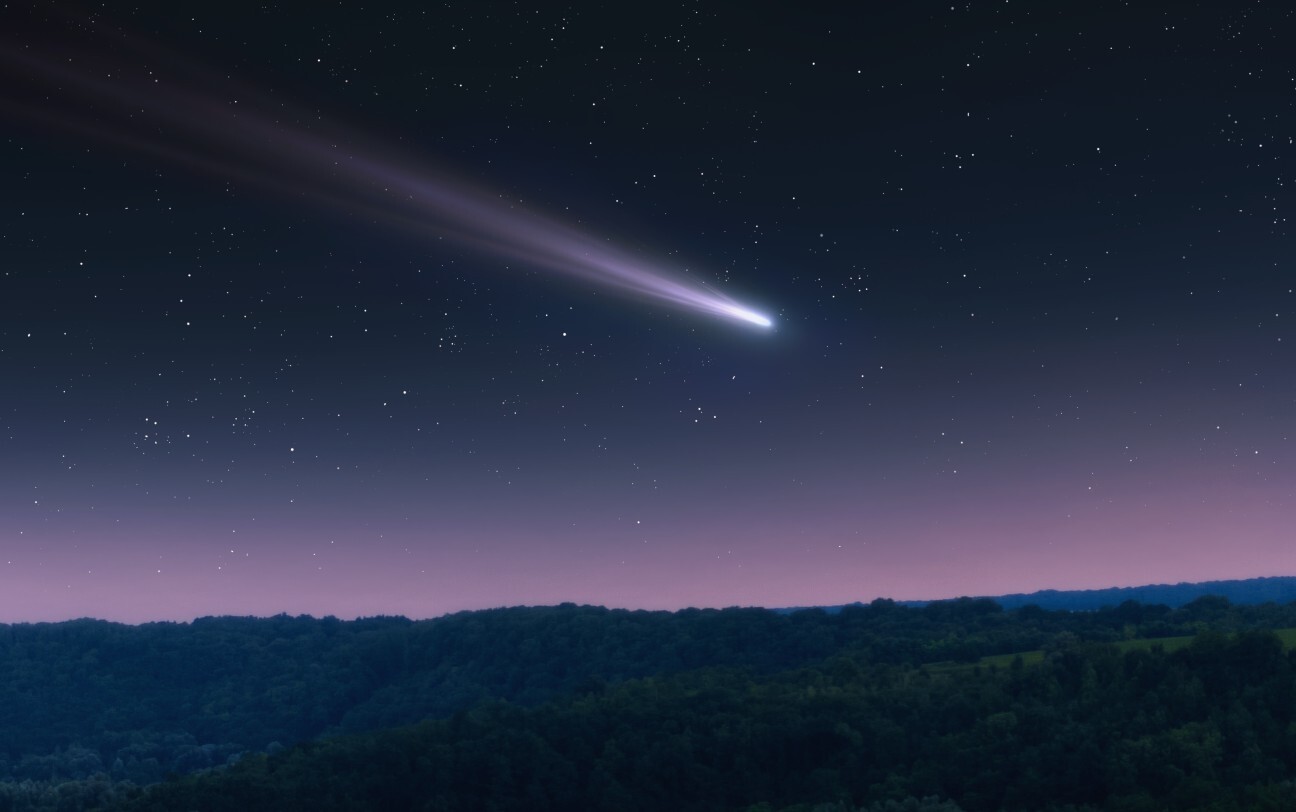
New York City isn’t exactly famous for its stargazing opportunities, but you just might be able to witness a few significant celestial events in the coming weeks. Between a rare sun-grazer comet, a long-awaited NASA moon mission and a reliable meteor shower, the evening skies are expected to be unusually busy.
First up is Comet C/2026 A1 MAPS, a mile-wide “sun grazer” comet—so named because it travels close enough to the sun that it will glow extra bright in our skies. It could shine as brightly as Venus, and will display an extra long tail. But comets are unpredictable, say astronomers. It could dazzle, or it might fizzle.
Later in the month, the sky should explode with even more activity. The Lyrids meteor shower returns, bringing along reliably bright, fast-moving shooting stars across the night. Expect up to 20 meteors per hour under ideal conditions. In NYC, that number may be lower, but patience (and darker corners of the city) will pay off.
Meanwhile, space action isn’t limited to what you can see overhead. NASA is gearing up for its first crewed moon mission in 50 years with Artemis II. The 10-day mission will loop around the moon without landing, a key step toward future lunar missions.
When can I see the sun-grazer comet?
The comet is expected to be visible April 5 to April 8, just after sunset.
What’s the best way to see the sun-grazer comet?
Look high toward the southwest sky at dusk, right after the sun sets. Find a spot with a clear horizon and minimal building obstruction. Rooftops, parks or even a west-facing avenue can help.
When can I see the Lyrids meteor shower?
The shower will light up the skies April 14 through April 30, with peak activity on April 21 and 22 after 10pm.
Where can I see the meteor shower and comet with a telescope?
If you’d like a little guidance with your stargazing, the Amateur Astronomers Association will host telescope nights throughout the month across the five boroughs.
Can I watch the Artemis II launch?
Yes. The launch is scheduled as early as April 1 at 6:24pm (weather permitting), and it will be livestreamed on NASA+.
