

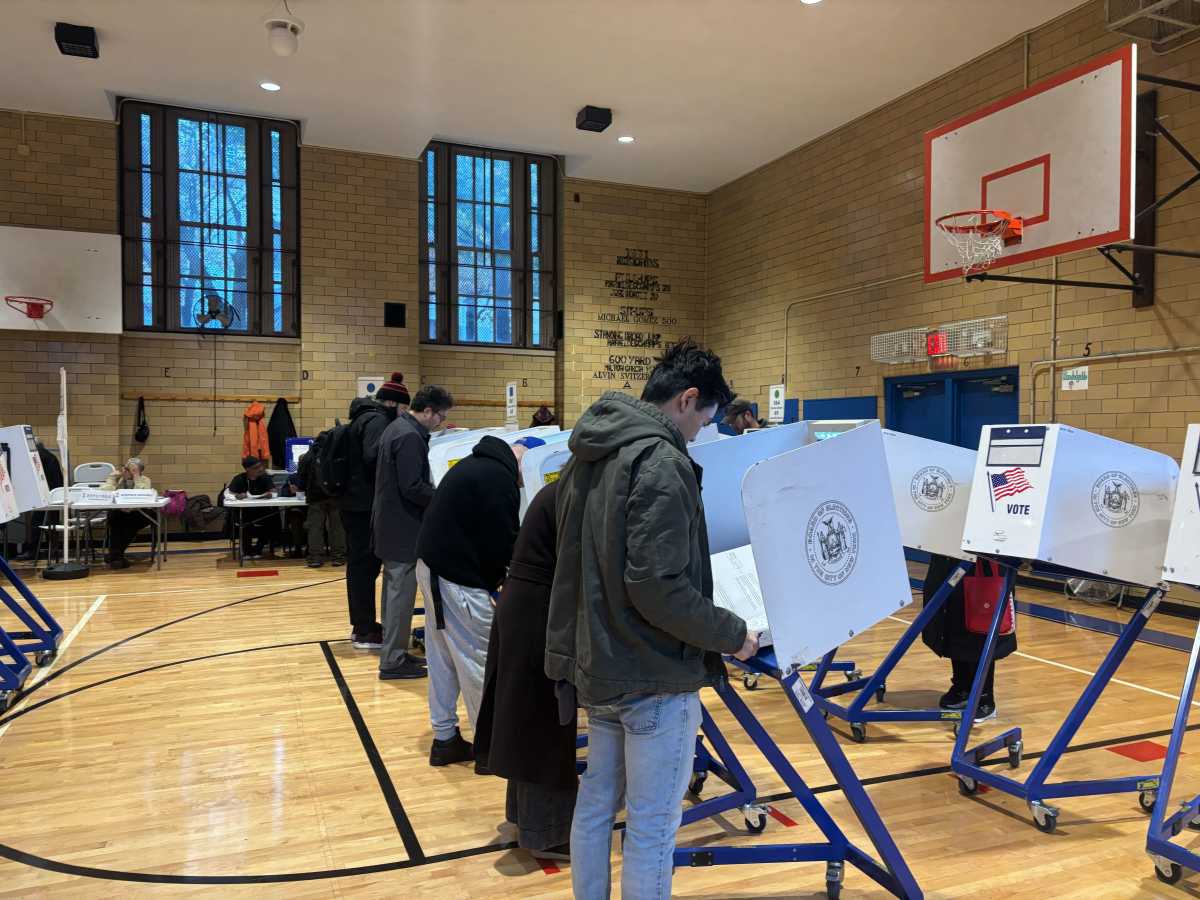
New Yorkers cast their ballots in the 2025 NYC Mayor’s race at P.S. 333 on the Upper West Side on Election Day, Nov. 4, 2025.
Photo by Shea Vance
The right to vote is often described as the cornerstone of American democracy. Yet the ability to exercise that right depends on something more basic: whether citizens possess the practical means to participate in the systems that govern their lives.
In the United States today, debates over voter identification laws reveal a deeper question about democratic participation—who is recognized within the civic infrastructure of the nation and who is not.
American political identity was forged through resistance to exclusion. Colonial opposition to the Stamp Act of 1765 reflected the importance early Americans placed on representation and participation in governance. Since then, the expansion of voting rights has been a defining feature of American democratic development. Constitutional amendments and landmark legislation—including the 15th Amendment, the 19th Amendment, the Voting Rights Act of 1965, and the 26th Amendment—were enacted to close the gap between democratic ideals and the lived realities of historically excluded populations.
Despite these advances, disputes over voting regulations persist. Voter identification laws have become one of the most contentious issues in modern electoral policy. Critics, including the American Civil Liberties Union (ACLU), argue that these laws disproportionately burden marginalized communities and risk suppressing participation. More than twenty-one million Americans of voting age reportedly lack government-issued identification, a gap that raises legitimate concerns about equitable access to the ballot.
Those concerns deserve serious attention. American history contains numerous examples—from literacy tests to poll taxes—of policies designed to silence particular communities. Ensuring that all citizens can exercise their right to vote remains one of the nation’s most important democratic obligations.
Yet this debate is more complex than it often appears. Public opinion research consistently shows that a substantial majority of Americans support requiring government-issued identification to vote. For many citizens, identification requirements are not seen as instruments of exclusion but as safeguards intended to reinforce confidence in electoral outcomes. Democratic systems depend not only on participation but also on public trust in the legitimacy of elections.
The real question, therefore, is not simply whether voter identification should exist, but how democratic societies ensure that identification requirements do not disenfranchise citizens.
Political theory provides a useful framework for understanding this challenge. Jürgen Habermas emphasizes that democracy depends upon communication and participation; citizens must be able to shape the laws under which they live. At the same time, Gayatri Spivak’s concept of the “subaltern” reminds us that marginalized groups can become voiceless when institutional structures prevent them from participating fully in political life.
Together, these perspectives highlight a simple but essential truth: democracy requires both voice and access. If identification becomes a prerequisite for participation, then access to that identification must itself be guaranteed.
This is where the voter ID debate should evolve. Rather than framing identification laws solely as restrictive policies, policymakers should examine whether the absence of universal identification represents a deeper infrastructural problem.
Modern societies rely on extensive systems of infrastructure—roads, digital networks, public health systems, and financial institutions—to sustain social and economic life. Increasingly, identification systems function as a comparable form of civic infrastructure. Government-issued identification enables individuals to access employment, healthcare, education, financial services, and public benefits. In practical terms, possessing identification is not merely a prerequisite for voting; it is often necessary for participating fully in modern society.
From this perspective, the solution to the voter ID debate is neither blanket opposition nor uncritical acceptance. Instead, the federal government should ensure universal access to identification documents. If voting is a foundational element of democratic life, then the documentation required to exercise that right should be publicly supported and readily available to every citizen.
Such an approach reframes the issue entirely. Providing universal access to identification strengthens not only democratic participation but also access to the social institutions that structure everyday life. It affirms that citizens must be recognized within the administrative systems of the modern state in order to participate meaningfully within them.
None of this diminishes the vital work of organizations such as the ACLU, whose defense of civil liberties has played a critical role in American democracy. But protecting democratic participation requires more than opposing potentially exclusionary laws. It also requires ensuring that the institutional conditions necessary for participation exist.
Ultimately, the debate over voter identification should not be reduced to a binary conflict between security and access. Instead, it should prompt a broader conversation about how democratic societies ensure that every citizen possesses the tools required to participate fully in political life. When identification becomes a gateway to both civic voice and social opportunity, guaranteeing universal access to it becomes not merely a policy choice, but a democratic imperative.
Andrew G. White IV, PhD., is an adjunct instructor in the St. John’s University Collins College of Professional Studies. He earned his degree PhD in multi-sector communication there.
