

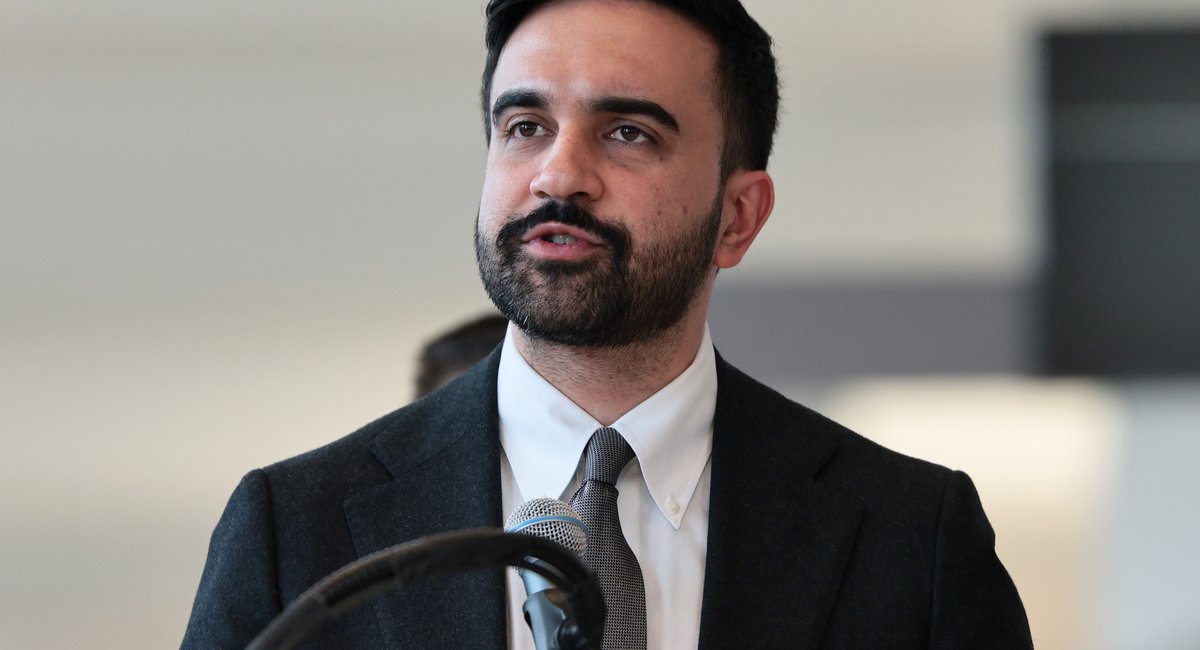
Mayor Zohran Mamdani’s campaign pledge to freeze rents for tenants in about 1 million regulated apartments got a lift Thursday, as newly released city data showed landlords faring quite well financially – but with several notable exceptions.
At the Rent Guidelines Board’s first hearing of the Mamdani administration, board members reviewed findings of a new report on landlord finances revealing an overall increase in revenue. The nine-member panel will consider the data, and other economic analyses, before voting in June on whether to raise rents, or to fulfill Mamdani’s campaign promise of freezing the rent.
The report showed landlords’ “net operating income” — which measures revenue minus mortgage payments — spiked by an average of 6.2% overall in 2024, with even larger increases on Staten Island and in “core” Manhattan south of 96th Street. It marks the third consecutive increase in net operating income, though lower than last year’s 12.1% jump.
Mamdani allies and supporters of a rent freeze seized on the overall rise in revenue to bolster their stance.
“Landlord incomes continue to rise while tenant wages stay stagnant and the cost of everything from food to transportation keeps going up,” said NYS Tenant Bloc Director Sumathy Kumar in a written statement. “A rent freeze is the common sense first step to making sure that the New Yorkers who keep this city running aren’t priced out of our homes.”
But those overall returns were not evenly distributed — a point that landlord and real estate groups were quick to point out.
Owners of older buildings where all apartments are rent-stabilized made far more modest profits on average compared to those with a mix of stabilized and market-rate units. And unlike other boroughs, net operating income actually decreased slightly in the Bronx. The dip was most pronounced in several South Bronx neighborhoods, including Hunts Point and Mott Haven, the data showed.
Overall, about 9% of buildings were found to be in financial distress, meaning expenses outpaced revenue. Most of those properties were concentrated in Northern Manhattan and the Bronx.
Ann Korchak, board president for the landlord trade group Small Property Owners of New York, said the largely positive report “presents a grossly inaccurate representation” of the economic hardships facing landlords like her.
“This data is an average, so just imagine the thousands of small properties that are operating in the red,” Korchak said. “We need a more accurate and transparent analysis that uses more timely information and reflects the economic distress of small property owners.”
Mamdani’s viral “freeze the rent” slogan captured attention and appealed to many New York City renters dealing with rising costs in an expensive city. His campaign and electoral victory have cast a brighter-than-ever spotlight on the makeup and considerations of a board with the power to fulfill or torpedo his pledge.
The first-term mayor appointed five new members to the Rent Guidelines Board last month, after his predecessor Eric Adams’ unsuccessful attempt to name the majority of the panel in the final days of his term.
Mamdani said on his first day in office that he expected board members would “assess the landscape for tenants in rent stabilized units across the city and find that they are in dire need of relief” though he has stopped short of calling for a freeze since taking office.
Asked for comment on the report, a City Hall spokesperson referred to a video Mamdani posted on social media encouraging New Yorkers to attend upcoming public hearings.
The city’s roughly 1 million rent-stabilized apartments are located in about 50,000 buildings, with major differences in the types and ages of the properties. Rent regulations apply to buildings with six or more units constructed before 1974, as well as newer buildings that receive tax breaks or government financing. That means the Rent Guidelines Board’s annual vote applies to apartments in century-old buildings in the Bronx’s Williamsbridge neighborhood as well as 2-year-old complexes that receive property tax breaks in Brooklyn’s Williamsburg.
Mark Willis, a senior policy fellow at NYU’s Furman Center, said a rent freeze would plunge many more of those older buildings into financial distress and called for unique approaches for different types of rent-stabilized housing.
“The stakes here are very high,” Willis said during a presentation to the board.
But other housing experts and anti-poverty researchers say that the subset of distressed buildings could benefit from more targeted programs or city intervention, rather than a rent increase.
In four years under Adams, the Rent Guidelines Board voted to raise rents by a combined 12%
Oksana Mironova, a senior policy analyst at the Community Service Society, said that the city’s deep affordability crisis necessitates a freeze. Rent Guidelines Board data last year showed tenants in rent-stabilized housing had a median income of $60,000 – far below the citywide median.
Mironova cited her organization’s October 2025 survey showing that about two-thirds of low-income tenants in regulated apartments said they were “struggling financially” even before factoring in rent increases. The vast majority of respondents said they had little to no savings.
“The combination of these two factors means people are basically on the brink of eviction,” Mironova said. “If something bad happens, they are a step away.”
The board will meet in the coming weeks to review additional data on landlord expenses as well the financial picture for tenants before reconvening May 7 to vote on a range of potential increases.
The board typically holds its final, binding vote in June after a series of public hearings.
This story has been updated with new information.
