

Poetry, depending on who is asked, is structure, seduction, or revelation. A classicist, with admirable rigidity, will insist it is form perfected. A romantic, more permissive, will argue it is emotion distilled. A philosopher, perhaps the most dangerous of the three, might suggest it is the closest language comes to truth without collapsing under its own ambition. Then, almost inconveniently, there is Raphael, who renders the entire debate insufficient. What he produces is not poetry as it is traditionally understood, but something closer to its origin—an ordering of the world so precise, so elevated, that it begins to resemble revelation itself.
There is, however, a confession that feels necessary.
My earliest encounters with Raphael were marked not by surrender, but by resistance. He seemed too measured, too exacting, too resolved. There was an almost unsettling absence of visible struggle, none of the theatrical friction that modern sensibilities have been trained to equate with genius. I understood him, certainly. I admired him, even. Yet I did not feel him. His perfection felt distant, as though sealed within its own authority.
This exhibition alters that understanding with quiet but unmistakable force.
This spring, The Metropolitan Museum of Art offers not merely a presentation, but something closer to a reorientation. Raphael: Sublime Poetry unfolds with the patience of a long-held breath finally released, revealing a body of work that, rather unexpectedly, pulses with life. What once appeared composed to the point of detachment now reveals itself as restraint under pressure, as emotion disciplined rather than absent.
The persistent comparison to Leonardo da Vinci and Michelangelo begins, almost inevitably, to feel reductive. Leonardo interrogates the world with relentless curiosity. Michelangelo imposes upon it a vision forged through force. Raphael, more subtly, persuades it into coherence. His compositions do not argue their case; they resolve it. Every figure, every gesture, every interval of space arrives with a sense of inevitability that feels less like invention and more like discovery. Such ease, it becomes clear, is not the absence of effort, but the concealment of it—a cultivated grace that borders on philosophy.
The drawings, perhaps more than anything, dismantle the illusion of effortlessness. They reveal a mind in motion, testing, revising, refining with a discipline that is both rigorous and intuitive. Line accumulates into thought. Thought sharpens into form. What appears inevitable in the finished work is, in truth, the result of an intelligence unwilling to accept approximation. One begins to sense, almost physically, the pressure beneath the surface.
Emotion, in Raphael, does not declare itself. It gathers.
It resides in the calibrated turn of a wrist, in the slight inclination of a head, in the charged stillness between two figures who seem aware of one another in ways that exceed narrative. His compositions hold feeling with a kind of composure that is neither cold nor distant, but sustained. The experience is cumulative. The longer one remains, the more the work begins to unfold, revealing layers that resist immediate consumption.

Portraiture, in this context, becomes something far more complex than representation. It is, arguably, a system of articulation—one through which identity, status, and value are rendered visible with extraordinary precision. Garments, jewels, posture, and gaze operate not as embellishment, but as language. For women, this language carries particular weight. Value is constructed through these visible codes, each element reinforcing a social order that is as exacting as it is elegant.
Yet, even within this structure, something resists complete containment.
There is often a moment—subtle, fleeting, yet undeniable—where the sitter’s interior life presses against the surface. The effect is not unlike a face held just behind an invisible barrier: fully present, exquisitely rendered, yet held at a remove that cannot be traversed. Emotion exists, undeniably, but it is disciplined into stillness. Raphael captures not only the image, but the condition of being seen, of being defined, of being, in some sense, held in place.
This tension finds a particularly evocative expression in the portrait of the Fornarina, developed in collaboration with Giulio Romano. The figure, nude yet marked by the blue band inscribed “Raphael Urbinas,” occupies a space that feels at once intimate and declarative. The inscription functions as both authorship and attachment, binding artist and subject in a relationship that is, perhaps deliberately, unresolved. If she is indeed his lover, the work becomes a meditation on proximity—on the desire to name, to hold, to preserve. Love, here, is neither abstract nor idealized. It is marked, claimed, and, in a sense, fixed in perpetuity.

The Madonnas, so often approached as embodiments of serenity, reveal a quieter complexity. Their tenderness is undeniable, yet it is constructed with an intelligence that borders on the architectural. Gesture, gaze, and composition align to produce an image of harmony that feels both immediate and aspirational. In a historical moment marked by fragility, these works do not deny reality. They refine it into something enduring.
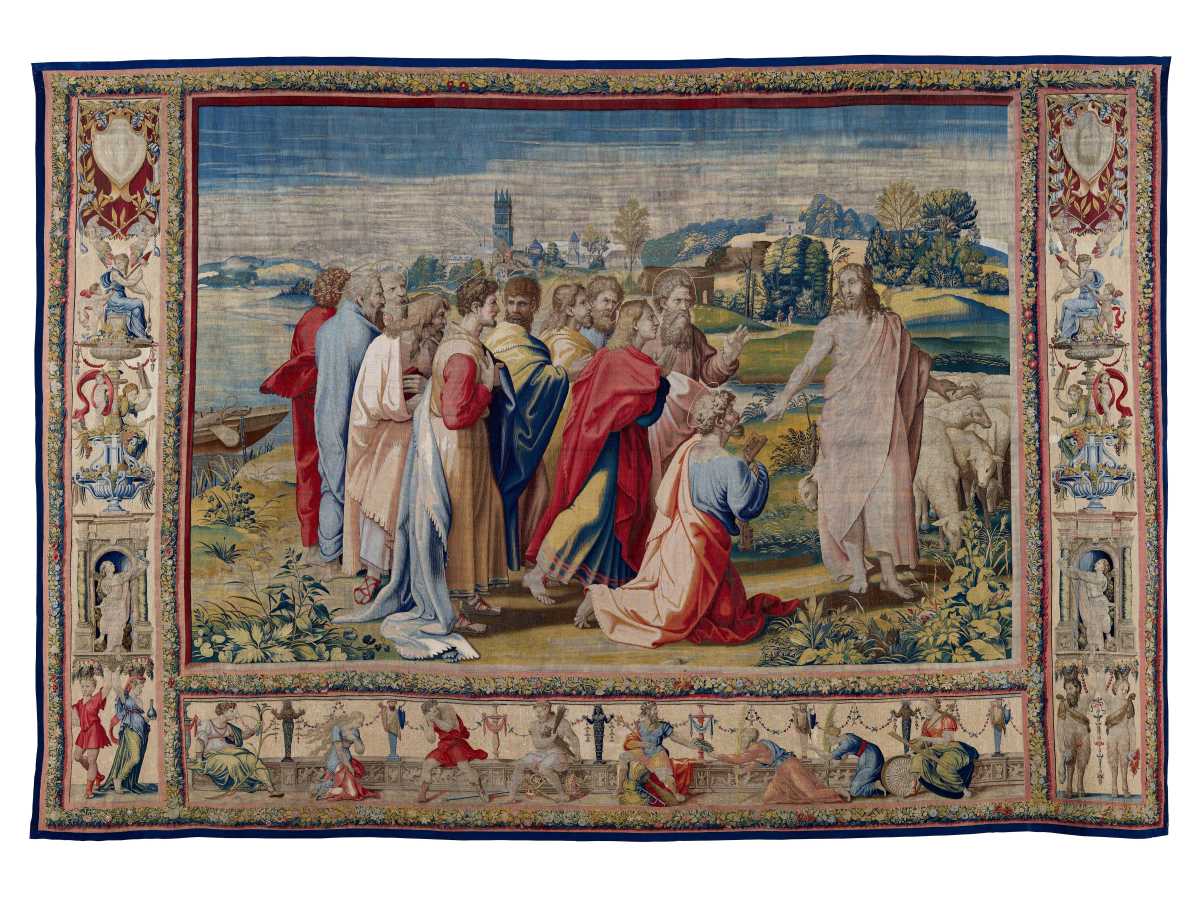
Then, almost decisively, the tapestries shift the register.
They do not simply extend Raphael’s language; they amplify it to a degree that feels, at times, overwhelming. Conceived for the Sistine Chapel and executed in Brussels with materials of extraordinary richness, they translate compositional intelligence into a medium that accumulates detail with remarkable density. Color deepens into something resonant and sustained. Narrative expands, unfolding across vast surfaces with a coherence that rewards prolonged attention. One does not merely observe these works. One navigates them.
Their historical significance, it must be noted, extends beyond their visual impact. Commissioned under papal authority and coveted by figures such as Henry VIII, Francis I, and Charles V, they operate at the intersection of art and power, serving as both aesthetic achievement and political instrument. Their presence within this exhibition feels, quite rightly, commanding.

The later works introduce a heightened intensity. Light sharpens. Shadow deepens. Compositions carry a sense of anticipation, as though something is about to shift. Raphael, even at the height of his recognition, does not retreat into repetition. He advances, integrating influence while maintaining a voice that remains unmistakably his own.
Carmen Bambach’s curatorial vision, shaped over seven years, allows this continuity to emerge with particular clarity. By placing process alongside completion, by allowing the viewer to witness both the searching and the resolution, the exhibition restores a sense of immediacy to an artist too often confined to the language of perfection.
What unfolds, ultimately, is not a static achievement, but a living presence.
Within the galleries of The Metropolitan Museum of Art, Raphael no longer reads as distant. He registers as something far more compelling—an intelligence attuned to both structure and feeling, to both order and its quiet undoing.
Raphael does not illustrate poetry; he consecrates it—composing a language so precise it outlives time, and so felt it refuses to release you. One leaves not having seen greatness, but having been entered by it—quietly, irrevocably, like a line of verse that alters the body long after it is read.
Visit metmuseum.org
