

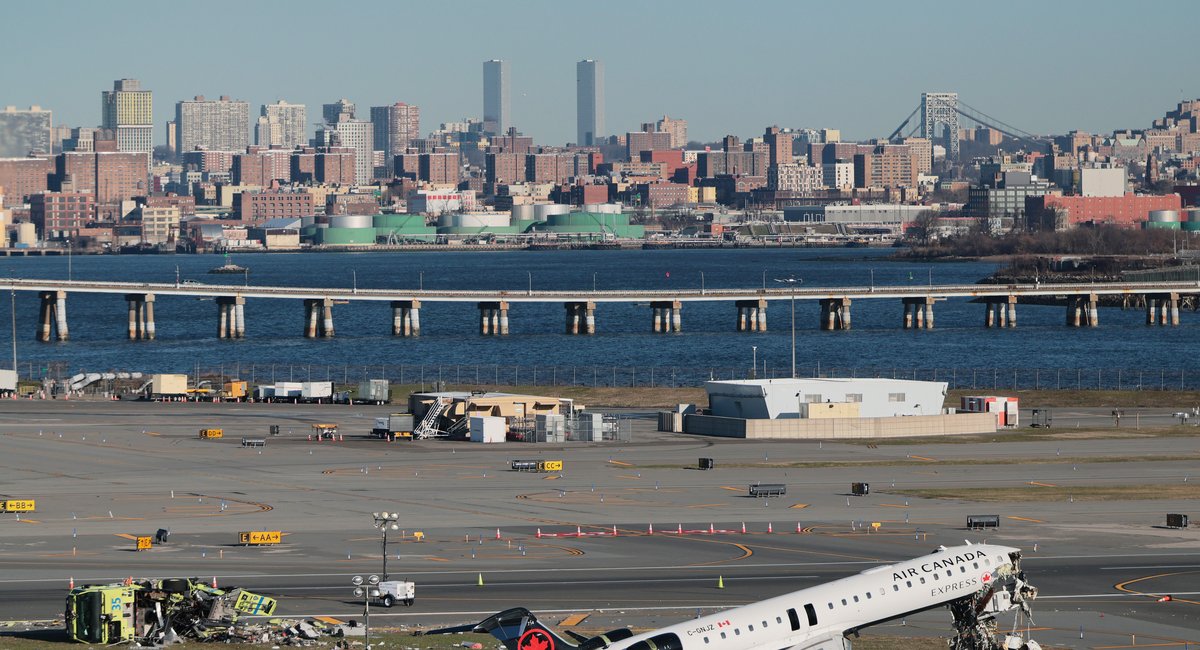
Federal transportation investigators on Tuesday pointed to two key areas under scrutiny in Sunday’s deadly runway collision at LaGuardia Airport: The fire truck involved was not equipped with a transponder and only two air traffic controllers were on duty at the time.
The National Transportation Safety Board’s findings raise questions about multiple potential layers of safety failure in the collision that killed two pilots aboard Air Canada Flight 8646, which collided with the rescue vehicle late Sunday night.
Of the 76 people on board, including 72 passengers and four crew members, 39 were taken to hospitals and six remained hospitalized as of Tuesday, according to Air Canada.
Officials said the Port Authority fire truck involved in the crash did not have a transponder — a device that helps identify aircraft and vehicles on tracking systems — limiting how it appeared to controllers and safety technology. Separately, only two controllers were staffing the tower, with one handling multiple roles, when the crash occurred.
NTSB Chair Jennifer Homendy said both issues are part of a broader investigation into how the collision happened.
“We rarely, if ever, investigate an accident where it was one failure,” she said. “Our aviation system is safe because there are multiple — multiple — layers of defense built in to prevent an accident. So when something went wrong, that means many, many things went wrong.”
Homendy said the fire truck had been dispatched to respond to a report of fumes in the cabin of a United Airlines flight when it crossed the runway into the path of the oncoming Air Canada plane.
LaGuardia’s runway safety system, known as ASDE-X, did not generate an alert before the collision, officials said. The system is designed to track aircraft and vehicles on runways and taxiways and warn controllers of potential conflicts.
Homendy said the lack of a transponder meant the vehicle could not be clearly identified by the system.
“For ASDE-X to work, you have to know where ground vehicles and aircraft are,” Homendy said. “And in this case, that ground vehicle did not have a transponder and it would have been helpful.”
Investigators said the tower was staffed by a local controller and a controller in charge — standard operating procedure for midnight shifts at LaGuardia and other airports.
The controller in charge was also assisting departing pilots, and it remains unclear who was handling ground control duties, which include managing the movements of ground vehicles like the fire truck, they said.
When asked about the staffing arrangement, Homendy said NTSB investigators have raised concerns about such configurations in the past.
“Our air traffic control team has stated this is a problem, that this is a concern for them for years,” she said. “I can understand that this is a concern for them, especially if there is a heavy workload.”
Homendy cautioned against concluding controller performance, saying investigators are still reviewing records and interviewing personnel.
The cockpit voice recorder and flight data recorder, which were extracted from the aircraft on Monday after crews cut a hole in the plane’s roof, have been sent to a lab in Washington, D.C. Officials said the recordings will be reviewed on Wednesday.
The FAA and the Port Authority did not immediately respond to requests for comment.
This story has been updated with new information.
