

There is a kind of collective amnesia in today’s debate over how New York City’s public schools should be governed. Proposals to weaken mayoral control are often framed as modest technical adjustments to a governance structure. But those of us who worked in the schools before mayoral control remember something very different.
I saw it firsthand – first as a teacher and principal in the days before the state granted the mayor control of the schools, and later as New York City’s senior deputy chancellor in Mayor Michael Bloomberg’s administration. What I remember is a school system marked by fragmentation, neglect and, at times, outright corruption.
Running the nation’s largest public school system requires more than good intentions. It requires leadership able to make coordinated decisions, direct resources where they are most needed, and be accountable for the results.
For decades, governance was divided between the central Board of Education, which oversaw high schools, and 32 local community school boards that controlled elementary and middle schools. Authority was scattered and decisions were often shaped by local patronage rather than the needs of students.
When I became a principal in 2001, the damage was already clear. It did not take long to see that many of the most consequential decisions were being made far from classrooms. I met educators who had been forced to pay $15,000 to local school board members to secure an assistant principalship, and $30,000 was the going rate to become a principal.
It was a system built to serve adults, not educate children.
The consequences for students were stark. In 2001, fewer than half of New York City students graduated from high school and roughly one in five dropped out. For Black and Hispanic students, the numbers were even worse. When families demanded answers, there was no clear line of responsibility. Power was so widely dispersed that blame could always be passed along. Mayoral control changed that by creating both the authority to act and the responsibility to answer for results. Over the next two decades, the city’s graduation rate climbed dramatically – from roughly 50 percent in 2001 to more than 80 percent – an achievement that would have been difficult to imagine at the time.
Mayoral control also paved the way for innovation. During the Bloomberg era, the city opened over a dozen early college schools where students can earn associates degrees in high school, giving kids a jump start in their careers and saving working families money. This kind of innovation required significant investments and citywide partnerships – elements that the old, decentralized structure simply could not deliver on.
Consider Mayor Bill de Blasio’s rollout of universal pre-K. In less than a year, the city created tens of thousands of early childhood seats – finding space, recruiting educators and directing funding across five boroughs at extraordinary speed. Under the fragmented structure that existed before mayoral control, a citywide expansion of that scale would have been nearly impossible.
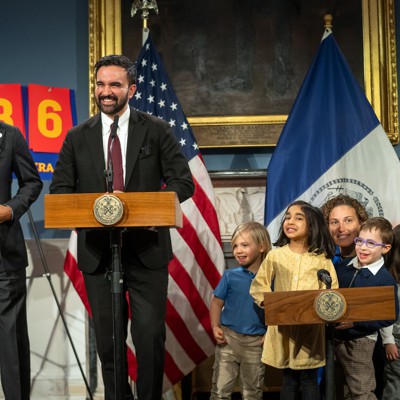
The same is true of Mayor Zohran Mamdani’s ambitious vision of child care for all, which includes the current launch of preschool for 2-year-olds and expansion of 3-K programs in neighborhoods from Elmhurst to Inwood. Efforts of this scale depend on the city’s ability to mobilize resources across the entire school system.
The current system is not perfect. Parents and communities deserve meaningful ways to shape decisions about their schools. But accountability requires clarity. If everyone is in charge, no one is responsible.
As state legislators finalize the budget, they should remember the lessons of the past. Extending mayoral control for another four years will ensure that someone has both the authority – and the responsibility – to deliver for New York City’s children.
