

It began as a shrewd campaign pitch from a longshot lefty mayoral candidate. Rather than absorb constant attacks for his past anti-cop statements, he would go on the offensive, coming up with a new vision for public safety that focused on civilian response to mental health calls, unburdening law enforcement from caring for the city’s most vulnerable people.
Then that candidate actually became mayor – taking on the daunting bureaucracy of city government, finding himself actually in charge of maintaining public safety and unexpectedly forging an alliance with the Upper East Side heiress-turned NYPD commissioner. As the city reeled from the police shooting of a 22-year-old man having a psychotic episode in his home in front of his family, questions about the mayor’s vision for a revolution in emergency response took on new urgency.
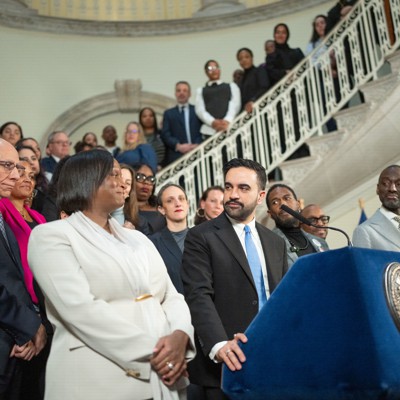
On Thursday, with an executive order, Mayor Zohran Mamdani brought the Office of Community Safety into being, led by a newly appointed Deputy Mayor for Community Safety Renita Francois. It’s not the $1.1 billion full-blown city agency Mamdani envisioned – just under half of which was set to be new funding. Right now, it’s just Francois “coordinating” several existing offices. But the mayor insisted Thursday that this is just the “first major step” – that the office will grow, and so will its budget.
Public Advocate Jumaane Williams, longtime criminal justice reformer, acknowledged there is much to sort out. “I’m sure the media and a lot of folks have a lot of questions. I just want to say there are a lot of questions to be answered, but you can’t do a thing unless you start.” Here are three major questions that remain about the city’s crisis response.
What exactly does the deputy mayor for community safety have power over?
There was ample praise for Francois following her appointment – and uncertainty about her role. Her portfolio is much smaller than those of her fellow deputy mayors and consists of five existing social service offices, ambiguous oversight of the city’s B-HEARD emergency mental health response system, and “Additional components TBD,” according to an org chart shared by City Hall. “The good thing is that Renita (Francois) is somebody who is fiercely talented and really knows this area,” said Vital City founder and former Director of the Mayor’s Office of Criminal Justice Elizabeth Glazer. “The issue still is that the structure – it’s unclear what authority she has over what and still unclear what exactly the goals are.”
What changes for B-HEARD, the city’s existing civilian response team?
Of all the existing city programs, the one most closely resembling Mamdani’s original campaign pitch is B-HEARD, or Behavioral Health Emergency Assistance Response Division. B-HEARD partners EMS workers with mental health providers to respond to certain mental health calls, and it remains under the shared control of the Fire Department and New York City Health + Hospitals – not the new Office of Community Safety.
Mamdani’s chief of staff Elle Bisgaard-Church, who designed the original campaign platform, said the deputy mayor will focus on “policy choices” regarding the program. “This, I think, shows exactly why we need the will to coordinate these things, because it’s too complicated being split across (FDNY and Health + Hospitals), and now the deputy mayor, through the office, will actually try to centralize the decisions that are made. To be determined exactly what those policy changes are.”
City Hall spokesperson Sam Raskin added that the Mamdani administration has “started exploring ways to redesign the 911 system to increase the number of calls going to B-HEARD.”
How does the NYPD factor into all this?
Absent from Mamdani’s crowded City Hall press conference Thursday was NYPD Commissioner Jessica Tisch. (Though she did contribute a positive quote to City Hall’s press release.) Also absent were any details about how this office, which is meant to shift crisis response away from cops, will actually impact cops. “If we want to keep New Yorkers safe, we have to also ensure that we are not just asking police officers to respond to every single issue that comes as a result of the fraying of the social safety net,” Mamdani said.
Tisch expressed confidence at a City Council hearing on Wednesday that the new effort wouldn’t impact NYPD’s budget. But neither the executive order nor the org chart shared by City Hall explain how officers’ duties could change – or how existing co-response efforts, which pair cops with social workers, could be impacted. Brian Stettin, former senior adviser on severe mental illness to former Mayor Eric Adams, said that discussion was “really missing from today’s announcement.”
“That’s how we handle the great majority of crisis calls that you can’t avoid sending police to. There’s no reason why we should be sending police alone,” he said. “They could get some help.”
