
The Democratic primary in the race to replace retiring Rep. Jerry Nadler features little daylight among the leading candidates on how to fight climate change.
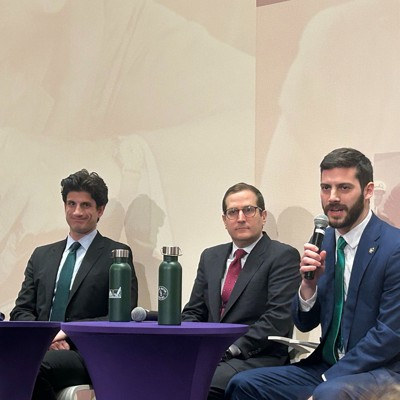
Kennedy scion Jack Schlossberg and Assembly Members Micah Lasher and Alex Bores, speaking at a policy forum Tuesday night, all agreed that congestion pricing has been a smashing success. They’re all open to nuclear energy as being part of the equation to reduce carbon emissions, if not particularly enthusiastic about it in comparison to renewables like wind and solar. And they all – in defiance of Schlossberg’s cousin and Health Secretary Robert F. Kennedy Jr.’s wishes – think fluoride should be in drinking water.
The contenders for the 12th Congressional District in Manhattan were brought together by the New York League of Conservation Voters Education Fund. And while it was focused mainly on environmental issues, the Upper East Side forum wasn’t entirely without distinctions among the three candidates.
Asked in a quick-fire round about the Northeast Supply Enhancement natural gas pipeline, or Williams pipeline, Schlossberg said he supports it, while Lasher and Bores said they didn’t.
Lasher and Bores think that New York Democrats need to “fight fire with fire” when it comes to partisan gerrymandering – engage in it – and then pass a national ban on partisan gerrymandering after gaining control of the House of Representatives. Schlossberg said New York shouldn’t stoop to the level of other states participating in gerrymandering and disenfranchise voters.
Asked if they own stocks in oil and gas companies, all three candidates said no. But when pressed by moderator and NY1 journalist Dan Rivoli, who was armed with recently released financial disclosures, Schlossberg said he inherited from his “great-great-great-grandfather” an investment in a well in Oklahoma that still produces oil, but he said he can’t sell it. (Schlossberg referred to him as Joseph P. Kennedy so he may have actually been referring to his great grandfather.) Asked about listed investments in Exxon and Hess Corporation, he said he no longer owns them. Lasher said he’s invested in target-date index funds through his 401(k), while Bores said he avoids index funds to be able to divest more easily.
Calling the environment the issue he cares most about, Schlossberg argued those facts don’t compromise him. “I don’t think it’s a bad thing for somebody to understand how the private markets work in energy. I don’t think that that makes me someone who’s going to be beholden to the fossil fuel industry. I think the most important question that you should want to know is not whether or not I used to own stock because I knew that the war in Ukraine would send oil prices up and I’m very interested in energy,” he said, apparently referring to his support for a congressional stock trading ban. “I think it’s what money is funding my campaign,” adding he’s not taking money from corporate PACs, billionaires or AI companies.
George Conway, another candidate who has polled high in some initial surveys (including one commissioned by his campaign) and who only entered the race in early January, was not invited to participate in the forum. Organizers said candidates either had to cross a fundraising threshold of $250,000 as of the last filing, or be an elected official. But that didn’t stop the former Republican pundit and Trump antagonist from showing up to a post-forum reception. How would he have stood apart on stage if given the chance to speak? “I don’t think I’d stand out from them on any of this stuff. Fundamentally, I’m where they are,” he told City & State. Conway argued the difference he brings to the field is he knows how to take on Trump.
