
Mayor Zohran Mamdani’s first St. Patrick’s Day in City Hall may start with something more pointed than the usual breakfast-pageantry circuit: a lesson in Irish history from one of his closest labor allies.
After the mayor said Monday that he had “not thought a lot about” whether he supports Irish unity, Transport Workers Union President John Samuelsen said he plans to raise the issue directly with Mamdani at Gracie Mansion’s annual St. Patrick’s Day breakfast — and made clear he sees the question as part of a much older labor and political tradition in New York.
“It’s clear to me that he will support the cause for Irish reunification,” Samuelsen told amNewYork, calling Mamdani’s answer “a cautious” one. He added: “We’re gonna go over this with him in detail, and he’s gonna stand with us.”
For Samuelsen, the issue goes beyond parade-season ethnic politics and lies within the same tradition of worker justice and Irish republican politics that shaped the TWU itself.
In his telling, that lineage runs through TWU founder Michael Quill, the Irish-born freedom fighter turned union firebrand who became a New York labor legend after leading the 1966 transit strike that shut down the city for 12 days and helped win a 15% wage increase for more than 30,000 workers.
Samuelsen said Quill was an Irish republican influenced by James Connolly, and that the TWU was modeled on the Irish Transport and General Workers’ Union.
“Our roots are in Ireland,” he said. “We’re directly named after the Irish Transport and General Workers’ Union.” At the luncheon, Samuelsen told this paper that while members will certainly differ on certain issues, the rights of workers and the cause of Irish unity were not up for debate.
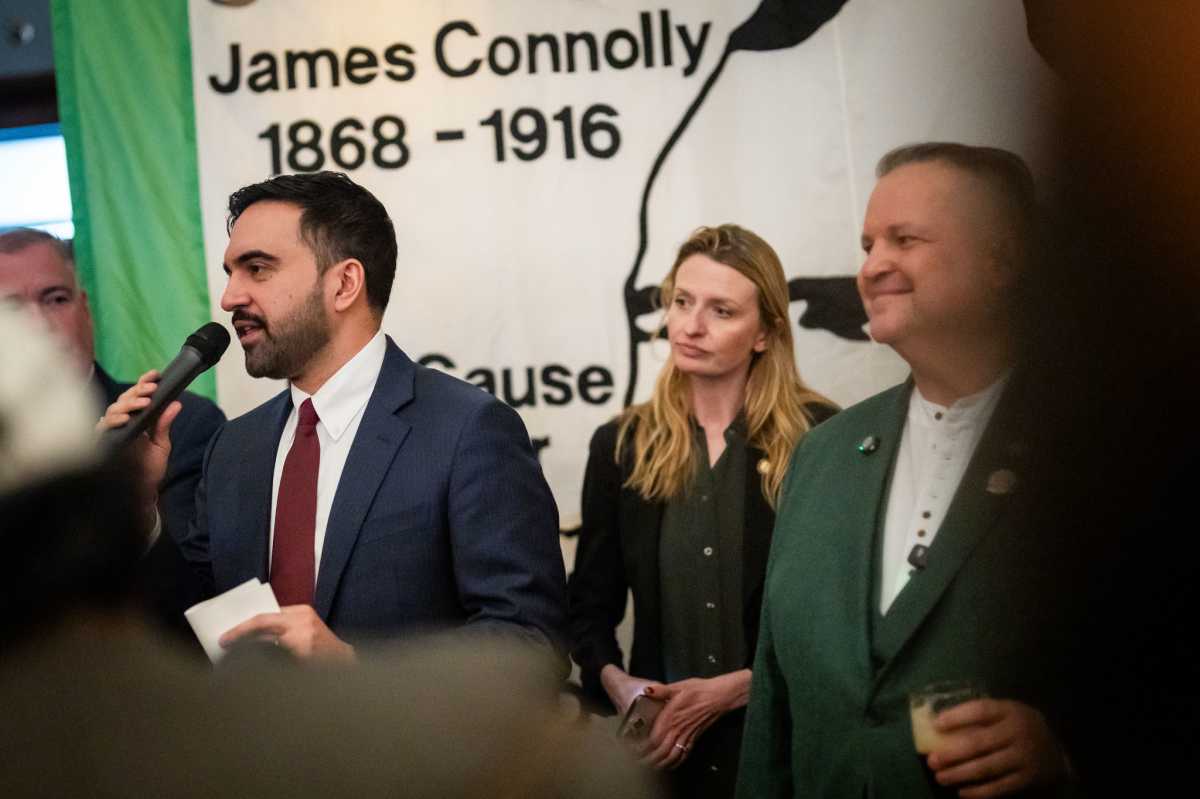
Mamdani’s Monday answer landed awkwardly after he stepped into that history on Friday at the James Connolly Irish American Labor Coalition’s annual luncheon in Midtown. There, Mamdani quoted Connolly — “The cause of labor is the cause of Ireland, and the cause of Ireland is the cause of labor” — and praised Irish Americans as central to both the story of New York City and the city’s labor movement.
“He’s not the ambassador to the United Nations. He’s the mayor in New York City, and he’s only been that for less than three months,” Samuelsen said of his ally on Monday, having praised him on Friday for doing an “excellent job” in standing with the city’s working class. “I don’t think it’s reasonable to conclude that he is going to be an expert on the geopolitics of every nation that’s in his constituency.”
“He’s going to give an honest answer, and then he’s going to go consult with people he trusts regarding this Irish question,” he added.
Mayors have an awkward history with Irish politics
New York mayors have a long, uneven history of brushing up against Irish nationalist politics.
Ed Koch long used hard anti-British language on Northern Ireland, then briefly softened his stance after a 1988 visit before reversing himself again in New York and saying it was “an error” to deny that the British were an occupying force.
David Dinkins once intervened on behalf of Irish republican figures, including urging compassion in the case of Jimmy Smyth.
On March 17, 2018, then-Mayor Bill de Blasio declared St. Patrick’s Day “Gerry Adams Day” at Gracie Mansion, honoring the former Sinn Féin leader for his role in the Northern Ireland peace process — a move that drew backlash from Troubles victims’ families and unionists.
Still, the issue has recently surfaced elsewhere in city politics.
Two Mamdani allies, former City Council Member Justin Brannan and Assembly Member Keith Powers, hosted visiting Northern Irish politicians from the SDLP — a center-left nationalist party that backs reunification through constitutional politics — at City Hall earlier this month.
Brannan later wrote that they had discussed “the possibilities, challenges, and future of a United Ireland,” adding that it was “always meaningful to spend time with people who are serious about Irish reunification.” He did not respond to requests for comment.
Sinn Féin reads Mamdani’s Connolly invocation as a nod to Irish unity
Friday’s luncheon also brought Ireland’s republican party, Sinn Féin, into the picture. Louise O’Reilly, the party’s TD (member of the house of Irish parliament) who appeared in New York as part of the party’s annual push to promote Irish unity, told amNewYork that Sinn Féin sees a referendum on unity coming within 4 years and wants Irish America to organize now.
“I’m here to talk to people about the struggle for Irish self-determination,” she said. “Without the influence of Irish America, we wouldn’t have a Good Friday Agreement…I’m here to ask these people to stick with us and to use their influence… to pass the resolutions… to talk about Irish unity.”
In Ireland, Sinn Féin is pushing for planning toward reunification, while Taoiseach Micheál Martin, the Fianna Fáil leader and Irish Prime Minister, has said a referendum by 2030 is premature. Under the Good Friday Agreement, a border poll would happen only if the British Secretary of State believed a majority in Northern Ireland would likely back it.
The latest Census data show Irish ancestry remains a major demographic force in New York. Nationally, 30.7 million Americans claimed Irish ancestry in 2022. A more recent survey compilation estimates roughly 2.1 million New Yorkers are of Irish ancestry, including about 376,000 in New York City.
Recent public polls measuring Irish-American support for reunification are sparse, but recent reporting shows the issue still has an organized constituency: POLITICO Europe reported in 2024 that Irish-American politics on the issue have moved “from bombs to ballots,” with Friends of Sinn Féin, which has a permanent office in NYC, raising $2 million over five years for nationalist advocacy in the US.
For Mamdani, whose politics are shaped by an anti-colonial worldview, that tension is not new. His outspoken support for Palestinian rights has made him a prominent voice on one of the most polarizing issues while governing a city with strong support for Israel. In that, there is at least some overlap with Ireland, which for decades has been among the most vocal backers of Palestinian rights on the world stage.
O’Reilly suggested he could look to Sinn Féin’s First Minister, Michelle O’Neill, the first Irish nationalist to hold the position, as an example of a politician who has remained grounded in movement politics while taking on the obligations of broader leadership.
“Michelle is a First Minister for all; she has had to stretch herself in order to fulfill that role,” said O’Reilly. “You can’t take Michelle’s Republicanism from her.”
O’Reilly said she was admittedly “starstruck” upon seeing the mayor in person, a politician whose rise over the last year attracted global attention and whose lefty political views align with those of Sinn Féin. Before being elected as an Assembly Member in 2020, Mamdani lauded Sinn Féin’s platform of expanding public housing, cutting rents, and freezing rents.
“People don’t want to see a compromise. They want to see that you are authentic and true to yourself, that you will work hard, and that you will represent them,” she said of the success of the new mayor. “He has stolen the heart, not just of New Yorkers, I think, but he’s stolen the heart of a lot of the world because he’s very true to himself.”
Sharing a selfie of herself and Mamdani after the luncheon, which party leader McDonald also posted, O’Reilly said she was honored to share a platform with Mamdani, to hear him quote James Connolly and “to reaffirm the close links between organized labor and Irish unity.”
Sinn Féin and O’Reilly did not respond to requests for comment at the time of publication on whether it was Mamdani’s invocation of Connolly that they viewed as an implicit endorsement of Irish reunification. The line Mamdani quoted comes from a longer Connolly passage that explicitly links workers’ rights to the cause of Irish freedom.
