

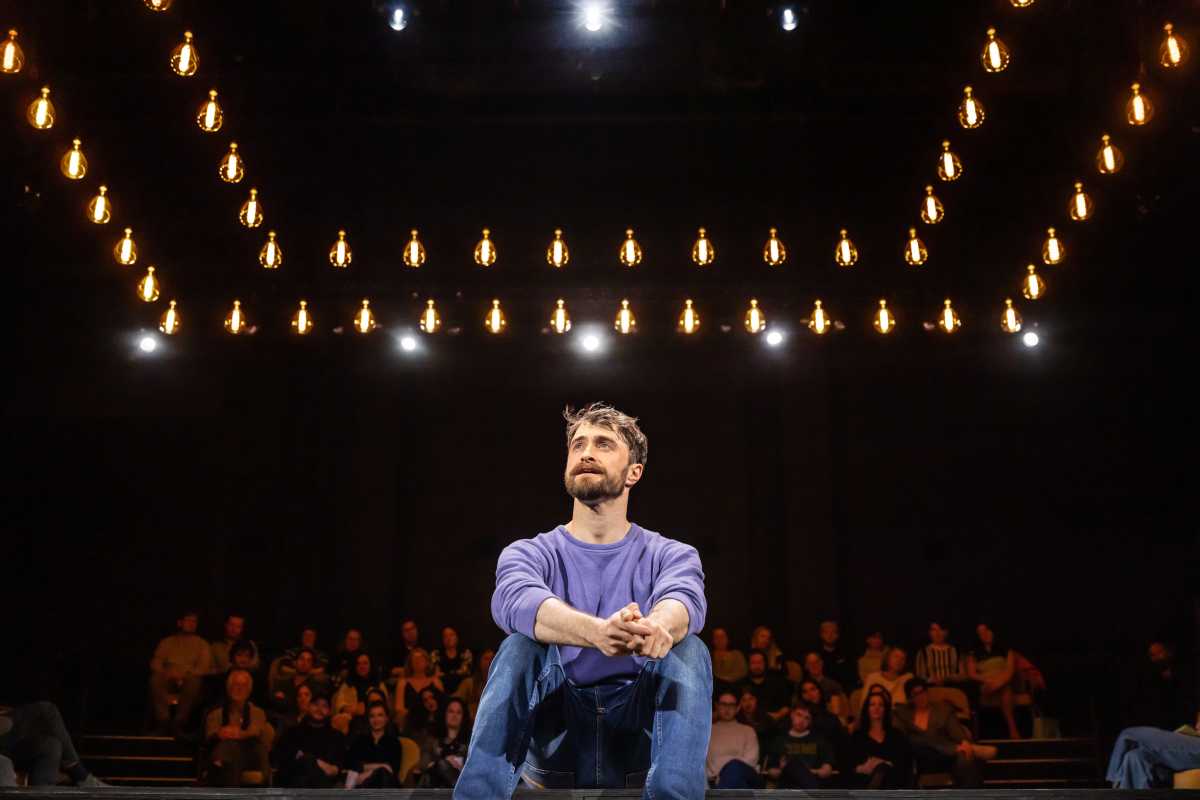
Daniel Radcliffe in “Every Brilliant Thing.”
Photo by Matthew Murphy
Fresh off his Tony Award–winning performance in the Broadway revival of “Merrily We Roll Along,” Daniel Radcliffe has returned to the Hudson Theatre with something far smaller in scale but no less demanding: a one-person play that depends almost entirely on his ability to connect with a room full of strangers.
The show is “Every Brilliant Thing,” Duncan Macmillan and Jonny Donahoe’s widely performed solo play about a person who begins compiling a list of life’s small joys after his mother attempts suicide. Since premiering more than a decade ago, the piece has been staged around the world in dozens of countries and venues large and small. It previously ran Off-Broadway at the intimate Barrow Street Theatre, where it was later filmed for HBO with Donahoe as the performer.
The premise is deceptively simple. As a child trying to make sense of his mother’s severe depression, the narrator begins writing down everything that makes life worth living. The earliest entries reflect a child’s perspective — ice cream, water fights, staying up past bedtime — but the list grows alongside the narrator’s life, gradually encompassing friendships, love, music, books, and countless small pleasures that accumulate across adulthood.

The list becomes both the framework of the story and a coping mechanism — a way for the narrator to push back against despair even as he struggles to understand his mother’s recurring mental illness.
What distinguishes “Every Brilliant Thing” from a typical solo show is the way it unfolds in collaboration with the audience. Before the performance formally begins, Radcliffe mingles through the crowd introducing himself and handing out numbered cards. Each card corresponds to an item on the narrator’s ever-growing list, which audience members read aloud when called upon during the show. Spectators are also occasionally recruited to portray figures from the narrator’s life — his father, a school counselor, a romantic partner, even the veterinarian who euthanizes the family dog.
The result is a hybrid of storytelling, improvisation, and communal participation in which each performance develops its own rhythms and surprises.
For its Broadway debut, the production wisely preserves the intimacy that defined earlier stagings. The Hudson Theatre has effectively been arranged to recreate the closeness of the Barrow Street Theatre experience. Some audience members sit onstage alongside those in the auditorium, surrounding the playing area and becoming part of the performance environment.

Those seated onstage inevitably have the most direct involvement, but Radcliffe makes a point of engaging the entire room. He moves easily through the aisles, kneels beside audience members, and responds warmly to whatever contributions emerge from the crowd.
Radcliffe proves an ideal guide for the evening. His approachable persona — earnest, slightly self-effacing, and quick with a joke — suits the show’s participatory format well. He approaches the role with enthusiastic sincerity while maintaining a light comic touch, ensuring that the play’s sentimental premise never becomes overly precious.
“Every Brilliant Thing” confronts serious subject matter — depression, suicide attempts, and the complicated experience of loving someone who struggles with mental illness — yet it does so with determined optimism. Over the course of the evening, Radcliffe turns the Hudson Theatre into a kind of temporary community, inviting the audience to contribute their own reminders of life’s small pleasures. The result is a modest but affecting theatrical experience that finds unexpected power in the simple act of paying attention to what makes life worth living.
Hudson Theatre, 141 W. 44th St., everybrilliantthingbway.com. Through May 24.
