

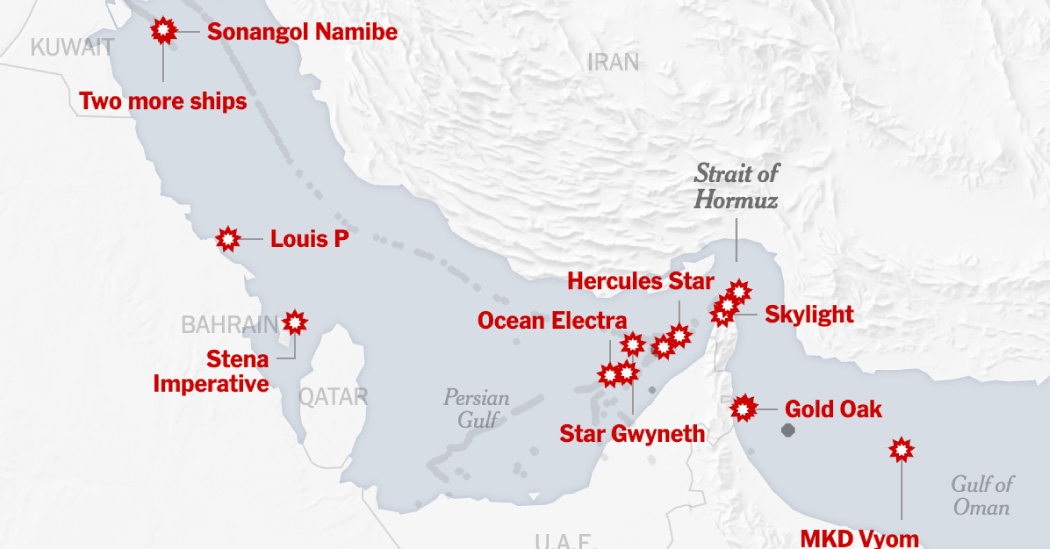
At least 16 oil tankers, cargo and other commercial ships have been attacked in the Persian Gulf since the U.S.-Israeli war against Iran began nearly two weeks ago, a New York Times analysis shows.
Iran has claimed responsibility for several of the attacks. On Thursday, two Iraqi tankers were ablaze at sea, some of the latest visible examples of how attacks have increasingly focused on oil and energy infrastructure as the war has sprawled.
The boat strikes come as Israel and the United States launch more assaults against Iran and its allies in the region. Hundreds of people have died, and thousands more have been displaced, since fighting began on Feb. 28. As the human toll mounts, so have the economic consequences of the war.
The Israeli military has struck several Iranian fuel storage and energy complexes. Iran has launched attacks on oil production and storage facilities across the Persian Gulf. It has also threatened shipping traffic in the Strait of Hormuz, the narrow passageway that connects the gulf with the rest of the world. The strait is normally a conduit for one-fifth of the world’s oil.
Amid growing concerns about international trade, projectiles hit three vessels on Wednesday in or near the strait. Hours later, the two Iraqi tankers were struck off the country’s coast. Iraq and Oman closed oil terminals in the wake of the attacks.
The reports of the attacks, and their locations, were compiled from company releases, announcements by official country agencies, shipping industry data companies and satellite tracking firms.
At least eight people have been killed, and one remains missing, following the attacks on these vessels, which included a tug boat that came to help one of the struck container ships, according to the International Maritime Organization.
The types of vessels that have been hit each day
Before the war, around 80 oil and gas tankers typically passed through the strait, according to a New York Times analysis of shipping activity from Kpler, an industry data firm. Roughly 20 million barrels of oil made the passage daily, helping to power much of the globe.
Now, barely one or two ships a day are able to cross.
The International Energy Agency on Thursday warned that the war had caused “the largest supply disruption in the history of the global oil market.”
Nations with major economies, including the United States, have pledged to release emergency reserves in order to make up for the shortfalls. But as the number of attacks has risen, so have the concerns.
International oil prices have spiked, and are up nearly 40 percent since the war began. Economists are warning that a prolonged conflict could ripple broadly across the global economy, threatening the energy, food and industrial supplies of countries far from the Middle East and stoking inflation.
