
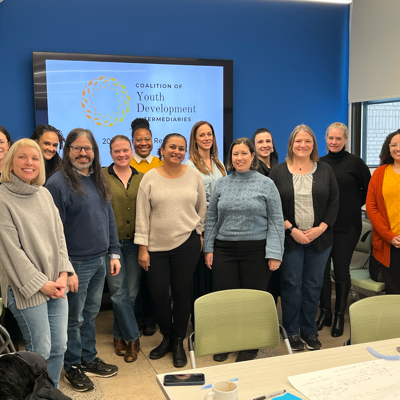
When the federal funding and policy landscape shifted abruptly at the beginning of the second Trump administration in 2025, a coalition of nonprofit intermediaries formed to meet the moment, lift up and generate resources to address sector needs. This new “network of networks” has reduced duplication, increased coordination, and amplified our collective voice.
After a successful pilot, the Coalition of Youth Development Intermediaries is kicking off a new year to build on the dynamic partnerships established last year. The focus now is not only on getting knowledge and resources to individual youth-serving nonprofits, but also creating the infrastructure needed to broker, bridge and sustain the kinds of shared services, partnerships, and creative operating models that are needed to sustain and strengthen the nonprofit sector.
A coordinated effort
Do you remember the chaos and uncertainty the nonprofit sector was experiencing exactly a year ago? Organizations serving immigrant and LGBTQ+ communities were seeing both heightened community needs and immediate funding cancellations, while virtually all nonprofits experienced the whiplash of federal funding being frozen and restored while getting mixed messages from private and corporate philanthropies about the stability of their support.
Nonprofit staff and families worried about what all of this meant for young people, with one reporting in an anonymous survey that “students are showing higher levels of anxiety and disengagement, they’re losing access to spaces that used to keep them connected and hopeful.” Meanwhile, staff bandwidth needed to continue programs and services were sapped by a barrage of novel and urgent questions: What do we do if our federal grants are cut? Do we need to change the language on our website? How can we train our staff on what to do if ICE comes to our building? Are our data systems secure?
We recognized that many youth-serving nonprofits in New York City were turning to nonprofit-serving nonprofits, known as intermediaries, such as the Lawyers Alliance, the Workforce Professionals Training Institute and the Partnership for After School Education with similar questions. So the initial idea for the coalition was a triage measure to bring these intermediaries together, better positioning them to support the youth development field at large – cutting duplication, coordinating updates, and offering capacity building, training and support to a larger number of nonprofits. This birthed CYDI, to unite leading intermediaries and nonprofit partners to address acute crises, such as funding cuts, program censorship, staff burnout, and safety concerns, while also tackling the longer-term systemic barriers of resource scarcity, inequitable funding and sector fragmentation.
As the acute crisis of early 2025 became whole seasons of constrictions, adjustments and worry, leaders voiced concerns to us in surveys. “We’re constantly in survival mode – chasing the next grant cycle instead of being able to plan strategically,” they said, and “Our biggest challenge is maintaining quality and morale when our staff are working two or three jobs to make ends meet.”
The coalition responded by providing support to hundreds of organizations through a number of emergent vehicles: a resource hub with news, policy updates, training and funding opportunities; monthly power hours with legal briefings, advocacy and other timely updates; a “needs survey” to compile and share specific funding needs with local funders; in-person convenings with new offerings respond directly to emerging needs; and no-cost technical assistance in key areas of need like fundraising, data management and leadership coaching. These triage measures all sought to mitigate the rippling effects of federal policy shifts, their downstream effects on other public and private funding and cultural impacts on young people and their communities.
These efforts resulted in tangible, practical help for hundreds of organizations that otherwise wouldn’t have had access, as well as a boost of morale for leaders and staff who found support and community. “Despite all of it, we’re finding new ways to collaborate,” one leader shared. “The relationships between organizations have never mattered more.”
Looking ahead: deeper, structural partnerships
Many of us in nonprofits and philanthropy have come into 2026 with new questions: Can the nonprofit ecosystem as we know it survive this moment? What does the future of our sector look like? What can we do to adapt to constriction in funding and continued uncertainty with courage and dignity, while continuing to ensure that our most vulnerable children and community members get the support they need? Is there a looming nonprofit crisis that will inevitably result in more layoffs, mergers or closures – or is there something we can do collectively to get ahead of it?
The coalition’s pilot year proved that nonprofit infrastructure is not a luxury, it’s a necessity. We need to invest in people, systems and sustainability so organizations can focus on supporting young people. Over the next year, CYDI will be exploring concrete, innovative ways to meet not just siloed, but system-level needs.
What you can do (it takes a village)
Join the coalition! Other field-building or intermediary organizations that support youth-serving nonprofits are welcome to join the coalition. Youth-serving nonprofits are welcome to join the monthly power hours and access any of the free, curated trainings and resources. Leverage this information to educate your boards and funders. Collect and share data about the effects of policy and funding changes on your organization. Let us know so we can share sector-wide effects as clearly as possible. Join us in reimagining the system. Bring your ideas and help us innovate to design a system that maximizes impact, sustainability, and wellbeing.
This is hard. You’re not in it alone. Lean on CYDI partners and fellow nonprofit leaders for connection, community, and support.
Funders: Spend more. If possible, increase your grantmaking budget. Provide general operating, multiyear support. Review the specific funding needs we’ve collected (reach out to nyc.cydi@gmail.com for a complete inventory) and see what gaps you might be able to fill. To date, funders have made small grants of $5,000 to $25,000 totaling $375,000 from this list. Fund capacity-building at individual organizations and support intermediaries for field support. Invest in innovative systems-building and infrastructure, like planning grants to explore models, partnerships, opportunities; or an innovation fund to support groups of organizations ready to pilot deep partnerships that address their infrastructure issues.Take meetings with nonprofits you do not currently fund to provide advice, establish a relationship, and consider them for future funding.
Government agencies: Enact contract reform, including standardizing advance payments of at least 25% of the annual contract/grant amount for each year the contract/grant is in place to ensure organizations have the resources necessary to provide the contracted programs and services. Provide shorter timelines for payments, e.g., reimbursement each quarter, with payments issued within 15 days of receiving claims. Reduce competition for funds and the time it takes to secure contracts by encouraging partnerships, simplifying the process, and considering entitlement style funding rather than grant competitions. Pay for the cost of doing business, including indirect and administrative costs that strengthen organizations and allow them to offer quality jobs and provide quality programs and services to youth and families.
Boards: Listen deeply – not only to senior leaders, but to staff and community members – to build a deep understanding of current challenges and needs. As you make recommendations and take action, do so with the knowledge that staff are likely burned out. Lean into core responsibilities, especially fundraising and resource development to ensure the organization can deliver on its mission. Revisit and/or build a board-focused resource development strategy tailored to the current environment of funding cuts that leverages their networks of individual donors. Calculate the organization’s operating runway to understand its ability to execute business model shifts that may be necessary. In partnership with leadership, analyze, address, and assess risk in its many forms. Explore creative ways to partner with other organizations to create synergy and strength such as shared services models. Engage in discussion around organizational succession planning including merging, or sunsetting (not as a foregone conclusion, but to build muscle in this area).
Impacted Communities: Help us continue to center your needs by sharing your experiences and feedback with trusted intermediaries and nonprofit partners. We’re honored to support you.
