

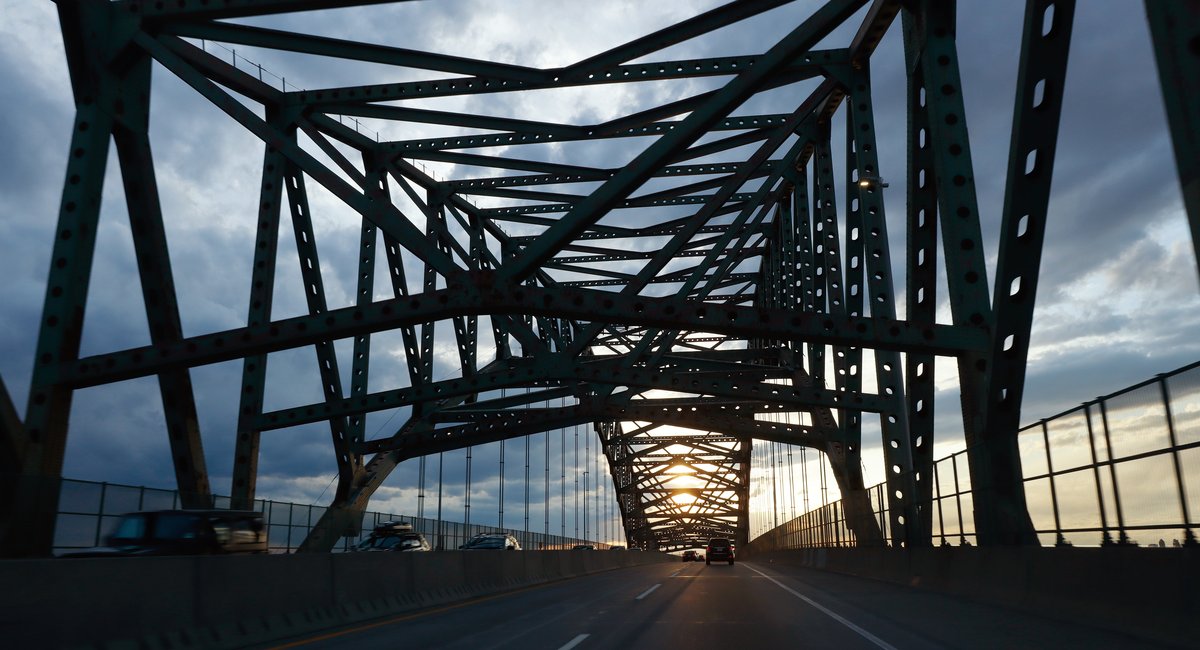
New Jersey Gov. Mikie Sherrill is winning praise from Newark and Jersey City leaders and residents after killing an unpopular plan proposed by her predecessor to widen the highway infrastructure leading to the Holland Tunnel.
Sherrill on Tuesday recommended the New Jersey Turnpike Authority’s board move forward with a $6.7 billion project to replace the Newark Bay Bridge, which carries the Turnpike’s Hudson County extension from Newark to Bayonne.
But the recommendation came with a critical caveat: Sherrill wants a single new bridge to be built to the same capacity as the current one, rather than building two new bridges to increase the number of lanes. She also wants to dump a plan to widen the extension.
“This $6.7 billion investment will be the largest single project the New Jersey Turnpike Authority has ever advanced,” Sherrill said.
The governor’s announcement came the night before the Turnpike Authority board meeting on Wednesday morning, where the board approved the first two construction contracts for the new bridge.
The existing Newark Bay Bridge, also known as the Casciano Memorial Bridge, carries about 95,000 cars and trucks daily. It opened in 1956, and the Turnpike Authority has warned that it is reaching the end of its usable life.
Last year, the bridge was one of 68 around the country that the National Transportation Safety Board recommended for a vulnerability assessment. The new bridge is expected to be done by 2031, and the project is expected to create 19,000 jobs.
Kris Kolluri, who serves as executive director of the Turnpike Authority and the president of NJ Transit, described the existing bridge as both structurally deficient and functionally obsolete.
“ What we are literally doing is advancing the first bridge because that’s what we have the money for,” Kolluri said. “It’s the right thing to do for safety reasons, right thing for financial reasons and the right thing for mobility reasons.”
Beyond the bridge replacement, Sherrill also recommended that the Turnpike Authority only make repairs to the Turnpike Extension in Hudson County as needed, stepping back from previous plans to widen the highway through New Jersey’s most densely populated county.
Sherrill’s decision scales back what originally had been a $10.7 billion plan put forward under previous Gov. Phil Murphy, which had included the proposed second bridge and additional lanes of traffic.
Murphy argued the expansion would alleviate traffic and would not create more pollution because, in the future, a “combination of electric vehicles, green buses, railcars” would limit emissions.
Critics, including current Jersey City Mayor James Solomon, argued that logic was nonsensical as the Holland Tunnel itself was not expanding. Many were also skeptical of the EV future Murphy imagined.
Solomon and Newark Mayor Ras Baraka said in a joint statement that Sherrill made the right choice for the future of both cities.
“For years, our communities fought against a seriously ill-conceived plan while proposing serious alternatives,” the mayors said. “It took Governor Sherrill’s leadership to listen and act in the best interest of the people of New Jersey.”
Baraka and Solomon sent a letter last month urging Sherrill to go with the one-bridge plan. A coalition of dozens of advocacy groups sent their own letter to the governor arguing for the same last week.
“ This is a sweet victory for the thousands of activists and the myriad of environmental, transit and community groups that have opposed the Turnpike expansion for the last six years,” said John Reichman, a steering committee member for the climate advocacy group EmpowerNJ.
The transportation sector is New Jersey’s largest source of greenhouse gases and air pollution. Advocates warned the original plan for two bridges and boosted traffic would have undercut the state’s climate goals and worsened public health in Newark, where one in four children has asthma, and Jersey City, where the areas alongside the Turnpike Extension have been called Asthma Alley.
“ When the highway was originally put in, it was put in the middle of the city. And so it passes by a number of schools,” said Jimmy Lee, a board member of Safe Streets JC. “It’s where it passes by residences where people live, parks where kids play. And we already suffer from all the effects of that tremendous amount of traffic, noise and air pollution.”
Zoe Baldwin, vice president of state programs for the Regional Plan Association, said Sherrill’s decision is a sign the administration is choosing to take the most pragmatic solution to address the critical problem: The existing bridge has to be replaced.
“ It’s in a way making sure that the money that we are spending is actually going to solve the necessary problem, which in this case is repairing the dilapidated bridge,” Baldwin said. “A bridge that is on life support, literally.”
