

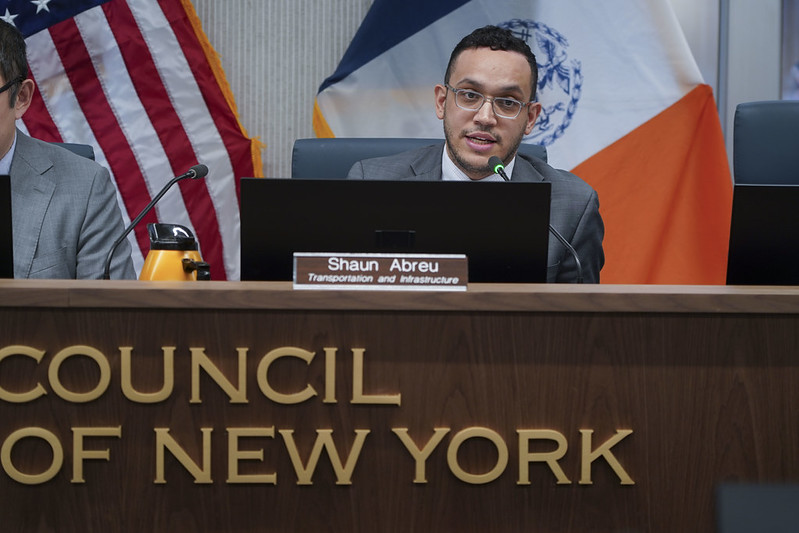
City Council Member Shaun Abreu, chair of the body’s Transportation Committee, leads a hearing on the city’s Streets Master Plan. Tuesday, March 3, 2026.
Photo Credit: Gerardo Romo / NYC Council Media Unit
Top officials with Mayor Zohran Mamdani’s Department of Transportation (DOT) on Tuesday blamed the agency’s years-long struggles to meet legally mandated targets for adding new protected bus and bike lane miles on the former Mayor Eric Adams’ administration, while pledging to “do better” going forward.
DOT Commissioner Mike Flynn faced sharp questions from members of the City Council’s Transportation Committee during a March 3 hearing probing why the agency has failed to create the number of protected bus and bike lanes required by the 2019 Streets Master Plan year after year. The plan, which mandates the city add 150 new miles of protected bus lanes and 250 new miles of protected bike lanes between 2022 and this year, was passed by the council in 2019.
Council Transportation Committee Chair Shaun Abreu (D-Manhattan), who led the proceeding, said DOT has “has lagged significantly with respect to bike and bus infrastructure.”
“The numbers for protected bus lanes…are almost too low to believe, and while DOT has made a fair effort to install protected bicycle lanes, they still fall short of what is required,” he added.
During the hearing, Flynn shared metrics from the DOT’s latest report on progress on its Streets Plan. He said the agency added 20.8 new bus lane miles and 18.2 new bike lane miles in 2025. That is up from the 13.5 bus lane miles it added in 2024, but down from the 29.3 bike lane miles it added that year.
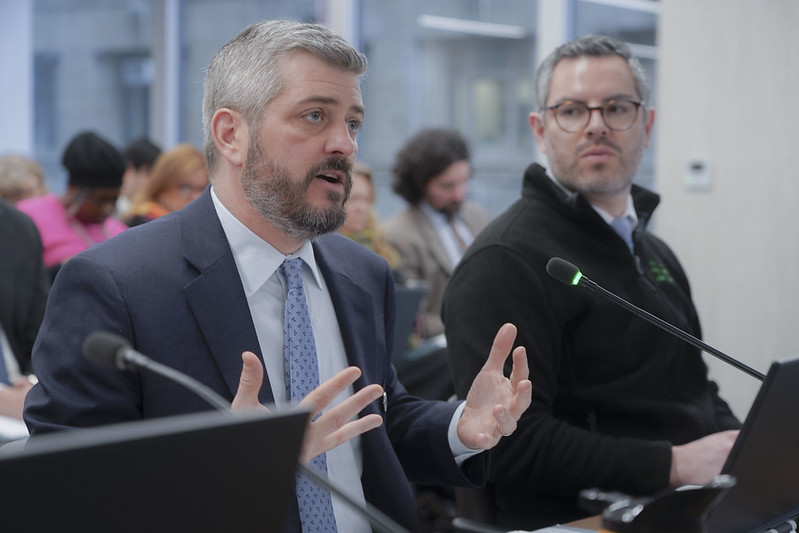
Flynn cited two reasons for the drop-off in bike lane creation when asked by Abreu to explain the drop-off.
“One is that, to be honest, the implementation of the Streets Plan and the capacity to do that was not, I think, fully prioritized by the previous administration,” Flynn said, referring to the Adams administration’s chronic underfunding of DOT.
“The other reason is that a certain number of projects were paused or delayed or canceled, either because of political considerations or lawsuits,” he added.
Those projects include adding protected bike lanes along Brooklyn’s McGuinness Boulevard and 31st Street in Astoria, Queens.
The former was allegedly derailed by Adams’ ex-top aide, Ingrid Lewis Martin, in exchange for bribes from a local production company, according to a federal indictment against her that came down last August. The latter was scuttled by a Queens County judge who sided with local businesses and residents, arguing the project was rushed and presented a danger to pedestrians and motorists.
When it comes to bus lanes, DOT Deputy Commissioner Eric Beaton said the agency created more last year than in 2024 because it worked with the MTA to add camera enforcement to more already existing bus lanes. However, it still fell nearly 10 miles short of the legal mandate.
Lisa Daglian, of the Permanent Citizens Advisory Committee to the MTA, said she was surprised to hear that camera enforcement counts toward adding protected bus lane mileage under the Streets Plan.
Flynn said he feels “confident” that DOT will “well outperform” the agency’s 2025 numbers this year. He also committed to drafting a new Streets Plan for the coming years, as required by law, that focuses on “outcomes,” such as improvements in bus speeds and drops in traffic deaths, rather than just adding miles.
The DOT boss said the big difference will come from Mayor Mamdani increasing the city’s investment in the agency’s ability to keep up with the plan’s staffing and equipment requirements. Mamdani, in his preliminary budget plan released last month, pledged an additional 5 million in recurring funding for the agency to staff up over the next few years.
“We’re very focused on increasing our capacity to deliver,” he said. “Government’s a big ship to turn right? And so, we’re basically building back from a few years where maybe the capacity wasn’t quite there, and we’re focused on building it going forward.”
But even with those additional resources, Flynn could not commit to meeting the legally mandated benchmarks for this year.
“We’re in the process of developing our 2026 implementation program. I don’t think that I could commit to a specific number today,” Flynn said.
Abreu said Flynn’s answer “brings me a lot of concern.”
“As the chair of this committee, but also as someone who is speaking on behalf of the council, we take the laws that we pass very seriously,” the council member said.
The DOT officials on the panel were also unable to provide specifics on how many additional staffers they will need to meet the plan’s targets. Abreu said he wants them to provide all of that information during a preliminary budget hearing scheduled for March 17.
