

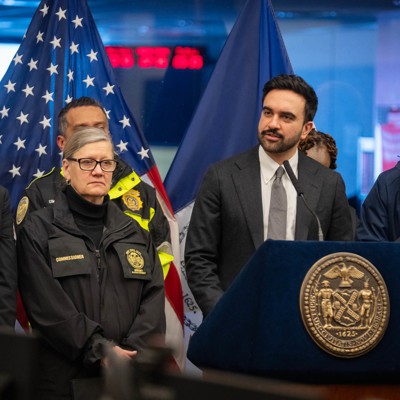
In her first week on the job as New York City Emergency Management commissioner, Christina Farrell spent a night at the agency’s headquarters in downtown Brooklyn when a historic blizzard hit on Sunday.
A 23-year veteran of the roughly 90-person agency, it was hardly her first time. “I wouldn’t say we stay over often, but certainly in my tenure, there was Hurricane Sandy, there was the 2003 blackout,” not to mention other blizzards and storms. (The HQ is fitted with city-issued cots, locker rooms and a small gym. One perk of being commissioner: Farrell now has a couch.)
Farrell, who previously served as first deputy commissioner, was appointed commissioner by Mayor Zohran Mamdani last week, taking over for Zach Iscol.
Farrell joined city government in 1994 in the Mayor’s Office of the Criminal Justice coordinator and joined NYCEM in 2003, when it was remade into a full-fledged department. Her work in two decades at the agency includes launching the agency’s external affairs arm.
City & State caught up with Farrell this week to talk about her promotion, and the blizzard that came just a few days later.
This conversation has been edited for length and clarity.
You’ve been at NYCEM for 23 years. Did you always have your eye on the top job? Was this the dream when you got into city government?
No, when I came into city government, I thought I was going to work for the city for two years and move to San Francisco.
Why San Francisco?
I was in my mid-twenties, I had other thoughts back then. I’ve worked for the city for 31 years, 23 here at NYCEM.
What changed that made you stick around?
I just loved living in the city. I loved working for the city. Just the immediacy of it, the ability to help people and really see the impact of your work directly. … It was a really good fit to come here right when Emergency Management was becoming its own agency. I was the first director of grants, and it was about a year and a half after 9/11 so there was a lot to do in the emergency management, homeland security space. But no, I did not have my eye on the commissioner’s office when I started all this.
One of the unique things about this blizzard that hit on Sunday is that it came just a month after another big snow storm. Were there lessons that you and NYCEM took away from that first January storm, and particularly the extended frigid temperatures that followed it, that you could then apply to this most recent storm? What if anything did you do differently this time around?
Every time we have kind of a major activation like this, we do run a process. Sometimes it’s an internal process with Emergency Management. This one, because like you referenced that was a big storm and then there was that frigid cold for three weeks, we actually a week ago today held a “hot wash” which is what we call it when we bring everybody in and talk about lessons learned with the first deputy mayor, deputy mayor for operations, and a lot of other agency heads. … I think we were hoping that those lessons would then be applied next fall, next winter. It turned out they were applied three or four days later.
Was there one takeaway in particular that you were able to bring into this storm?
I think the mayor and others have talked a lot about it: certainly the (emergency shovelers), increasing them. … They went out in the middle of the blizzard, which is pretty incredible. To my knowledge, that hadn’t happened before, but that really helped to get a jump on the snow removal at places. (Also) the Department of Sanitation bringing in a lot of equipment, bringing it in earlier.
The name of the agency might lead people to think that NYCEM is standing up only in emergencies, but obviously you’re operating year-round in between emergencies. What is NYCEM doing day-to-day?
We in the biz, we call it “blue sky days” and “gray sky days.” Gray sky is when we’re activated with the storm and everything. Most days are hopefully blue sky days. Our mission is preparedness, education, response, mitigation and recovery. So a lot of what we’re doing is building the city’s emergency plans. … We’re already looking at an extreme cold weather annex to add to our winter weather plan. … But then once you have the plan, you need to train people on the plan. You need to exercise the plan. … There are emergencies in New York City every day, just not, you know, to the extent of this blizzard. But there are large scale fires, unfortunately, that our response team will go out to. We will help if people are going to temporary housing and they can’t keep their pets. Or kids are going to be in a hotel for a bit, but they still want to go to their school, we’ll figure out the transportation. All those secondary impacts.
I saw that there’s some new funding for the agency in the preliminary budget for the FIFA World Cup. What kind of role will you have there?
We’ve been doing a lot of planning around FIFA. Hopefully it’s all sunny skies and 75 degree weather during FIFA. But you know, based on reality, I’m expecting we might have some extreme heat during that time since it’s June and July. We could have some flash flooding. We could have some power outages, things like that. … There are going to be a lot of visitors in the city, potentially a lot of people who don’t speak English or aren’t familiar with New York the way residents or frequent visitors are. So we are doing a lot of work with Notify NYC and with the FIFA host committee and others on messaging, and making sure Notify NYC is available in 14 languages, including American Sign Language.
Do you have a favorite disaster movie?
It’s not exactly a movie. I love Survivor. … It’s Season 50, which is going to be a big deal. I watch it with my husband every week. A lot of times we tape it and don’t see it til like Saturday. … That’s my show where I can troubleshoot everything and say what I would have done in that situation.
