

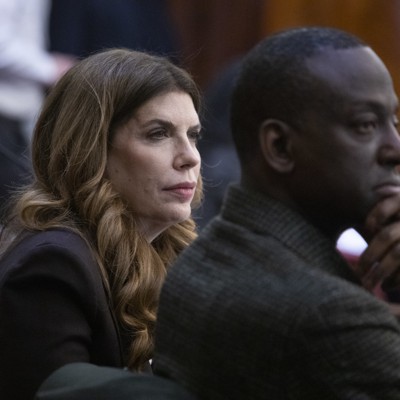
New York City Council Speaker Julie Menin urged lawmakers and religious leaders to back her security proposal regarding protests around houses of worship and schools on Wednesday – after amending her original bill to remove references to a “security perimeter” up to 100 feet from entrances.
The speaker’s headline-grabbing proposal, first announced in January, went beyond Gov. Kathy Hochul’s suggestion of a 25-foot buffer zone. It also went beyond Mayor Zohran Mamdani’s Jan. 1 executive order directing his administration to consider establishing protest zones between 15 and 60 feet from houses of worship.
After feedback from the NYPD, the latest version of Menin’s bill includes no barrier mandate at all, instead calling for the police commissioner to propose and implement a protest response plan within four months. Menin, who is the first Jewish City Council speaker, continues to frame it as essential, holding a Wednesday morning rally around the anti-hate crime legislative package ahead of a legislative hearing. However, the amendments have left the measure looking less like a sweeping directive and more like a request for further analysis.
Council Member Sandy Nurse voiced as much in the hearing. “My concern here is we’re putting forth a symbolic bill that doesn’t really address the real concerns and fears that are being expressed,” she said. “I really want to see this committee and this council spend more time deliberating and exploring data-backed solutions to preventing attacks in our communities.”
Asked about it on Wednesday, Mamdani said the latest version is a “distinct shift from the original, which proposed a specific policy that I know our police department, as well as a number of legal scholars, had expressed concerns about.” At the hearing, NYPD Deputy Commissioner of Legal Matters, Michael Gerber, said the police workshopped the proposal with Menin to eliminate operational and legal concerns, in case they determine barriers should be larger than 100 feet proposed by Menin.
The legislation was proposed after demonstrations in front of synagogues, with some chanting in support of Hamas. One controversial protest occurred in November outside Manhattan’s Park East Synagogue, where an information session about Jewish immigration to Israel, including the occupied West Bank, was taking place. Another protest in January in Kew Gardens Hills, Queens, was against an event on Israeli real estate sales, also including land in the occupied West Bank. However, Menin emphasized that the bill is meant to protect all religious groups, not just Jewish ones. She noted that while anti-Jewish sentiment made up the highest proportion of hate crime complaints, “we’ve heard from so many community groups all across the city that as many as 90% of bias incidents and hate crimes in the Muslim community go unreported.”
Some politicians, both Christian and Jewish, voiced the need for the proposed bills due to the rise of religious hate crimes. “We’ve seen the increase in antisemitism, which traditionally has been mostly from the far-right to increase to the far-right and the far-left,” said Assembly Member Jeffrey Dinowitz. He said he started experiencing antisemitism for the first time after Oct. 7, 2023, when anti-Jewish crimes began to rise in the city.
The larger legislative package includes bills requiring the Department of Education to provide students with information on the risks of online hate, a requirement for the NYPD to report on the status of hate crime cases for transparency, and emergency planning for religious institutions. It’s also part of Menin’s five-point plan to combat antisemitism. Whether it produces results is another matter.
