

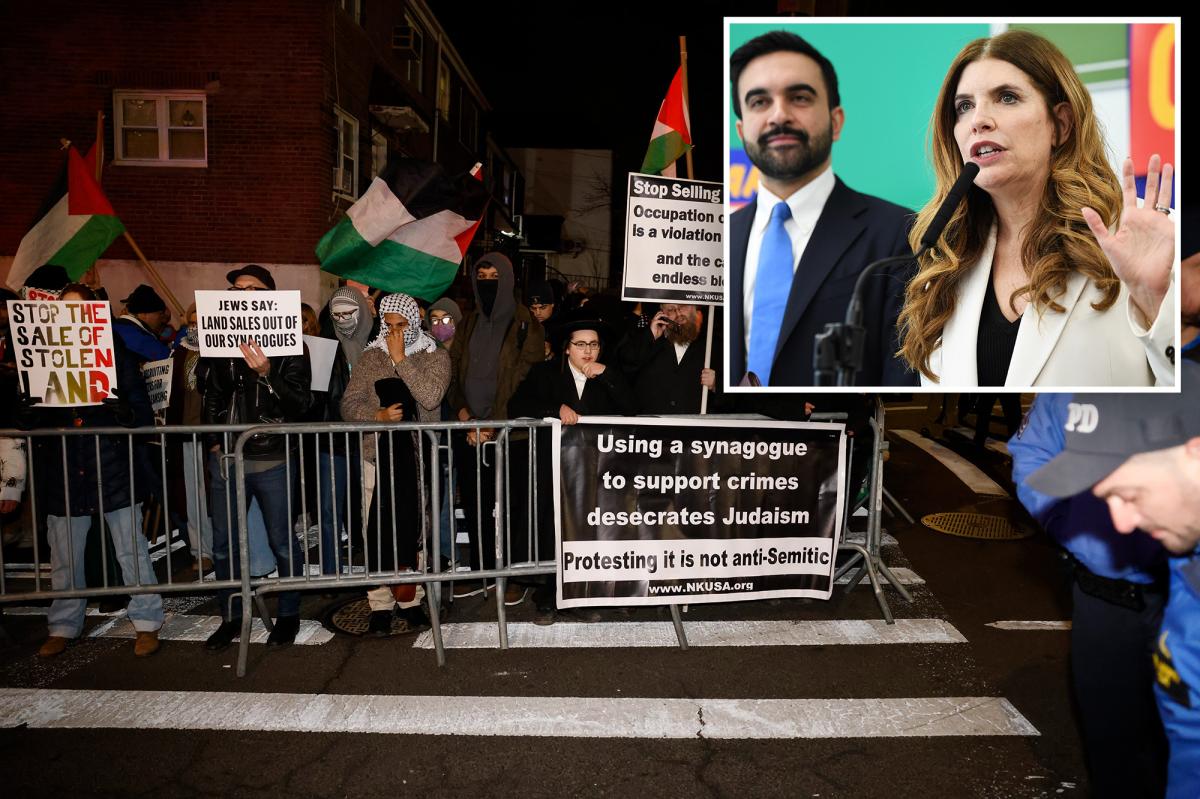
City Council Speaker Julie Menin rallied alongside faith leaders and fellow lawmakers Wednesday in support of a slate of new bills to combat antisemitism, including one to beef up protections for houses of worship during protests.
“These bills are grounded in a simple but urgent principle: every New Yorker should feel safe entering their house of worship or their school,” said Menin ahead of a hearing held by the council’s Committee to Combat Hate.
Menin, who at the start of her tenure in January unveiled a five-point plan to combat antisemitism, had originally proposed a bill that would have required the NYPD to establish a secure perimeter of up to 100 feet in the event of protests outside of religious buildings.
But after discussions with NYPD Commissioner Jessica Tisch and concerns over potential violations of Constitutional free speech rights, the bill was amended to provide a more flexible framework for the police department and on-the-ground discretion by officers.
“The NYPD needs to be able to make decisions based on the facts on the ground,” said Michael Gerber, deputy commissioner of legal matters for the NYPD, in testimony to the council committee.
Gerber stressed the need to protect First Amendment rights allowing protesters to be “seen and heard” as one of the stipulations driving the changes to the legislation.
“Anytime you have a fixed rule across the board that’s going to raise constitutional questions,” he said.
The current bill would require the NYPD to provide the speaker and the mayor with a detailed proposal within 45 days, and a final plan within 90 days, outlining how and when police buffer zones may be used in the event of protests outside of houses of worship.
“I think any suggestion that the bills aren’t needed is just minimizing what the impact has been to the Jewish community,” Menin said, hitting back at some progressive council members who appeared skeptical of the legislation.
Menin and other lawmakers recalled an anti-Israel protest outside of a Queens synagogue in January — in which demonstrators were heard chanting “we support Hamas” — and a hate-filled November rally outside of the Park East Synagogue in Manhattan as main catalysts for the legislation.
“In talking about what happened at Park East Synagogue, that was not a peaceful protest,” said Menin of the Israel-hating mob that harassed congregants on their way in and out of the historic building.
Mayor Zohran Mamdani, who was slammed for his slow reaction to condemn the protests outside of both synagogues, said he was looking forward to seeing the final version of the legislation.
“This is a distinct shift from the original legislation, which proposed a specific policy that I know our police department, as well as several legal scholars, had expressed concerns about,” he said Wednesday during an unrelated news conference.
Council Member Eric Dinowitz (D-Bronx) is sponsoring a similar bill for schools facing potential protests.
State Assemblyman Sam Berger, a Democrat who represents the 27th District home to the Kew Gardens Hills synagogue, shared the fear his constituents felt while waiting for hateful chants to die down outside of their neighborhood.
“They were 300 feet away, and we were able to hear them and hear their calls of hate,” Berger testified to the council via Zoom.
“I had a call from a mother living in one of the houses nearby, huddled with her children. The daughter of a Holocaust survivor who heard them, loud and clear,” he recalled.
“We have to be doing more, and I urge the passage of the package swiftly.”
Mark Trager, CEO of the Jewish Community Relations Council, praised the legislation, emphasizing the importance of codifying such protections into law.
“There’s a significant difference between guidance and an actual law. Now it’s going to be a right rather than just a suggestion,” he said.
