

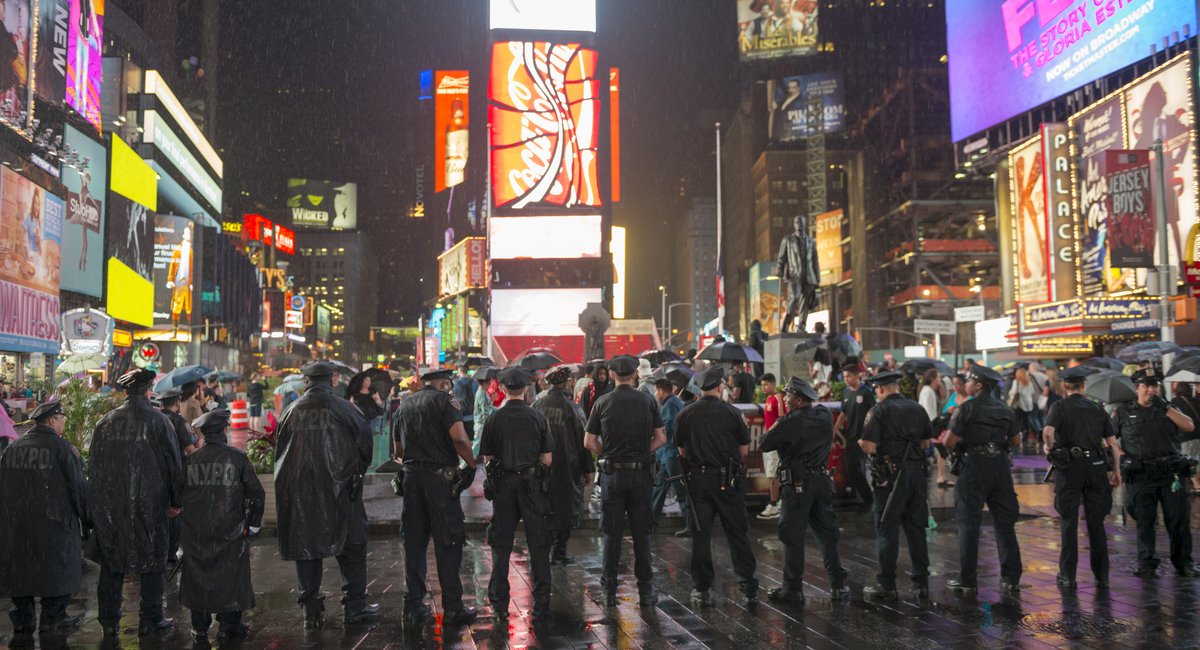
A City Council bill that supporters said would help tame raucous protests outside of houses of worship and educational facilities got a key endorsement Wednesday from the NYPD, which had earlier expressed apprehension about the legislation.
To get there, a critical provision that would have allowed for the establishment of 100-foot security barriers or buffer zones outside of houses of worship, schools and colleges was removed from the legislation. Michael Gerber, the NYPD’s deputy commissioner of legal matters, told a City Council hearing that the change resolved the department’s concerns about the proposed protest measures.
Supporters of the revised protest bills, part of City Council Speaker Julie Menin’s legislative package designed to combat antisemitism, told a public hearing on Wednesday the bills would nonetheless help ensure safe access for worshipers to houses of worship during rowdy demonstrations.
The revised legislation merely calls for the NYPD to establish a plan for dealing with such protests. But police officials said it would change nothing on the ground, in terms of how the department oversees demonstrations. And progressive opponents argued that in the absence of any substantive measures the legislation is a hollow gesture that does little to address actual hate against religious communities.
“My concern here is we’re putting forth a symbolic bill that doesn’t really address the real concerns and fears that are being expressed today, and that are held by a broad spectrum of New Yorkers,” Councilmember Sandy Nurse said.
Under pressure from the Trump administration, many colleges and universities, which were hotbeds for protest over the Israel-Hamas war, conducted self-examinations aimed at addressing antisemitism and improving the religious climate on their campuses. The protest bills represent the City Council’s further entry into how New Yorkers are heard.
A number of elected officials voiced support for the legislation, despite the absence of any buffer provisions, including Jewish councilmembers and state legislators who said they were alarmed by the rise in antisemitism. Anti-Jewish bias made up the highest proportion of hate crime complaints in 2024 (53%), according to the Office for the Prevention of Hate Crimes, more than all other groups combined.
“ When I go into my synagogue, I am struck by the extent of the security measures that exist today that did not exist when I was a kid,” said Assemblymember Micah Lasher, who represents Upper Manhattan. “Because that is what we must do in this time to make sure that people entering a synagogue are safe.”
At a rally in support of the bills before the hearing, Menin said the legislation would strengthen police transparency and ensure “safe access while fully safeguarding First Amendment rights.”
“We must protect freedom of religion and freedom of education while upholding the sacrosanct First Amendment rights that define our city,” Menin said.
Mayor Zohran Mamdani did not weigh in on the bill during a press conference on Wednesday. But he said the removal of the 100-foot barrier provision represented “a distinct shift from the original legislation, which proposed a specific policy that I know our police department, as well as a number of legal scholars, had expressed concerns about.”
Gerber, the NYPD official, told the Council that in the absence of any buffer zones, the bills “would not change what we do day-to-day,” and would merely require the NYPD to develop a plan related to demonstrations.
“It would require us to articulate and put in words and on paper our approaches in these situations,” he said, referring to protests.
At times, supporters of a buffer zone took issue with the NYPD official’s insistence that any such zone, if applied broadly, would be unconstitutional.
“Why can’t you have something 200 feet from houses of worship?” Councilmember Darlene Mealy of Brooklyn asked Gerber.
“Any situation in which the [NYPD] were to say in advance, ‘Oh, we’re going to have some bright line rule for the number of feet’ is going to run into legal issues,” Gerber said. “It is. Because it has to be case specific, context specific to avoid legal problems.”
The Supreme Court, in a long line of cases, has allowed time, place and manner restrictions on protests if they are content-neutral, narrowly tailored to serve a significant government interest, and leave open ample alternative channels for communication.
In a 2014 case, the court rejected a fixed, 35-foot buffer zone around abortion clinics, ruling they were unconstitutional because the restriction was not narrowly tailored. However, in a 2000 case, the court upheld a more limited “floating” buffer zone of just 8 feet. The court’s decisions make plain that the totality of the circumstances matter in a constitutional review, including whether the restriction is content-neutral.
Progressive groups argued that the debate over public safety was designed to stifle free speech.
“At best, the bills change little about existing NYPD protocol,” said Sophie Ellman-Golan, the director of strategic communications at Jews For Racial & Economic Justice.
“At worst, they contribute to a climate of government repression of protest, and further embolden the NYPD to racially profile and target protests towards which the agency is historically antagonistic,” Ellman-Golan said. “Either way, the legislation fails to accomplish the speaker’s stated goal of combating antisemitism.”
