

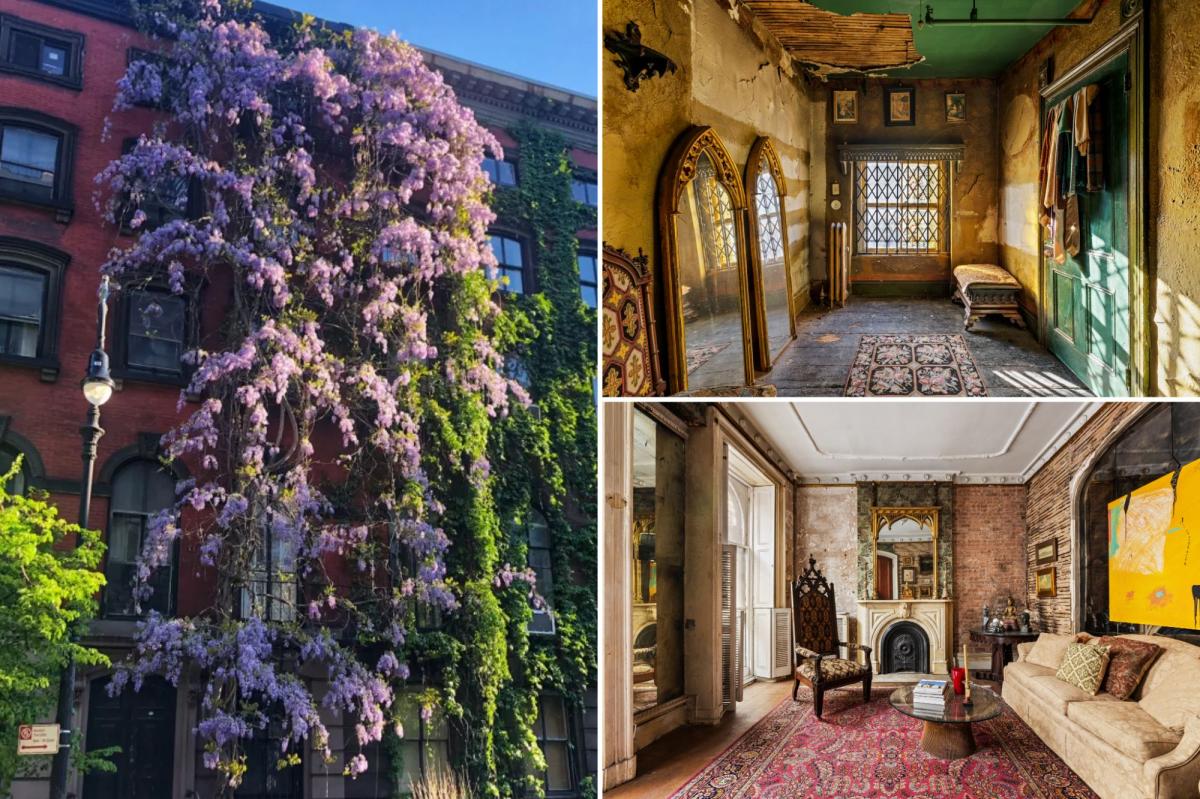
On a crooked sliver of pavement that slices across Manhattan’s rigid grid, one townhouse signals the change of seasons before the calendar does.
When the cascading wisteria unfurls across the brick façade at 35 Stuyvesant St. in a brilliant display of draping purple blooms, neighbors know that spring has arrived. Now, the storied East Village residence, long a neighborhood touchstone, is on the market for $3.89 million.
The four-bedroom, roughly 3,584-square-foot house sits within the enclave often dubbed the Renwick Triangle, a cluster of mid-19th century homes shaped by the odd meeting of Stuyvesant Street and East 10th Street.
The block traces its lineage to Peter Stuyvesant’s farm, and the street itself — running at a rare diagonal — is the only one in Manhattan that travels true east to west.
Andrew Berman, executive director of Village Preservation, calls the property irreplaceable.
“35 Stuyvesant Street is a truly special house with roots that go back to Peter Stuyvesant and his direct descendants,” Berman told The Post. “The house was built on what had been the garden of Elizabeth Stuyvesant, and its odd triangular shape stems from the intersection of the acutely-angled Stuyvesant Street — a pre-Manhattan Grid thoroughfare that was originally the road separating two of Peter Stuyvesant’s farms — and East 10th Street,” he added.
“The wisteria which has covered the house for decades is as much a landmark of the neighborhood as this house and its companions, which collectively form what is often referred to as ‘Renwick Triangle,’” Berman added.
James Renwick, whose commissions include Manhattan’s St. Patrick’s Cathedral and Washington’s original Smithsonian building, completed the townhouse in 1861.
Its proportions remain striking: 32 feet wide, with four south-facing window bays stretching across a rusticated stone base and red-brick upper stories. Inside, five fireplaces with marble mantels anchor rooms layered with tin ceilings, exposed brick and carved woodwork. An English basement and cellar sit below, and above, an unfinished roof offers the potential for a private terrace overlooking the historic district.
The current listing leans into possibility, inviting buyers to “Bring your architect to a 32-foot-wide townhouse on the best block in the East Village.” The language nods to the building’s need for sensitive restoration rather than wholesale reinvention.
Nick Gavin of Compass, who is marketing the property, said demand is already building.
“We already have substantial interest in the house,” he said. He believes its appeal lies less in polish than in provenance.
“There is a deep set of buyers especially those in the creative world (art, design, music, literature) who are searching for a home with real character and patina. 35 Stuyvesant represents an incredible opportunity to gently restore this East Village townhouse landmark while honoring its incredible history,” Gavin said.
That history took on an especially colorful chapter in 1958, when arts educator and collector Lee B. Anderson acquired the home. At a time when Gothic Revival furnishings were largely dismissed as fussy relics, Anderson was amassing what would become one of the country’s most notable private collections.
Art historian Stephen Calloway later described him as someone who “had a great eye, even better judgment, and an amount of daring, buying works just before they became fashionable.”
The townhouse became a cabinet of curiosities, crammed with Civil War-era paintings, ecclesiastical-inspired furniture and idiosyncratic decorative objects.
Anderson’s salon drew curators, writers and designers in steady rotation. Artist Hunt Slonem recalled the scene succinctly: “Everybody and their dog came there.”
He ticked off regulars that included Andy Warhol, Halston, Cher, Lee Radziwill and Sylvia Miles.
At some point during Anderson’s tenure, the wisteria vine began its ascent up the façade. Whether he planted it or merely nurtured it, he tended the flowering climber for decades, earning a Village Preservation Award in 2003 for beautifying the neighborhood. The vine grew as synonymous with the block as the house itself.
After Anderson’s death in 2010, the Lee B. Anderson Memorial Foundation carried forward his mission to promote decorative arts. Glenn Zecco, who had shared the home and served as caretaker, remained there until 2023.
