
In a game of chicken, two opponents hurtle towards a mutually disastrous outcome. The loser swerves at the last minute to avoid calamity, while the victor wins because they hold their nerve.
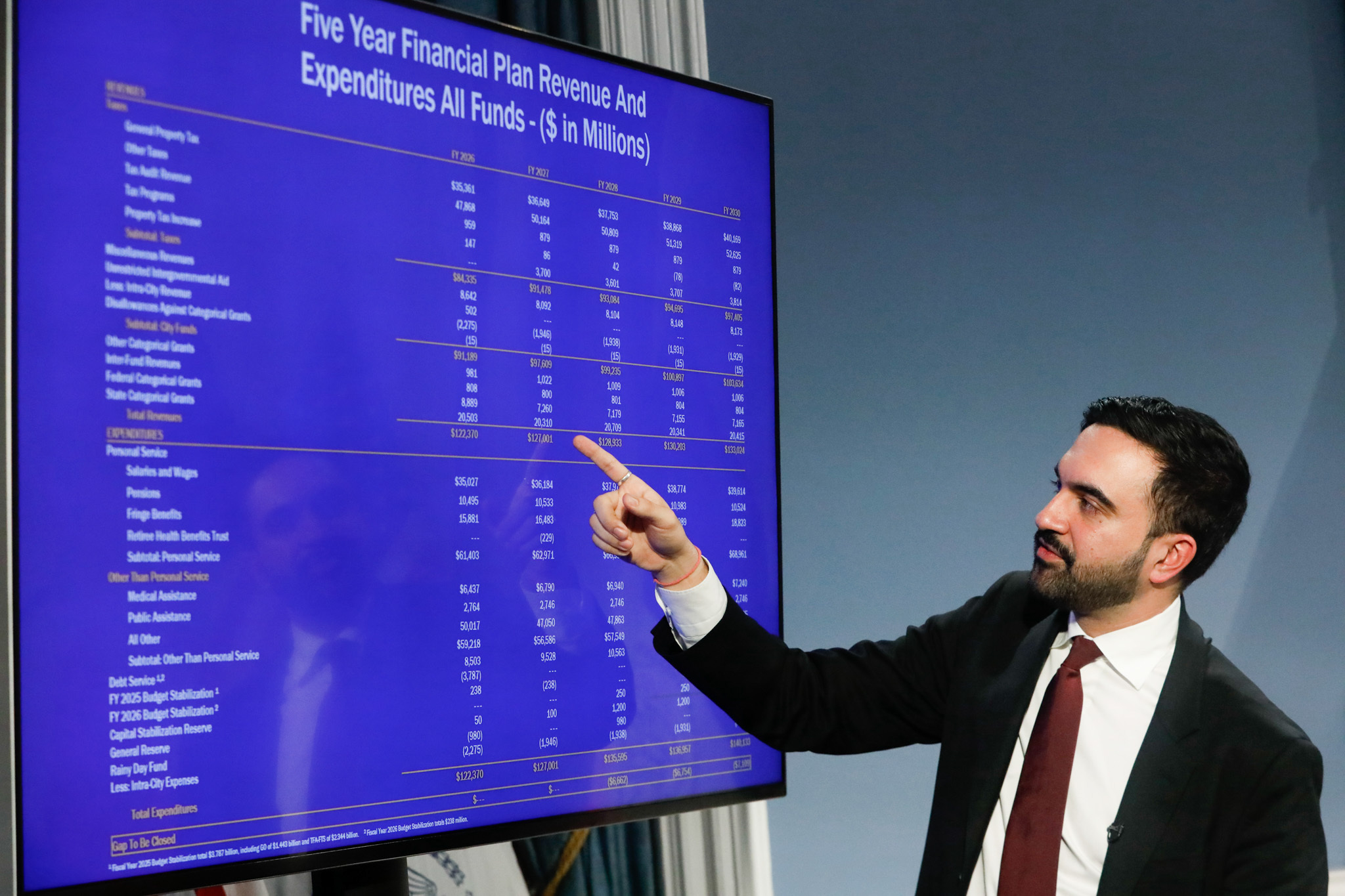
That’s the scenario Mayor Zohran Mamdani created for himself and Gov. Kathy Hochul last week when he threatened to raise property taxes by 9.5% to close a $5.4 billion city budget gap unless the governor agrees to raise taxes on wealthy individuals and corporations.
Hochul didn’t blink, remaining steadfast in her refusal. And so Mamdani’s chances of forcing the governor to change course depend on the perception that he would, if forced, actually raise property taxes — and that he even could.
Now, as the mayor’s supporters fan out to press his case, they are being met with widespread skepticism on both fronts.
Andrea Scarborough, a homeowner in Addisleigh Park in southeastern Queens, told THE CITY that she flipped out when she heard about Mamdani’s gambit.
“Because you’re not able to raise taxes on the 1%, you’re looking to burden your constituents? I see it as a game of chicken, where you’re poking the governor,” she said. “I can’t imagine that this man would really want to do this, but if he does, he would be a one-term mayor.”
Mamdani’s property tax proposal also garnered swift backlash from lawmakers and officials, who pointed out that higher property taxes would disproportionately squeeze lower- and middle-class homeowners in majority neighborhoods of color, as well as renters.
The mayor would need the City Council to approve any property tax hikes, but Speaker Julie Menin said in a statement last week that increases “should not be on the table whatsoever.” While Mamdani’s allies in the Council haven’t said much publicly about the property tax proposal, it’s unlikely he would find enough political support for a property tax hike if it came down to it.
Nonetheless, Mamdani’s supporters rallied Wednesday at the State Capitol in Albany to put pressure on Hochul, including Councilmember Chi Ossé (D-Brooklyn); he and 21 other members signed a joint statement Wednesday pushing for the state to give the city authority to enact higher taxes on the rich. Mamdani didn’t attend, but organizers of the rally have been pushing the same idea as the mayor — that he doesn’t really want to raise property taxes, but if he must, then the governor is to blame.
“It’s not something that Zohran wants to do. They would be Hochul’s homeowner taxes, if they do end up happening,” said Batul Hassan, a Democratic Socialists of America steering committee member and board member of Our Time for an Affordable New York City, a lobbying group which champions Mamdani’s agenda.
“It’s now Kathy Hochul’s choice. She can either raise taxes on the richest New Yorkers, which is an extremely popular measure,” Hassan continued, “or she can enact austerity on the city and the state.”
But political consultant Evan Roth Smith said people aren’t buying Mamdani’s framing and called the messaging “muddled.”
“Do they want to do this or not?” he said. “They’re talking themselves into a doom loop. You can’t set up your own failure logic like that.”
“Voters don’t want or expect Mamdani to play games. Zohran tells you what he wants to do, not what he doesn’t want to do,” he added. “That’s why it’s been so unsuccessful for him to try and convince New Yorkers that he would be forced.”
Dora Pekec, a spokesperson for Mamdani, said, “The mayor has been crystal clear he believes we need to raise taxes on the wealthiest New Yorkers and the most profitable organizations.”
Pawns and Bargaining Chips
Mamdani met last week with Black state senators and assemblymembers at City Hall to discuss property taxes — and apologized for proposing it before reaching out, according to people familiar with the meeting.
Homeowners in predominantly Black neighborhoods pay property tax rates that can be double what homeowners in primarily white neighborhoods pay. The disparity — and many stalled attempts to reform it — was a highlight of Mamdani’s inauguration speech.
Property taxes affect New Yorkers well beyond homeowners. Rents can include the cost of property taxes. Utility companies bake property taxes into the customer bills. Consumer goods may also increase as taxes do. So, jacking up property taxes would run counter to Mamdani’s affordability agenda.
“The whole thing about raising property taxes when you ran on affordability seems to be confusing,” said Lupe Todd-Medina, a political consultant. “It’s unfair to put the blame on the governor.”
Democratic state Sen. James Sanders, who represents parts of southeast Queens and the Rockaway peninsula, later posted on X that raising property taxes was “not an option.”
“NY already has high costs, I won’t support balancing budgets on the backs of hardworking families and homeowners,” he posted. “We urge the Mayor to explore other solutions.”
Edmundo McKenzie, a homeowner in Canarsie, Brooklyn, said he was confused to hear the mayor proposed a property tax increase.
“The city to me is spending so much money and they can find this money in other areas, other than taxing the homeowners,” he said, adding he was worried about further taxing the wealthy for fear they’d leave.
Queens Borough President Donovan Richards told Mamdani during his preliminary budget briefing last week that raising property taxes was a “nonstarter” for him.
“I was shocked,” he said. “I thought whoever came up with this strategy, I felt it was misguided.”
Struggling homeowners and renters were being used “as a bargaining chip,” he said, adding that he’d been approached by people begging him to make sure the property tax hikes didn’t happen.
“Once you put that message out there, what do you want me to tell my constituents? They’re looking to me now,” Richards said. “I just think it’s a misguided strategy to put — especially Black and brown communities who are already living in the margins — to put us in the middle of this isn’t fair.”
Brooklyn Borough President Antonio Renyoso said the mayor had to be “careful about pushing for an outcome from Albany that makes homeowners feel like they’re pawns in a budget proposal.”
“I just believe first and foremost we should be taxing the rich,” he said. “The alternative is not taxing the middle class.”
The state Black, Puerto Rican, Hispanic and Asian Legislative Caucus supported increasing taxes on the wealthy. And the idea is popular, according to some polls.
Still, Hochul said she disagreed with increasing taxes and would be “unwavering” on refusing to raise taxes on the wealthy — though she pledged to work with the mayor on the budget. Last week, she touted the $1.5 billion in state aid she provided to the city to help plug a gap.
Andrew Rein, president of the Citizens Budget Commission, called Mamdani’s framing a “false choice” and advocated that the city rein in spending by targeting inefficiencies. He has warned against raising income taxes and said hiking property taxes would make the city even less affordable, counter to Mamdani’s agenda. CBC estimated the property tax proposal Mamdani floated would amount to about $700 per year for an owner of a small home.
But Emily Eisner, chief economist at the Fiscal Policy Institute, said Mamdani’s proposal to raise property taxes shows he’s trying to figure out how to achieve the promises he campaigned on.
“I think his first choice, and most people’s first choice, is progressive income tax and corporate tax measures that would require approval in Albany, but wouldn’t come with the same political outrage as a property tax increase,” she said. “But I am glad to see him taking seriously alternatives for how to raise revenue and keep his spending commitments.”
In the meantime, as the budget comes closer to being hammered out, Our Time and DSA are coordinating thrice-weekly canvassing shifts where volunteers — many decked out with Zohran for New York City merch — talk to local residents about Mamdani’s tax plan.
“You can’t balance the budget on the backs of working class people. Those are the people who are going to be hurt the most by any of the different alternatives that are being posed here,” said Divya Sundaram, deputy director of Our Time.
“The only way to actually fund all the things we need to keep New York more affordable, to allow working people to stay in New York, is to tax the rich.”
