

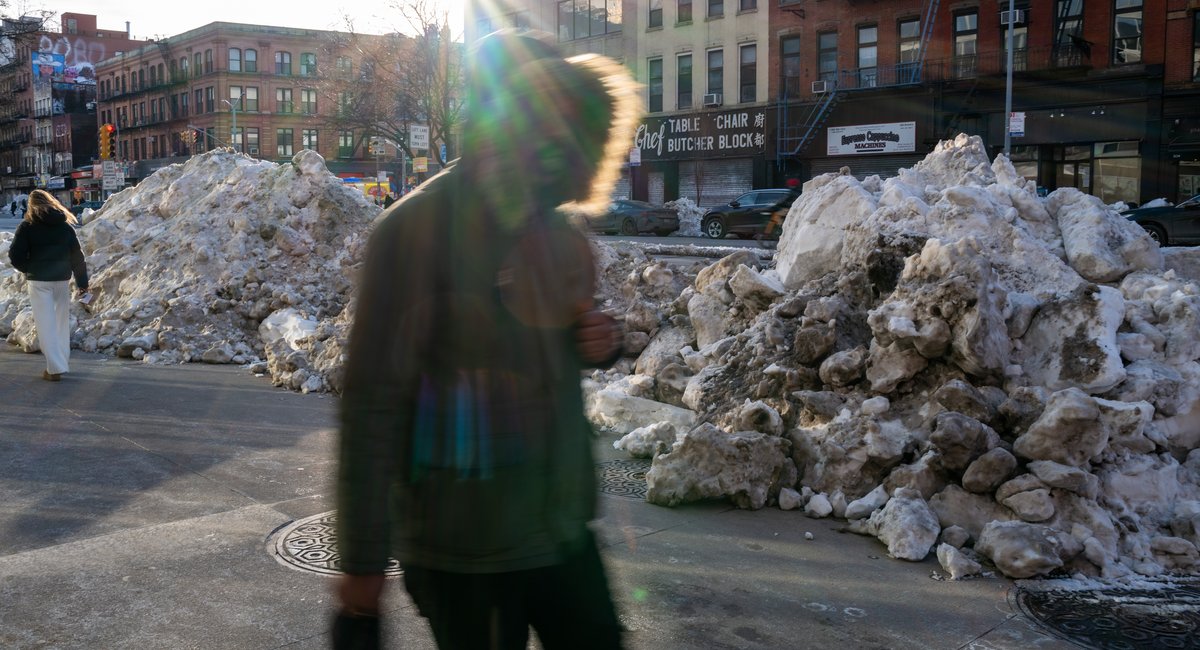
After days of competing forecasts and press conferences about what was coming, the late January storm blew in on a Sunday morning, not quite a blizzard but more than enough snow and wind to turn everything white.
New Yorkers took to hills with their sleds and hid out in open bars with friends. Snowboarding legend Shaun White pulled stunts in Central Park.
In the midst of it all, Mayor Zohran Mamdani spoke to the press to praise sanitation and emergency workers — and to invite students, who were disappointed he hadn’t called a snow day for Monday, to throw a snowball at him if they saw him around.
And then he struck a somber note.
“For those without shelter, the intense cold can be fatal,” he said. “Yesterday alone, before the snow had even begun to come down, at least five New Yorkers passed away and were found outside.”
It was the first indication that the storm and the intense freeze that followed it would exact a grim price in the coming days and weeks. The death toll would climb as the city issued update after update, eventually making the storm one of the deadliest weather-related disasters in recent memory.
Now with the worst of the cold behind them, lawmakers and city officials are grappling with questions around whether New York, under a new administration, did enough for its most vulnerable residents, and how to help those on the fringes when extreme weather threatens everyone’s safety.
But for a moment that day, New Yorkers continued to play in the still-white snow, until the sleet and the setting sun drew them indoors.
**
Thousands of sanitation workers plowed and salted roads on Sunday night. Nearly a foot of snow had fallen by the time students woke up and tried to log into remote learning portals the following morning, but the city had been made more manageable.
This was no storm of 2010, when a blizzard dumped more than double that, shutting down the city as then-Mayor Michael Bloomberg’s plane was spotted in Bermuda.
Many city residents spent Monday indoors as conversations shifted from the storm to the cold. The city was experiencing its third straight day of subzero temperatures and the pattern wasn’t likely to lift for days to come. New Yorkers would have to go back three decades to find a colder winter.
A man using a shovel to dig his car out.
Deb Cohn-Orbach/UCG/Universal Images Group via Getty Images
This was the third day the city had been in what it calls an “Enhanced Cold Blue,” an emergency state in which shelter admission restrictions are lifted and outreach teams work around the clock to transport people to shelters and warming centers open across the city. Outreach workers had already made 170 placements from New York’s streets into shelters and other centers, according to city officials.
“Just because the storm has passed does not mean that the danger to homeless New Yorkers has passed,” the mayor told the press during an afternoon briefing.
By the following day, however, the danger was even clearer. The city announced that at least 10 New Yorkers had died out in the cold — and the deep freeze that gripped the city showed no signs of lifting.
**
From her office on 121st Street in East Harlem, Aly Coleman was busy managing the outreach team for the Center for Urban Community Services.
The Center is one of several contractors that handles homeless outreach for the city. It covers all of Upper Manhattan — everything north of 110th Street on the West Side and north of 96th on the East Side.
An Enhanced Code Blue, like the one Mamdani had declared, meant it was “really an all-hands-on-deck situation,” Coleman said.
The city works with about 400 outreach workers in total. It may sound like a lot, but the number begins to seem small when broken down across five boroughs and countless neighborhoods. For the Center’s coverage area, that usually means a two-member team out on the streets from 5:30 a.m. to 5 p.m., handling canvassing, transports, 311 responses and client meetings.
They’re managing a list of known clients alongside a shorter list of people they have specific concerns about.
“Clients who use substances and may not feel the cold,” Coleman said. “Clients who have more severe mental health conditions or are taking psychiatric or other medications, they might not feel the cold.”
People walk across 7th Avenue in front of Times Square during the snowstorm.
Gary Hershorn/Getty Images
Of course, she said, during an emergency like this, “we are concerned about anybody who’s outside.”
Coleman isn’t one to stay behind her desk. As the temperatures dropped, she took to the streets alongside her staff.
“It can be really challenging to not approach our clients in a panic,” Coleman said. “This is so cold, this is so dangerous, we are so worried about you. No one is saying we don’t believe you’ve been strong and resilient in the past. But why? Why do we have to be today, right? Let’s try to get somewhere warm today.”
That week, Coleman had to make the sort of call she says is her least favorite part of the job. She ordered an involuntary transport to the hospital for one of the center’s clients. It wasn’t just the cold; the man also had wounds covering his legs.
In the end, a physician decided the man’s medical condition was not so dire that he should be held against his will and released him back into the cold.
**
Within a week of the snow storm, the death toll had risen to 16.
City officials didn’t release names or other identifying information at the time, and cautioned that while at least a dozen of those who died had interacted with homeless services in the past, not all of them were without homes.
One woman, Gothamist found, had wandered out of her apartment and into the snow while wearing her nightgown. A different man died in the cold, with his hospital discharge papers in his pocket. Another, reporters learned, lay down in a park and never got up.
It became increasingly difficult not to see the storm and its growing death toll as a crisis for the city’s new mayor, even as thousands of sanitation workers marshalled plows and mobile snow-melting trucks across the five boroughs.
The death toll even then eclipsed the 12 the Mamdani administration had noted died during a similar cold stretch a decade earlier. The figure also surpassed the average annual toll of exposure deaths among homeless New Yorkers over the past decade, according to city data.
Some critics, including his predecessor, argued that Mamdani’s decision not to clear homeless encampments was at least partly to blame. The city said there was no evidence that any of those who died were living in encampments.
And then there was the issue of involuntary removals — forcing people off the street and into care.
People walk down a Brooklyn street on a day when an ‘extreme cold warning’ is in effect on Feb. 07
Spencer Platt/Getty Images
Regular debates over whether homeless people should be involuntarily transported to hospitals were moot, said Brian Stettin, who was a senior adviser on severe mental illness to former Mayor Eric Adams. As far as Stettin was concerned, when it’s as cold outside as we saw, anybody who declined to come in met the criteria for removal to a hospital — that they’re mentally ill and acting in a way that could result in serious harm to themselves or others.
“There really is no legal question or controversy over whether people who are insisting on staying out in the cold need to come in,” he said.
Not everybody was as certain.
“It’s a very tricky issue,” said David Giffen, the executive director for Coalition for the Homeless. “You have to balance respecting somebody’s rights and their autonomy and their agency with the priority of keeping people alive.”
During yet another press conference, Mamdani said the city’s policies on the practice had not changed since the last administration — involuntary removal would still be used as a last resort and had been in “a number of moments” already.
Mamdani also announced the city would rush to open a new shelter and add more warming centers as well as another 150 outreach workers.
Yet even as the city’s response expanded, in some ways, it faltered.
The mayor had dispatched 20 new “warming buses” around the city. Two were parked outside the Staten Island Ferry Terminal. But when a Gothamist reporter visited one night, nobody there seemed to know they existed. There were no signs directing anyone to them.
You have to balance respecting somebody’s rights and their autonomy and their agency with the priority of keeping people alive.
Mamdani would later take responsibility for the communication breakdown on WNYC’s “The Brian Lehrer Show.” When Gothamist visited again on a different night toward the end of the cold snap, about 20 people were on board one of the buses, hunkered down and sleeping under blankets.
**
After nine days of deadly cold, temperatures across the city finally rose just above freezing, though the enhanced Code Blue remained in effect.
Coleman, the Center for Urban Community Services’ outreach manager, was walking with Katie Sylla, one of her morning outreach workers, down Third Avenue toward a busy area on 116th Street.
Sylla had been out on the streets earlier that morning, looking for anybody who had spent the night outside. It was a good sign when she found no one.
Now they were making the rounds again. They thought they might see the man who had been taken to a hospital against his will a week earlier.
“He’s obviously not happy with us, so we’re just working on trying to keep him safe and rebuild that relationship,” Coleman said.
The streets, though, were largely empty.
“That’s really due to the cold,” Sylla said.
Outside a McDonald’s, they found one client. He was wearing two coats — one of them had been given to him by an outreach worker some weeks earlier.
The outreach team has known the man, on and off, for more than five years. Lately he’s been talking about accepting shelter, but he wasn’t quite there yet. He promised them, though, that he had a place to stay the night.
“He wants to wait for what feels right for him,” Coleman said. “And we’ll continue to check on him.”
Across town, Andrew Chappotin had finally accepted housing that week, after years of living on the streets. City officials and the organization he works with, Urban Justice Center’s Safety Net Project, had managed to find him a single-room occupancy unit in Hell’s Kitchen.
People walk along a salt-covered sidewalk on Hudson Street past snowbanks.
Photo by Gary Hershorn/Getty Images
Still, the nights he had spent out in the cold had settled into his body.
“I’m in a lot of pain,” he said. “Still, to this day, my entire body just hurts. I’m sure I have some kind of damage to my nerves in my hands.”
He’d long resisted housing, he said, because it was always in faraway sections of Queens or Brooklyn. Chappotin said he was born and raised in Manhattan, which he called his “comfort zone.”
Now, after having finally come inside and having seen friends lose fingers, he said, he wished he had done it earlier and he would tell others the same.
“I would just tell them, please just come inside,” he said. “They are not missing anything.”
**
More than two weeks after the snow, temperatures began to rise enough for the dirt-colored ice lining the city’s streets and sidewalks to begin melting.
On Feb. 10, the City Council held an oversight hearing about the city’s response. By that morning, the death toll of those found in the cold outside stood at 18. It would later rise further yet again.
“These deaths are not inevitable,” Council Speaker Julie Menin said. “They are the result of gaps in outreach, shelter capacity, mental health services and follow-up. Every person who freezes to death in this city is a reminder that systems that are designed to protect human life are failing the people who need them most.”
Still, administration officials highlighted the work they had done.
Outreach workers made 1,400 placements to transitional housing, including to shelters, safe havens and stabilization beds, said Molly Wasow Park, the city’s social service commissioner. Of those, only 34 people had to be taken in against their will. (The NYPD removed 52 people as well, according to city officials.)
Wasow Park also spoke about new warming shelters, more than 300 new low-barrier beds and a new peer outreach program that was showing promise. She finished her testimony by saying she was “proud of the work that DHS has done over the last several weeks. The agency has been creative, persistent, and compassionate in very challenging circumstances.”
“That doesn’t mean that these deaths are not a tragedy,” she said.
Councilmember Crystal Hudson, who had called for the hearing, said she believed the city had done well taking care of the residents whom outreach workers know.
”I think what we learned is that those who died, at least the majority, seemed to have been on the fringes,” Hudson said. “A safety net isn’t safe until it’s catching everyone.”
A day after the hearing, city officials announced seven additional hypothermia-related deaths — this time at private residences.
Those deaths were in addition to the people found outdoors during the prolonged stretch of cold.
