

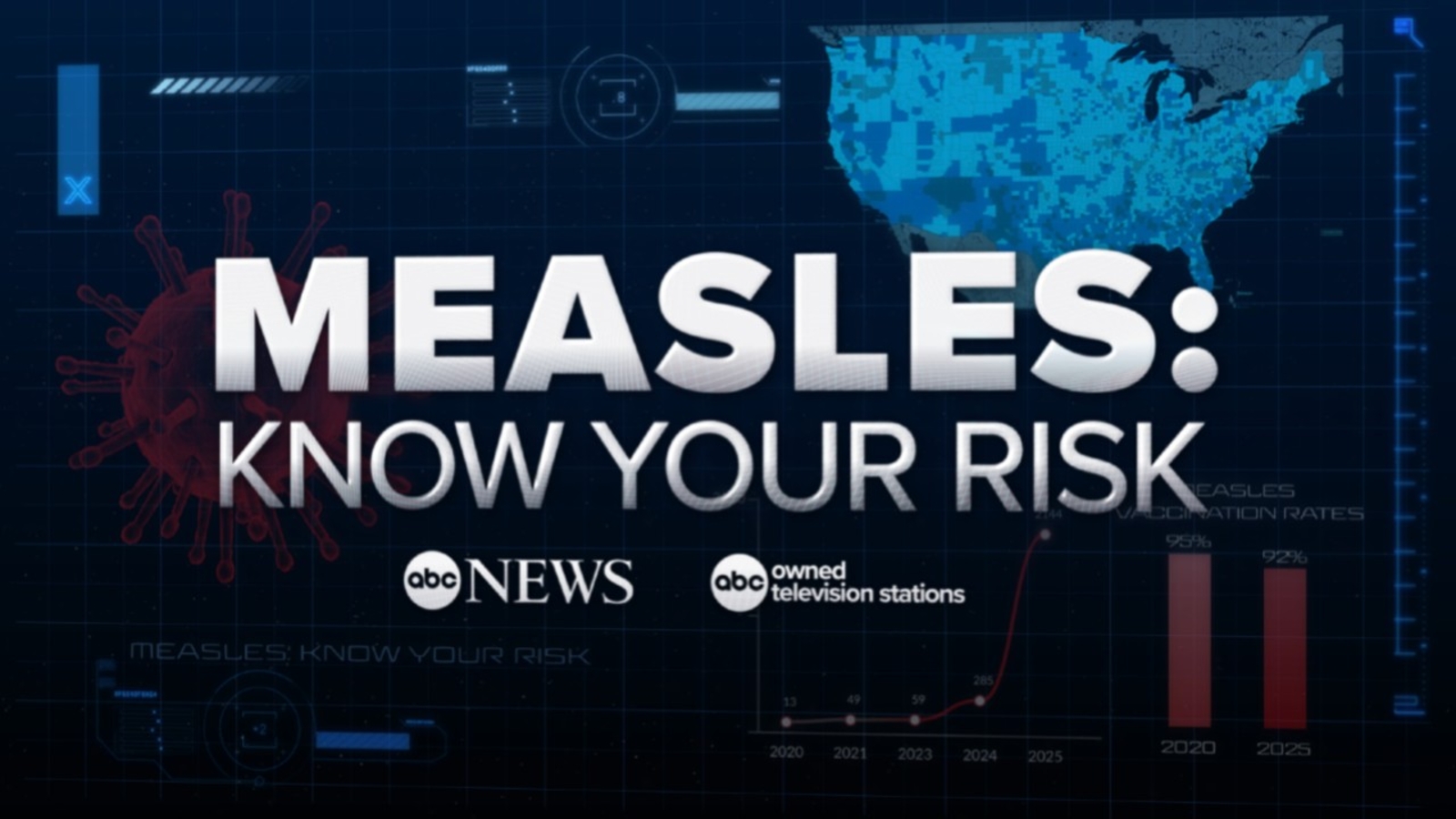
Type in your ZIP code above or search your county to see vaccination levels and the risk in your area.
As measles has spread throughout the United States, with cases recently reaching a 33-year high, many Americans have worried about their risk level.
For the first time, a measles outbreak map has been created that allows people to type in their ZIP code and see an estimated percentage of their neighbors who have been vaccinated against measles, which can help determine the risk of the disease in their area.
Vaccination status is the most critical factor in determining one’s risk, doctors say, and lower rates of vaccination allow the virus to spread more easily in communities.
The data was provided through a collaboration of researchers from Boston Children’s Hospital, Harvard School of Medicine and Icahn School of Medicine at Mt. Sinai with researchers publishing their findings on Thursday in the journal Nature Health.
“We’re seeing the tip of the iceberg in terms of risk,” said Dr. John Brownstein, co-author of the paper as well as an epidemiologist and ABC News medical contributor.
U.S. seeing record-high measles cases
Last year, the U.S. recorded its highest number of measles cases since 1992 with 2,144 infections across 44 states. An estimated 93% of cases were among those who were either unvaccinated or had unknown status, according to the Centers for Disease Control and Prevention.
“There are many communities around the country that are nowhere near the required thresholds of vaccination,” Brownstein said. “This map gives us an unfortunate sort of crystal ball into the future of where we’ll see these future outbreaks.”
Nearly 50 outbreaks occurred last year nationally, compared to 16 in 2024 and just four in 2023, CDC data shows. Almost 90% of cases in 2025 were associated with outbreaks.
For the study, the researchers used a nationally representative sample of more than 22,000 adults with children under age 5 who received one or more doses of the measles, mumps and rubella (MMR) vaccine. The team then used statistical models to generate county-level estimates of MMR vaccination coverage.
Based on vaccination levels, the researchers grouped counties — and ZIP codes — into five categories of risk from “lowest risk” with 85% or more of children under 5 years old receiving one or more MMR dose to “very high risk” with fewer than 60% of children under age 5 receiving one or more MMR dose.
The researchers used “hot spots” to identify areas of low vaccination coverage and “cold spots” to identify areas with high vaccination coverage.
They found hot spots in West Texas, southern New Mexico, parts of Mississippi and across the rural Southeast.
The authors noted that several of these high-risk hot spot counties were in states that experienced recent measles outbreaks.
For example, Gaines County — which was the epicenter of last year’s measles outbreak in Texas — was grouped into the second-highest risk category with 60% to 69% of children under age 5 receiving one or more doses of the MMR vaccine.
Lea County, located in New Mexico and the epicenter of that state’s outbreak, was grouped into the highest risk category with fewer than 60% of young children vaccinated.
Last year, at least three measles deaths were recorded, including two among unvaccinated school-aged children in Texas and one among an unvaccinated adult in New Mexico, marking the first U.S. deaths from measles in a decade.
Meanwhile, the researchers found that cold spots were concentrated in the Northeast and Upper Midwest.
In Maine, for example, no county was placed in a category higher than medium risk, with every county recording at least 70% to 79% of young children receiving at least one MMR dose.
“We know that outbreaks are highly local, so to be able to respond to an outbreak that is highly localized, you need highly localized data, and this is really a first-of-a-kind study to do this,” Brownstein said.
Declining MMR vaccination rates
It comes as the rate of kindergarteners receiving the MMR vaccine has dropped steadily since before the COVID-19 pandemic, CDC data shows. An estimated 92.5% of kindergarteners received the MMR vaccine in the latest school year, compared to 95.2% in 2019.
It leaves nearly 300,000 kindergarteners without protection from one of the most contagious of all infectious diseases. If one person has measles, they can infect nine out of 10 people who are not vaccinated. The virus can also linger in a room for at least two hours.
“We certainly hope, with all of this new information, parents can make more informed decisions about their children’s vaccination,” Dr. Eric Zhou, co-author of the paper as well an assistant professor at the Icahn School of Medicine at Mount Sinai, told ABC News.
Public health officials acknowledge that vaccination is a personal choice but caution that the rate of vaccination in a community impacts how easily a virus can spread.
“If you’re surrounded by a lot of people who aren’t vaccinated, you’re at risk, and much greater risk, because they have a much greater chance of spreading the virus to you,” Dr. Paul Offit, director of the Vaccine Education Center at Children’s Hospital of Philadelphia, previously told ABC News.
Offit cited a study about an early 2000s measles outbreak in the Netherlands which found that unvaccinated people were 224 times more likely to get infected than vaccinated people. Those who were vaccinated, however, were at much higher risk when living in a community that had lower vaccination rates.
This concept is known as herd immunity, when enough of the population is vaccinated to limit the ability of a disease to spread. It is especially important to help those who have not been vaccinated, including newborns, or cannot receive vaccines, infectious diseases experts say.
Herd immunity was a key component in how measles was declared eliminated from the U.S. in 2000 — a status that is now under threat.
The authors noted there are some limitations including that the risk levels are estimates, risk levels are individual, and that vaccination rates include children who are not eligible for the vaccine, particularly those under 1 year old.
But they add that the estimates may help the general public, as well as public health officials, make informed choices about vaccination.
“Hopefully (this) will help provide more up-to-date information, more localized information, for not only the public, but also the government agencies to make the best decisions that work for everyone,” Zhou said.
Copyright © 2026 ABC News Internet Ventures.
