
An offshore wind project that would bring renewable power to over half a million New York City homes could be dead in the water.
Work on Empire Wind, an in-progress project developed by the company Equinor, has been on hold since the Trump administration “paused” the leases for it — and four other projects, including Sunrise Wind in New York — just days before Christmas.
Because of that pause, no work in federal waters can happen right now. And Molly Morris, president of Equinor Renewables America, said the project would likely face cancellation if construction could not resume by Friday.
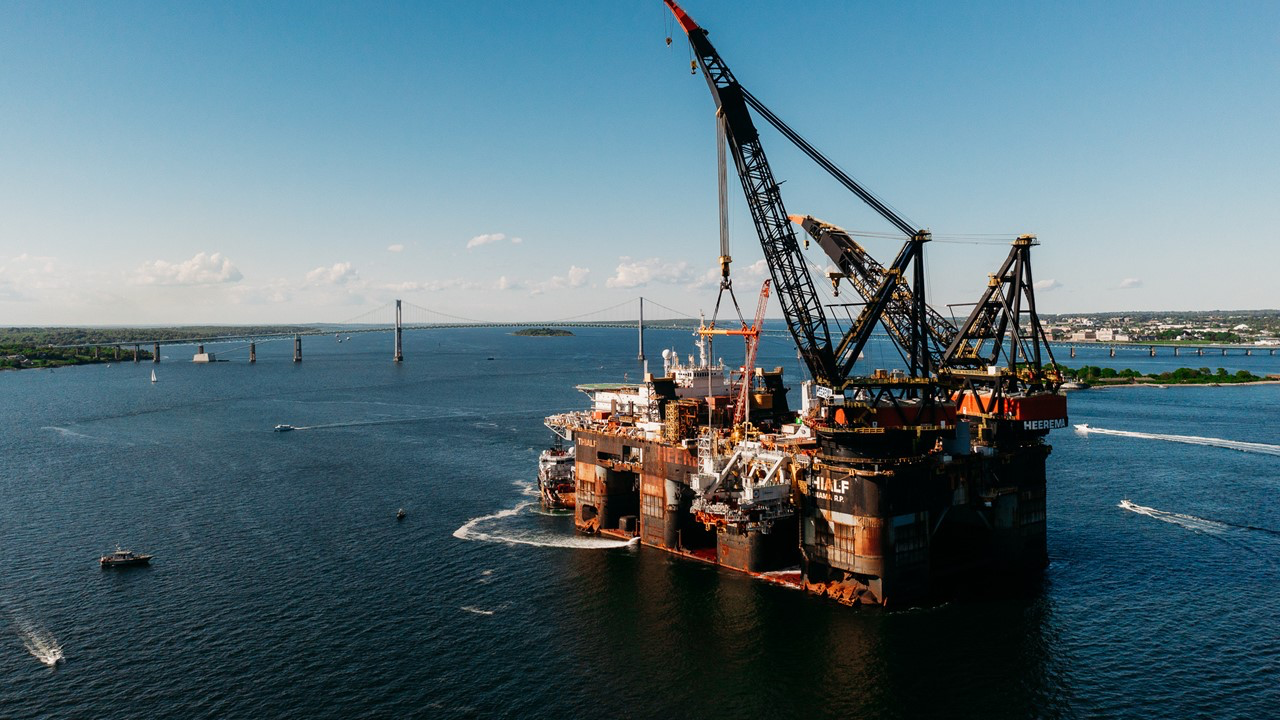
That’s because a special vessel used for lifting very heavy equipment can only be at the project site, about 15 miles off the coast of Long Island, until February. Then it won’t be available for another year. If that timeline is thrown off, “cascading delays” would jeopardize the project.
“It’s critical that those activities are able to continue for vessel availability that we have and specifically being able to install the offshore substation, which is a very critical piece of equipment,” Morris said. “Our time of being able to do that is very limited.”
Equinor took to court to request a preliminary injunction, but the federal judge who heard the case Wednesday did not make a ruling. The judge will issue an order on Thursday. Meanwhile, hundreds of workers remain in limbo, waiting to start jobs at sea.
One of those workers is electrician Sally McKleinfeld, who lives in Bedford-Stuyvesant, Brooklyn. A member of International Brotherhood of Electrical Workers Local 3, McKleinfeld underwent special training to be able to work on Empire Wind, but can’t get a deployment date because of the work stoppage.
“It’s extremely frustrating,” she said. “Our job is risky on a good day. There’s environmental risk and our particular trade is very dangerous. When you couple that with the danger of being at sea, it’s an exceptional little pool of people who are excited — not just excited but thrilled — to do this … I’m willing to walk away from my kids, go on a boat and make the future happen.”
The job would require McKleinfeld, 48, to live on a ship for three weeks, away from her husband and two children. But without a date, the family can’t prepare for her absence.
John Blanchfield, a rigger and member of the Dock Builders Union Local 1565, was scheduled to go back out to sea on Monday to continue working on Empire Wind. He’d lived on a ship for several weeks at a time between last summer and the end of the year to assist with lifting the equipment and he loved the work, enough to center the rest of his career around offshore wind.
“The uncertainty for the future is there now. Am I gonna continue in the offshore program?” he said. “When you have this opportunity in front of you and it’s taken away for no reason, it’s quite disturbing.”
At home in New Jersey without pay, the 47-year-old has turned down other job offers, anticipating he’d go back to sea.
“Now I’m sitting here like, should I have said yes?” Blanchfield said.
He was supposed to be mobilized to the heavy-lifting vessel that’s only available to Equinor until February — and he still hopes it happens. He enjoyed being out on the water, witnessing scenes that he said inspired “awe.”

“It’s hard to describe: the 300-foot monopiles get lifted into the air like it’s nothing,” Blanchfield said, referring to the massive tubes that serve as the turbine’s foundation. “The sheer scope of it becomes incredibly breathtaking.”
Flat Air
Empire Wind is not the only New York offshore wind project affected by the Trump administration’s stop-work order: Sunrise Wind, developed by Orsted, was also caught in the crosshairs. Three additional projects serving other East Coast states were paused, too.
The Department of the Interior had cited unspecified national security risks in its order.
Both Orsted and Equinor — as well as New York Attorney General Letitia James — took to court earlier this month to challenge the lease suspensions. On Monday, Danish developer Orsted won a preliminary injunction for a project it’s working on to serve Connecticut and Rhode Island, allowing construction to continue — though the time frame for the Sunrise Wind court case remains unclear.
“New Yorkers deserve clean, reliable energy, good-paying jobs, and a government that follows the law,” James said in a statement. “These projects were carefully reviewed and already under construction when the federal government pulled the plug without explanation. This reckless decision puts workers, families, and our climate goals at risk.”
Empire Wind and Sunrise Wind are projected to generate enough power for about a million homes when they are in operation, targeted for 2027. The power from the wind projects is especially important for New York City, as the electricity grid could face reliability challenges in the coming years.
Sunrise Wind is almost halfway to completion. Each day the project is delayed costs $1 million, and the full cancellation of the project could result in losses of over $8 billion, according to a court filing.
Empire Wind is 60% complete, and Equinor has spent more than $4 billion on the project, the company disclosed in a court filing.
Equinor is also developing the city-owned South Brooklyn Marine Terminal, a port in Sunset Park that would support Empire Wind’s operations and maintenance. The terminal, at 90% completion, is also where the power from the wind project out in the ocean connects to the New York City grid.
Equinor said that if the Empire Wind does not move forward, the terminal’s future is in the air — though the company has been looking for other users to lease the space for activities not related to wind.
McKleinfeld, the electrician, has been working on site at the South Brooklyn Marine Terminal. But as the project wraps up, she’s looking forward to working on the wind farm itself.
She has a silver keychain etched with a wind turbine that she holds on to as a sign of hope that she can live out the adventure she’s trained for.
“Once the turbines are erected, I would love to be the one up in the nacelle, the head of the wind turbine behind the propellers,” McKleinfeld said. “To me, that is so cool. You’re on top of the world and you’re doing what you’re trained to do.”
