

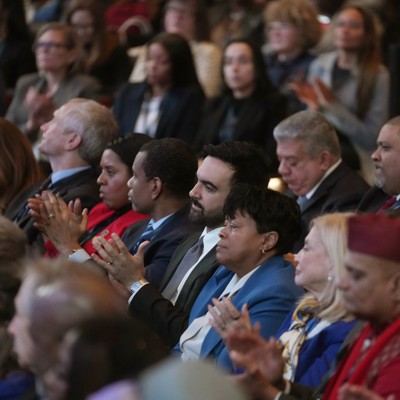
New York City Mayor Zohran Mamdani returned to Albany on Tuesday like a prodigal son. As the parable goes, Mamdani’s return was warmly welcomed and rewarded at Gov. Kathy Hochul’s State of the State address – despite his own frequent absences from the Assembly last session.
At the top of her speech, Hochul laid out plans to inch toward universal child care, marking a commitment on one of Mamdani’s three major campaign proposals. No first-time mayor gets everything they want out of their partners in Albany, even one with as much political capital as Mamdani. But Hochul’s speech was anchored in a message of affordability, keeping time with Mamdani’s own political drum.
The warmth goes both ways. Mamdani appeared in a video alongside other local elected officials to complement Hochul and tout her leadership. And in a press conference shortly after Hochul’s address, Mamdani was positively gushing. “It was a privilege to attend Gov. Hochul’s State of the State address and to hear her vision for the year to come,” he said. “I was struck by how deeply the governor’s words showcased a new approach in politics right here in our state.”
Music to Mamdani’s ears
Mamdani and Hochul are speaking the same language when it comes to affordability. From tackling rising home insurance costs to a tuition freeze at City University of New York senior colleges, the governor repeatedly returned to the same theme throughout her 50-minute speech that helped drive Mamdani’s rise.
Her plan to vastly expand free and low-cost child care for families over the next few years is perhaps the most obvious example of this. A nod to their partnership on an issue Mamdani made a cornerstone of his campaign, Hochul first announced the news last week alongside the new mayor, honing in on it again during her speech. “We stood together,” she said of the mayor. In Albany Tuesday, Mamdani was in full victory lap mode. “This is so much more than the fulfillment of a campaign promise,” Mamdani told reporters after the address. “It is the assurance instead that New Yorkers need not any longer consider the choice between raising a family and the city that they love.”
Hochul’s pledge to bolster protections for immigrant New Yorkers was another aspect that was well-received by Mamdani. One bill she is pushing this year would expand legal options for New Yorkers to sue federal immigration officers for constitutional violations – a measure spurred by heavy-handed enforcement tactics deployed under the Trump administration. Another bill would require federal immigration agents to show a judicial warrant when carrying out civil enforcement in “sensitive locations” such as schools, hospitals and houses of worship. Mamdani has repeatedly stressed his commitment to protecting New York City’s immigrants, vowing to oppose any efforts from the federal government to expand ICE’s efforts in the city. He swiftly condemned the detention of a City Council data analyst Monday after he was seized by federal immigration agents while attending a routine court appearance on Long Island. Hochul did the same in her speech. “What we’ve seen lately has gone too far, and enough is enough,” she said.
Tenants, another key group of New Yorkers that Mamdani has honed in on increasing protections for, are also on the governor’s mind. Hochul also unveiled a proposal to prevent utilities from shutting off services like electricity or gas when landlords fall behind on payments. Hochul also plans to propose aggravated criminal penalties for landlords who systematically harass rent-regulated tenants. Similar to the immigration-related legislation though, both measures will also need sign-off from state lawmakers to go into effect.
Points of discord
In her speech, Hochul had plenty of good news for Mamdani, as well as some silences that spoke volumes. While Mamdani has repeatedly said that a tax increase on the wealthy will fund his major policy priorities – including universal child care – Hochul made no mention of a tax hike, an apparent continuation of her frequently stated opposition to the idea. (She celebrated the contrary, in fact, saying “we can make transformative investments in our future without raising taxes.”) As she laid out last week when unveiling the child care plan, Hochul said that existing state funds could cover the first two years of new investments – a price tag that starts at $1.7 billion – but hasn’t detailed a plan for funding beyond that.
“There is no question that New York City requires additional recurring revenue,” Mamdani said after Hochul’s speech, adding that a more than a million New Yorkers voted for his agenda, “an agenda we made explicit to pay for by raising taxes on the wealthiest New Yorkers, the most profitable corporations. I look forward to making the case directly to our partners in Albany.”
Hochul’s silence on the possibility of raising taxes on the rich and raising the corporate tax rate could translate to stalling on Mamdani’s other policy priorities. Hochul did not mention the other plank in Mamdani’s core campaign promises that will require direct state involvement: fare-free buses. That makes the outlook for Mamdani making progress on “fast and free buses” in his first year dim, unless he’s able to rally support from state lawmakers to pressure the governor. Metropolitan Transportation Authority Chair and CEO Janno Lieber has also poured cold water on the pitch, and he appears more interested in stopping fare evasion on buses and targeting affordability to those who most need it.
Other campaign proposals – like raising the minimum wage in New York City to $30 by 2030 – also went unmentioned, though Mamdani contended during the campaign that there’s a path for the City Council to take that proposal up on its own. (That proposal hasn’t featured as prominently in Mamdani’s platform as promises to make buses free and freeze the rent for rent-stabilized tenants.)
And then there are the gray areas of Hochul’s address, like a new commitment to expanding police and clinical co-response teams for people experiencing mental health crises on the subway. The so-called Subway Co-Response Outreach Teams, which pair MTA police and clinical workers from the Department of Homeless Services, would expand from 10 to 15 teams under Hochul’s new proposal. But as the model includes police involvement in responding to mental health calls – a practice Mamdani has said he wants to move away from by creating a new Department of Community Safety – it’s unclear if the expansion is one Mamdani will fight.
With reporting from Jeff Coltin.
