
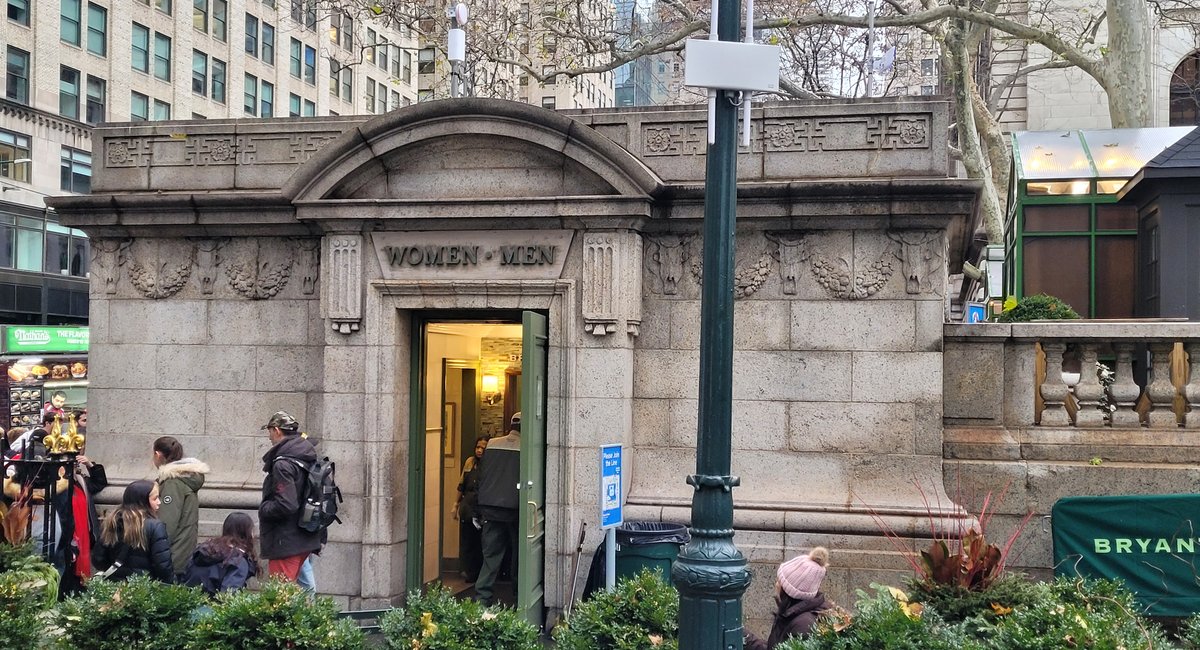
You can get almost anything in New York City, but when nature calls, public bathrooms remain one of the city’s most elusive amenities.
That collective anxiety was the focus of a Saturday morning press conference in West Harlem, at which Mayor Zohran Mamdani and City Council Speaker Julie Menin announced a new effort to dramatically expand access to public restrooms across New York City.
“In the greatest city in the world, you should not have to spend $9 to buy a coffee just to be able to find a little relief,” Mamdani said, describing what he called “ a desperation that nearly every New Yorker holds, or instead struggles to hold.”
To help tackle the problem, Mamdani — who was also joined by Councilmember Shaun Abreu and state Assemblymember Jordan Wright — announced the city would commit $4 million to a request for proposals for modular public restrooms that would not need to be connected to the city’s deep sewer and water lines.
Right now, Mamdani said, there are nearly 1,000 public restrooms in the city, which amount to one public bathroom for every 8,500 residents.
“Why aren’t there more restrooms in our city? Well, there is a lot of infrastructure underneath our feet,” he said. “ This pilot, however, will allow us to install public bathrooms even where we cannot drill into the bowels of this city.”
The mayor has spent his first 10 days in office rolling out seemingly small-bore, quality-of-life projects that nonetheless resonate with a wide swath of New Yorkers. Aside from the age-old quest to find a public bathroom in NYC, Mamdani personally oversaw the repair of an infamous bike-lane bump at the foot of the Williamsburg Bridge. He also promised to complete Greenpoint’s McGuiness Boulevard redesign in the way it was initially proposed, before the Adams administration stepped in.
The mayor also said Saturday that the city would begin installing a public toilet near 12th Avenue and St. Clair Place, the site of the press conference. The facility is one of the city’s already-existing bathrooms that Mamdani said “have been languishing.” The unit will be self-cleaning, limited to 15-minute use periods and maintained twice a day, he added.
Menin framed the public-relief effort as part of a broader push to make the city more livable.
“In a city greater than 8.5 million people, to have 1,100 public bathrooms is really shameful,” she said, noting that cities like San Diego, Denver and St. Louis have more public bathrooms per capita than New York.
Councilmember Shaun Abreu, whose district includes the new installation, called public restrooms a small but powerful piece of public infrastructure.
“Every public bathroom brings dignity and accessibility to its location,” he said, arguing that bathrooms help keep people out in their neighborhoods, enjoying parks and shopping.
This latest effort comes as the City Council has set a strategic goal of building more than 2,100 public bathrooms by 2035, roughly double the city’s current network.
The pilot announced Saturday will only add about 20 to 30 new public restrooms to the city’s total and the timing is uncertain. Mamdani said the request for proposals would be issued within 100 days and a timeline for installation would follow.
Across the country, expanding access to public restrooms has long been a struggle.
Cities have experimented with prefab designs like the Portland Loo, a freestanding, durable stainless-steel toilet prized for its low maintenance, for decades now.
Costs and timelines have a tendency to balloon. Critics have seized on examples like a San Francisco public toilet once projected to cost nearly $1.7 million for a single unit and take years to build before budget revisions brought the eventual price closer to $200,000.
