

This column originally appeared in On The Way, a weekly newsletter covering everything you need to know about NYC-area transportation.
Sign up to get the full version, which includes answers to reader questions, trivia, service changes and more, in your inbox every Thursday.
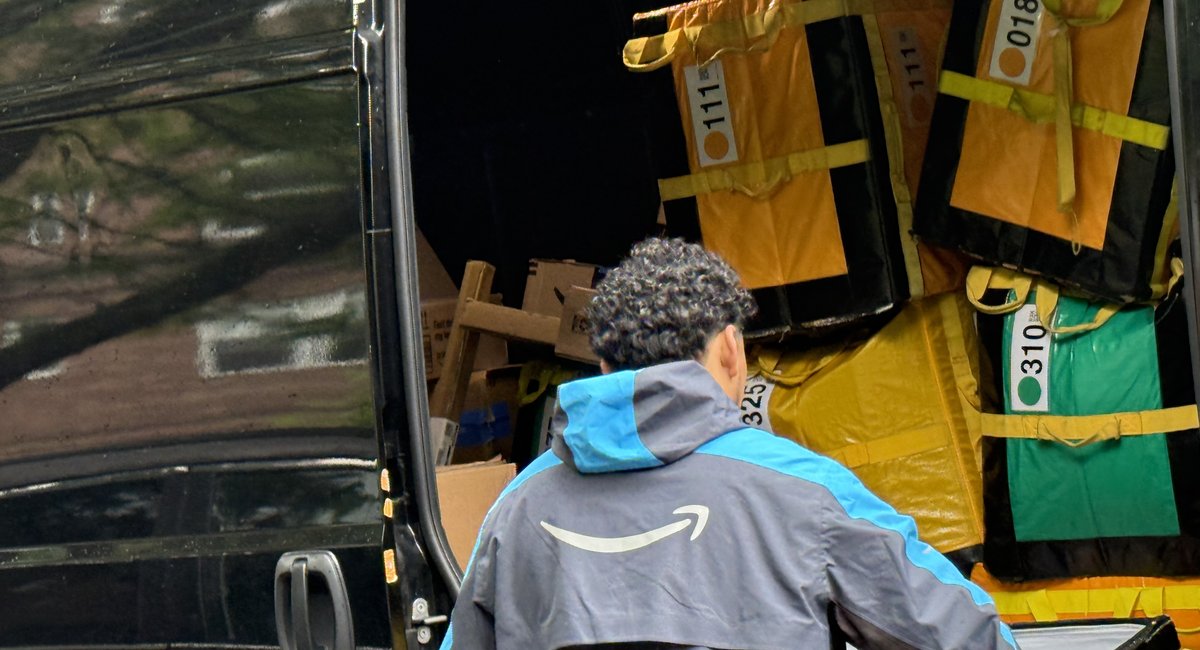
Every year, an army of delivery workers schleps enough packages across New York City to make Santa Claus blush.
Old Saint Nick might deliver gifts to New York City’s 1.4 million children on Christmas Eve. But workers for shipping companies like Amazon, UPS, FedEx and the U.S. Postal Service move upward of 2 million packages in the city every day, according to estimates from the City Council and Manhattan borough president’s office. And that figure doesn’t include grocery and food orders carried by e-bike delivery workers.
Demand for delivery skyrocketed in the city when New Yorkers were stuck inside during the COVID-19 pandemic, and it’s shown no signs of slowing down. The relentless growth of the city’s convenience economy — where a tap on a phone screen sets in motion a supply chain that sends items to your building — has led city policymakers to try to crack down on delivery apps while adding protections for the workers who actually haul packages around town.
Earlier this year, the City Council passed a bill mandating a minimum wage for grocery delivery workers — and later overrode Mayor Adams’ veto of the measure. The Council had already set minimum wage rules for restaurant delivery workers. And this month, Attorney General Leitita James sued UPS for allegedly chiseling thousands of seasonal delivery workers out of millions in wages.
Now, as Adams leaves office, some of the city’s brightest transportation minds are thinking about further ways to rein in the companies behind the city’s delivery boom.
Ya-Ting Liu, whom Adams appointed as the city’s chief public realm officer in 2023, said city agencies should be able to regulate the delivery apps’ practices to ensure their operations don’t further gum up the city’s streets.
“ The demand for that convenience is only going to grow, and delivery workers are on the front lines of providing that service that has real impacts on the street and sort of public spaces throughout the city,” Liu said. “There is an increasing need to ensure that companies and the app companies dispatching these services are at the table and held more accountable.”
The proliferation of e-bikes and its effects on street safety are among policymakers’ biggest worries. Critics say the apps incentivize workers to ride dangerously and take risks in order to make enough money. NYPD Commissioner Jessica Tisch deployed a major crackdown on bicyclists this year.
But Mayor-elect Zohran Mamdani during his campaign said any crackdown on the city’s e-bike delivery industry should focus on the app companies, not the workers on the street. And one of the biggest app companies does not appear to be a big fan of Mamdani. DoorDash donated $1 million to a political action committee backing the campaign of his rival Andrew Cuomo.
NYC transportation news this week
Mayor Adams’ unfulfilled promises to bus riders in the Bronx. Adams won the Bronx by a wide margin back in the 2021 mayoral primary, running on a campaign that promised to build 150 miles of new bus lanes during his first term. But as the mayor prepares to leave office, he’s also leaving behind unfinished progress on improving bus service, especially in the Bronx.
The trouble NYC seniors have with OMNY cards. The end of the MetroCard is fast approaching, and seniors are particularly worried. Here’s how they’re preparing.
How New Yorkers are getting around new fare gates. The MTA is testing out its new fare gates, which feature high glass doors that quickly slide open when a rider pays their fare and slam shut when they pass through. But some New Yorkers are already thinking of new methods to get around them.
A failed subway conductor bill. Gov. Hochul ruffled some feathers in the Transit Workers Union by vetoing a bill that would’ve required two-person crews on every New York City subway train, including a conductor and a driver. Here’s her reasoning.
A very violent weekend in the subway system. Four separate subway slashings took place over the weekend, injuring several passengers. The violent weekend comes after officials touted major drops in subway crime this year.
Curious Commuter
Have a question for us? Use this form to submit yours and we may answer it in a future newsletter!
Curious Commuter questions are exclusive for On The Way newsletter subscribers. Sign up for free here.
Question
Are there any alternatives being considered for the gas-powered generators used by food carts?
Answer
There have been efforts to provide electric batteries to the thousands of street vendors who use noisy, polluting gas generators. In 2023, the Street Vendor project launched a pilot to provide the batteries to a few vendors. The group estimates there are as many as 23,000 vendors, and the vast majority use gas to power their food operations. While rechargeable batteries are quiet and emit less pollution, they’re also expensive, and would only be feasible if there were electric outlets for vendors, which aren’t readily available in most locations.
