

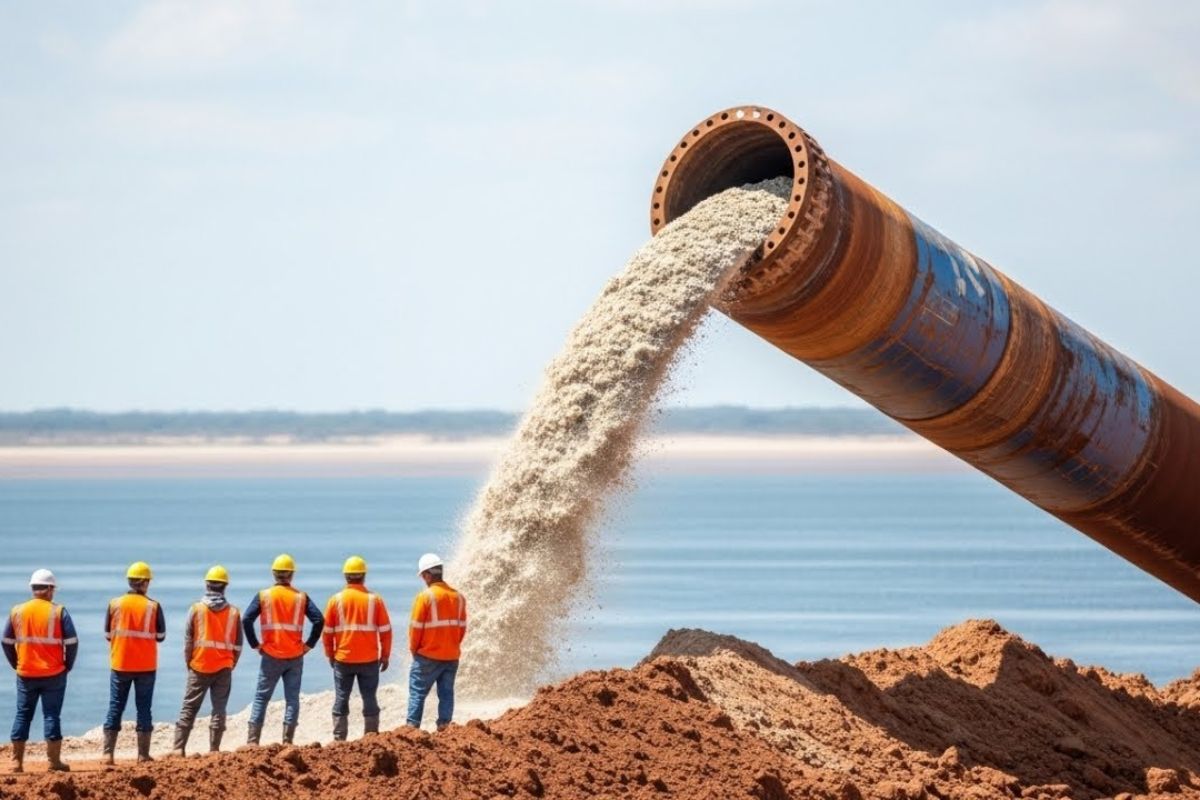
While millions of tons of sand and rock are pumped from the bottom of the Hudson River every day, machines, sensors, and thousands of workers excavate a giant tunnel that promises to double rail capacity, reduce traffic congestion in Manhattan, and protect the multi-billion dollar economy of the entire New York metropolitan area.
In 2013, after decades of delays, the United States decided to finally put into action the plan to open a giant tunnel Under the Hudson River, between New York and New Jersey, to reinforce the East Coast rail backbone. In 2024 and 2025, work entered full swing, with drilling rigs working tens of meters deep and millions of tons of sand and sediment being removed from the riverbed to make way for the new rail tunnels that will support transportation for decades to come.
Behind this megaproject, valued at 16 billion dollars, lies the attempt to… saving a system on the verge of collapsesupported by century-old tunnels that were completely flooded by Hurricane Sandy in 2012, accumulating thousands of hours of delays. The project is presented as structural surgery to prevent that… A prolonged failure in this connection interrupts the flow. of passengers and wealth that passes through New York daily.
Traffic jams pose a risk to Manhattan’s economic heart.

Beneath the surface of one of the most expensive areas on the planet, the giant tunnel under the Hudson It targets a problem that begins on the streets.
See also other features
-
Built with structural cardboard tubes instead of beams and pillars, this habitable ‘paper house’ designed in Japan withstood wind and rain, drastically reduced the use of concrete, and showed that even paper can become a structure.

-
Building homes to sell in 2026 is still worthwhile: 6 critical decisions that separate profit from loss in the “Minha Casa, Minha Vida” program and the local real estate market.

-
Construction accelerates in southern Minas Gerais, injecting over R$15 million, creating 1,3 jobs, promising fewer accidents on the MG-290 highway, faster travel, and renewed economic activity in Borda da Mata and Jacutinga.

-
In just 117 days, a man single-handedly built a stone house in the mountains without using nails, cement, or any outside help.

Manhattan, covering just over a few dozen square kilometers, accounts for a significant portion of the United States’ GDP and functions as one of the world’s leading financial centers.
Every day, hundreds of thousands of people and hundreds of thousands of vehicles cross bridges and tunnels to enter and leave the island.
Average traffic speeds have dropped to levels typical of chronic global traffic jams, causing residents to lose dozens of hours a year stuck in congestion.Meanwhile, rail transport is struggling to absorb a demand greater than its capacity was designed for over a hundred years.
In this case, A prolonged collapse in any existing tunnel would mean not just some delays, but the partial disruption of a corridor linking Boston, New York, Philadelphia, and Washington., an axis that concentrates strategic financial, political, and industrial decisions for the country.
The new tunnel aims to create redundancy and provide relief in this historical bottleneck.
Century-old tunnels on the brink of collapse after Hurricane Sandy.

The North River Tunnels, which today form the main rail link under the Hudson River, were opened in 1910, excavated under extreme conditions and with technology far removed from today’s standards.
Immigrants and low-income workers have spent years under immense pressure and constant risk to open the corridors that support the daily flow between New York and New Jersey.
More than a century later, These structures accumulate corrosion, leaks, and damage that worsened with the flooding caused by Hurricane Sandy in 2012..
Rails and cables were attacked by saltwater, the ventilation system was overloaded, and the number of failures increased consistently, causing recurring delays and a growing perception of risk among technicians and transport managers.
From an engineering standpoint, the solution was no longer simply to reinforce the old structure.
The strategy became to build new tunnels alongside the old ones, transfer the rail traffic, and only then calmly modernize the historic tunnels., reducing the chance of a sudden outage that interrupts service for extended periods.
How the giant tunnel is being excavated under the Hudson River
The Hudson Tunnel Project is part of the Gateway program, designed to create two new rail tunnels under the Hudson River.
At the heart of the project are large tunnel boring machines, with diameters close to the height of a multi-story building, which advance beneath the riverbed, cutting through rocks and sediment and installing concrete rings that form the final structure of the tunnel.
These machines are guided by sensors, underground radars and real-time monitoring systems, which adjust the trajectory with centimeter precision to avoid soil settlement above and impacts on existing structures.
Behind the cutting head, teams install concrete segments that can weigh around ten tons each, closing the structural arch that will support the tunnel for decades.
In New Jersey, bridges and infrastructure networks had to be moved to make way for excavation work.
In Manhattan, the most sensitive section lies beneath the area of large real estate developments, where The engineers work practically centimeter by centimeter, combining controlled excavation, pressurized concrete injection, and soil monitoring to avoid affecting buildings and roads above ground..
Billion-dollar costs, jobs, and economic impact of the project.
Open a giant tunnel Living under one of the most strategic rivers in the American economy has a cost proportional to the risk.
The estimated cost of 16 billion dollars includes everything from stabilizing the riverbed to complementary works on access roads, signage systems, energy, and ventilation.
The subsurface treatment phase alone consumed hundreds of millions of dollars, including cement injection, containment, and environmental remediation.
On a daily basis, more than 70 thousand direct and indirect jobs They are associated with the project, in a chain that involves concrete plants, steel mills, cable companies, engineering firms and environmental consultancies in several American states.
The tunnel acts as a major driver of industrial and service demand., while simultaneously attempting to resolve a mobility bottleneck that costs billions annually in delays and lost productivity.
For proponents of the project, the Hudson Tunnel Project should be viewed as a long-term investment, not an isolated expense.
The expectation is that Expanding rail capacity will reduce car dependency, decrease pollutant emissions, cut travel time, and make the eastern corridor more competitive. compared to other global centers.
Green corridor and new steel heart of the east coast
The completion of the project is planned in stages, with the new tunnels becoming operational followed by extensive rehabilitation of the old tunnels.
When the system is complete, rail capacity under the Hudson is expected to nearly double, from about 24 to approximately 48 trains per hour, with direct repercussions on delays and overcrowding.
At the same time, the new tunnels were sized for Fully electric trains and more efficient energy systems, paving the way for a cleaner rail corridor between the major cities of the East Coast.
The idea is that, with more reliable and faster journeys, fewer people will depend on cars for their daily commute, easing surface traffic and reducing greenhouse gas emissions.
In this drawing, the Giant tunnel under the Hudson River transforms into the new steel heart of the American economy., responsible for keeping the flow of workers, executives, students, and cargo that depends on the New York metropolitan area pulsing.
The redundancy created by the new system is also seen as insurance against extreme weather events and structural failures.
Even by the end of 2025, the Hudson Tunnel Project will still be under construction, but the volume of earth removed, the concrete installed, and the number of jobs mobilized indicate the scale of the underground transformation underway.
Each meter of tunnel built brings New York closer to a more resilient, less polluting transportation network and less vulnerable to the chaos of daily traffic.
In your opinion, is this giant tunnel under the Hudson River worth the billion-dollar cost to transform transportation between New York and New Jersey, or should the money be invested in other mobility solutions?
