
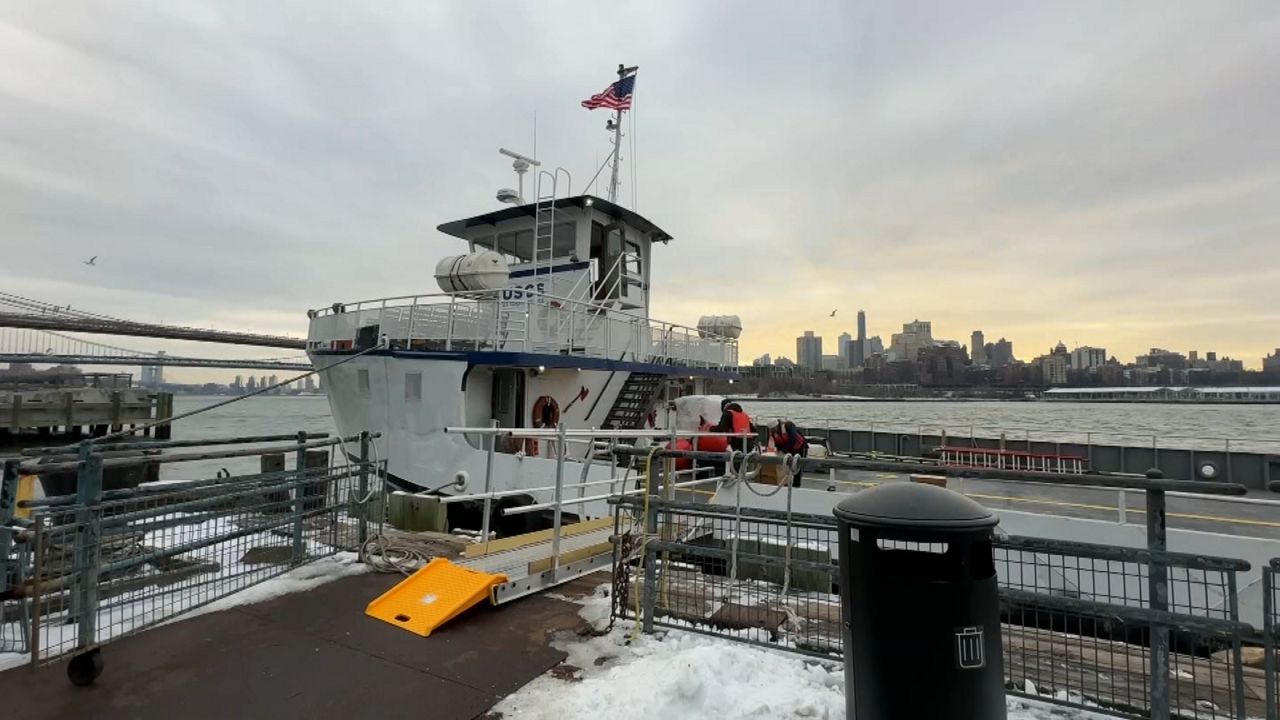
It’s a nod to the city’s port history and a drive to make it the future: a vessel bringing fresh seafood from the Fulton Fish Market Cooperative in the Bronx to South Street Seaport on the east side of lower Manhattan.
“Everything old is new again,” said Captain Jonathan Boulware, president and CEO of the South Street Seaport Museum.
Water will carry the weight of goods shipped into the city — or at least, that’s the goal of a joint pilot initiative called the Blue Highways program.
What You Need To Know
- The city’s Department of Transportation and Economic Development Corporation are two of the agencies behind a joint pilot initiative called the Blue Highways program
- The program aims to increase commerce via the city’s waterways
- It’s a modern take on shipping that’s being touted as reliable — and a way to eliminate congestion on the city’s roadways, as well as pollution and wear-and-tear on streets
The city’s Department of Transportation and Economic Development Corporation are two of the agencies behind the effort. The goal is to reduce truck traffic and pollution in the five boroughs.
“Blue Highways program, which is a great initiative, is in effect returning to New York’s roots as a port,” Boulware said. “What we’re talking about is moving goods by water, which has always been the most efficient, the most inexpensive, and the most sustainable method of moving cargo.”
NY1 was there Wednesday morning as a ferry delivered the fish from the Bronx to lower Manhattan.
The demonstration was with one company in the fish market. A low-carbon ferry is replacing at least two seafood delivery trucks delivering to Manhattan each day, as a proof of performance led by a nonprofit organization, Empire Clean Cities, funded by the U.S. Department of Energy.
The seafood is transferred from the ferry to e-cargo bikes for what advocates call a “zero-emission delivery.”
“Our goal is to reduce petroleum consumption within New York’s transportation sector. And so New York has a serious truck traffic problem, and so we are excited to take some of those trucks off the road, and start to move goods by water,” said Joy Gardner, executive director of Empire Clean Cities.
Organizers hope to lure in all 27 Fulton Fish Market coop members to start using ferries in the spring. It’s part of a broader clean freight initiative.
The city’s transportation leaders say around 90% of goods that come into the city every day are carried by truck, creating congestion and greenhouse gas emissions. Trucks usually deliver to businesses during the middle of the day, when streets are congested and curbside space is limited.
This avoids all that by connecting city businesses via the East River — and the Fulton Fish Market to its historic location at the South Street Seaport. The Fulton Fish Market existed there for about 180 years before moving to the Bronx in 2005.
“We are historically a port city. We’re going back to our roots here,” said Nicole Ackerina, CEO of the Fulton Fish Market Cooperative in Hunts Point. “And the Fulton Fish Market is pretty darned pumped to participate.”
It’s a modern take on shipping that’s being touted as reliable — and a way to eliminate congestion on the city’s roadways, as well as pollution and wear-and-tear on streets.
“Let’s go back to the way that is actually efficient, green, sustainable, and also, of course, for the congestion that the trucks put on the road, that’s gonna be reduced,” Boulware said.
This is phase two of the Blue Highways program. The first phase ferried goods from Red Hook to Governors Island. The city says the third phase will be spent trying to grow the program, extending it to other parts of the city with more businesses and vendors involved.
No date has yet been set for its launch.
